The historian Hans Rosenberg once said "The most wicked atrocities perpetrated on a civilian population in modern times occurred during the Napoleonic occupation of Spain." This statement said in 1948 greatly angered future historian Raul Hilberg and moved him to bring the knowledge of the then recent Nazi Holocaust into serious academic study. I'm curious as to how bad was the conduct of Napoleon's forces in France? Was Spain an unusual case or were crimes of a similar nature perpetrated on other occupied territories during the Napoleonic period?
One of the main primary sources to study the atrocities committed during the Peninsular War (here, in Spain, we call it Guerra de la Independencia, Independence War) are the works of Francisco de Goya.
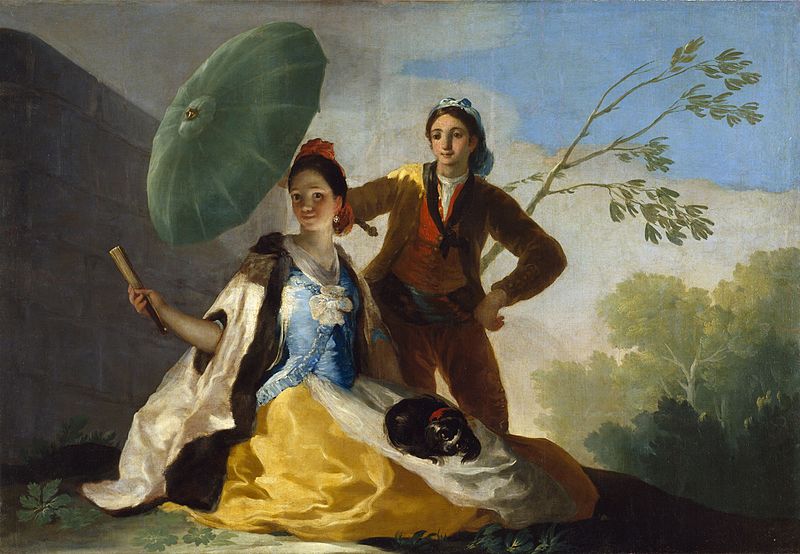
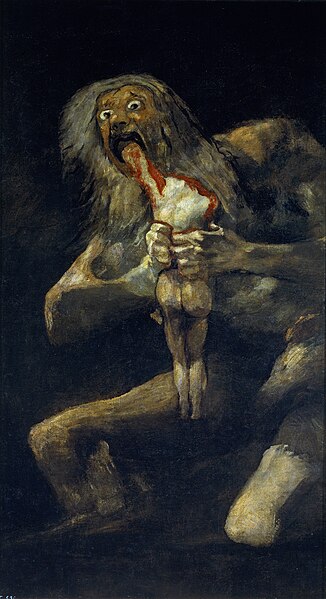
First I will provide some context about him, although you have probably heard about him before. Francisco de Goya y Lucientes (1746-1828) was a Spanish artist and one of the most influential painters of all time. His style evolved a lot during his life, starting with a luminous style, centered in costumbrist themes like El Quitasol (The Parasol) and ending with a much darker style usually centered on fantastic or mithological themes like the famous Saturno Devorando a un Hijo (Saturn Devouring His Son). He is considered one of the first romantic painters and one of the precursors of the avant-garde styles. For instance Perro Semihundido (The Dog), is considered a strong influence for abstract art. This change in style that made his final paintings become so pessimistic was marked by an illness that left him deaf in 1793 and thus made him to become an isolated man.
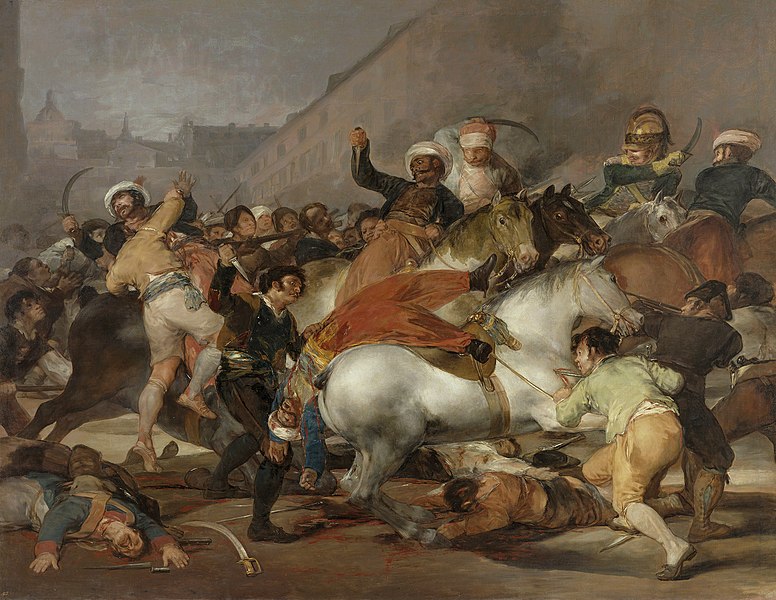
Now, talking about the Peninsular War (1808-1814), Goya was in Madrid during all the war. He witnessed the uprising of the second of May, which was the starting event of the war, and he made it into a painting: El 2 de Mayo de 1808 (The Second of May 1808), also known as La Carga de los Mamelucos (The Charge of the Mamelukes). This painting depicts one of the episodes of the uprising: the people of Madrid fight against the mamelukes, an unit of Napoleonic army that was formed by Egyptian soldiers, near Puerta del Sol. This painting is paired with another one, El 3 de Mayo en Madrid (The Third of May), also known as Los Fusilamientos del 3 de Mayo (The Executions of the Third of May 1808). The day after the uprising, the Napoleonic army took hundreds of people of Madrid and executed them by firing squads in several places of the city. The one depicted in the painting took place in what now is Plaza de España, then known as the Hill of Príncipe Pío.
But the most interesting work by Goya about the war were the series of 82 prints known as Los Desastres de la Guerra (The Disasters of War). In this work, Goya depicts the atrocities committed by both sides and he does it without a trace of heroism, he even uses his irony to express how distasteful the scenes are. It can be considered as one of the earliest examples of war journalism. Here you have some examples. The one titled with irony “Grande hazaña, con muertos” (A heroic feat, with dead men). Another one in which some Napoleonic soldiers are torturing a Spanish guy called “¿Qué hay que hacer más?” (What more should be done?). This one is called “Esto es peor” (This is worse). In this one, a Napoleonic soldier is trying to rape a Spanish woman while another woman is about to stab him in the back “No quieren” (They don’t want).
Here you have the Museo del Prado gallery where you can see all the prints (sorry, but the source is only in Spanish, but all the prints are listed on the right side).