I'm particularly interested in the assertions that chain-mail was usually impervious to arrows, and that Saracen armies were equipped with bows that were too weak to penetrate steel and leather armor.
Here is the album. http://imgur.com/gallery/GViTsoC
For the convenience of others, I'll copy out the text. The background images provide no value, they're just stock photos or equivalent.
The only copyediting I did was punctuation/capitalization to turn consecutive clauses into a sentence. 1 bullet point = 1 image.
Argh. Could spend a long time debunking some of these. I'm more knowledgeable on military history than the other stuff, so I'll try to stick with those:
"Chainmail" (presumably, chain armor, the term "chainmail" is a popular, if incorrect, neologism) was "nearly impervious" to all attacks, especially arrows.
This is false. Here is a video showing a modern recreation of mail armor being penetrated by authentic modern recreations of medieval bows and arrows. There is some debate about whether or not contemporary mail armor could have been penetrated by contemporary arrows from contemporary bows among historians now. I am in the school of thought that it could. That said, mail armor, first of all, was virtually never worn on its own -- it would have been extremely uncomfortable to wear a tunic made of metal chains on your skin, and also would not have been that effective on its own. Typically, warriors wore a thick cloth garment called a gambeson, or other form of leather jacket or jerkin underneath, or sometimes integrated with, the mail armor. Together, these provided excellent protection from slashing weapons, like swords, which were commonly used. They also provided good, but not anything like "impervious" protection to most piercing attacks -- however, specific arrows, such as the Bodkin arrow that English longbows shot, which were very long and pointy, were highly effective against mail -- but these were comparatively uncommon in the medieval period. Crucially, mail provided little protection against crushing weapons, such as maces and war hammers, which is one thing that led to their rise.
95% of casualties were due to routing
I don't know where this number comes from. Certainly in Ancient and Classical battles, a large proportion of casualties and losses came from routing, rather than actual combat, but I've never heard the proportion so high. For example, at Cannae, the Romans lost about 60% of their entire army to Carthaginian troops, many of that number (but by no means all) in the ensuing rout, but at least as many died during the actual fighting itself. Carthage, too, lost most of its troops in the initial fighting, as they never routed. The statistic is suspect in and of itself, since in any combat, only one side will ever rout, and the victors will always lose some troops. Again, I don't know where this number comes from with regard to medieval combat -- a great deal of casualties in the medieval era came from disease and exposure, not combat itself. Here's a good article, however, about the wounds received in combat (and during a rout) in a battle during The Wars of the Roses
Most high-born commanders were neither incompetent nor cowardly.
Answering this would require a survey of literally all nobility who commanded armies (down to brigades) throughout medieval times. I think it's safe to say that there were some brilliant men and some idiots.
The bow was a bad "personal weapon."
I don't know what this means. As in, it wasn't a good self-defense weapon, like a six gun? Probably true. It wasn't designed to be. The bow in medieval times is best thought of as artillery, not direct-fire, which brings me to:
They were always deployed en masse and few archers hit what they aimed at
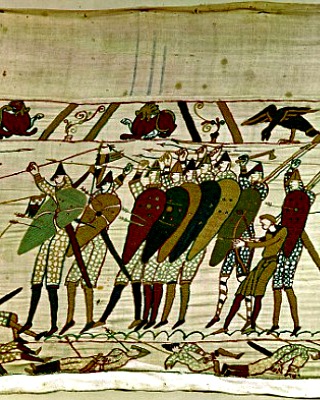
Archers were not always deployed "en masse" in medieval times, this is flat false. A quick look at the Bayeux tapestry will show you that Vikings, Normans, and other northern European armies that employed short-bowmen used archers as skirmishers both on land and at sea, and they were quite effective in that role. Medieval armies didn't always employ archers at all, in fact -- we tend to think of them as being an integral part of the combined arms tactics, but, for example, there is no evidence of archers being employed by either side in the pivotal Battle of Tours in 732.
The crossbow really was the turning point here, because unlike bows, it required comparatively little training to learn (it still required a good deal of training, however) and it was more "point and shoot." At the Battle of Hastings in 1066, the Normans employed crossbows against the Anglo-Saxon short bows to great advantage in range and stopping power. Again, crossbowmen were sometimes massed in groups, and sometimes deployed as skirmishers in mobile units to harass the enemy. The imgur image is straight wrong here. And that brings us to one more development:
The longbow required years of practice --
Absolutely true.
And could fire like a machine gun --
Wut. No, even the best, strongest longbowmen would not try to fire more than six arrows per minute, according to Strickland and Hardy (citations below). That's nowhere near the firing rate of even the earliest machine guns.
A single arrow was worth more than a soldier's spear.
This is just a ridiculous statement. First of all, a lot of different kinds of arrows were shot from longbows. Here is a good AskHistorians thread about the cost of medieval arrows. But just think about this one for a second: if arrows cost more than a spear, how would people have been able to hunt?
Archers had to be the most muscular people in the army.
Archery was the state-sponsored hobby of everyone in England during much of the medieval period. The pros were usually quite strong because they were shooting huge longbows all the time, though it's hard to make a historical analysis of musculature. However, this particular picture leaves out one critical fact: most people in the world are not English. Therefore, there were plenty of archers in armies who were shooting crossbows, short bows, composite bows, and guns (not strictly archers, I know), and didn't need the same level of brawn as the Englishmen did. So this statement leaves much to be desired.
This is getting really long, I will come back and address the gun stuff later, if I can. For now, sources:
Strickland & Hardy: The Great Warbow: From Hastings to the Mary Rose (2005, Sutton Publishing)
Lienhardt: The Crossbow (1997, University of Houston Press)
Hanson: Carnage and Culture (2001, Anchor)
Most of the statements are either outright wrong or too simplistic. I won't answer to each of them but here are a few select corrections. Thanks to /u/throwaway_lmkg for sparing me having to look at IMGUR.
"Guns had no value over bows except the noise. For nearly 200 years, guns and cannons were used to a minor degree and bows still had monopoly on power, force, range and rate of fire."
This is wrong. See any number of previous posts on this and FAQs.
"Chainmail was nearly impervious to all attacks, especially arrows."
Don't even know where to begin .... chainmail does little to protect against penetrating weapons and projectiles, such as arrows, musket balls, pikes, etc.
"The longbow required years of practice and could fire like a machine gun. But a single arrow was worth more than a soldier's spear."
Like a machine gun? Wut. Single arrow more expensive than a spear? Wut.
"Guns had no value over bows except the noise. For nearly 200 years, guns and cannons were used to a minor degree and bows still had monopoly on power, force, range and rate of fire."
Really not true, this misses the very important military revolution that was happening in the 16th-17th century.
"Plate armor could easily block bullets. Contrary to public opinion, guns were never able to easily slay knights. They were just easy to use and cheap to make compared to suits of plate."
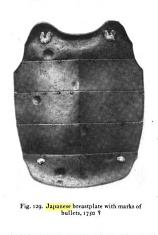
Sigh ..... in a very narrow context the first sentence maaaaaaaaaay just be correct. It was common for some manufacturers to shoot a gun at point-blank range at torso plate armour to "proof" it, that's why you sometimes see one single dent, or several, on an otherwise perfectly finished armor.
But this is to miss the important point that the torso piece was thicker than other pieces. To proof an entire suit in the same fashion leads to a very, very expensive and heavy overall suit.
To give an idea, I like this list of cost of items in late medieval times. A ready-to-wear Milanese armor from 1440s is L8 6s, 1L (pound) is 20s (shillings). A musket from 1600s is 16s. So a simpler suit of armor is at least 10-15x more expensive than a musket. An armor of proof -- suggesting it is proofed against a particular caliber of firearms -- is L14. That's 15-20x more expensive than a musket from the same era.
To wit, a group of arquebusiers could and would seriously hurt a group of fully armored knights. An excellent example was in Pavia (1525) when an imperial tercio surprised a group of armored French gendarmes, and either killed or maimed or captured the majority of them.
Finally, the following may or may not be true: 95% of all factoids you read on a poster are probably not correct.
Most of these are obviously either false or overgeneralized, but there are a few interesting tidbits behind some of them that might be of interest.
"Chainmail was nearly impervious to all attacks, especially arrows."
This is of course nonsense, but something similar did actually happen. Ammianus Marcellinus described Persian Cataphracts, or heavy full-armored cavalry like so
all the companies were clad in iron, and all parts of their bodies were covered with thick plates, so fitted that the stiff-joints conformed with those of their limbs; and the forms of human faces were so skillfully fitted to their heads, that since their entire body was covered with metal, arrows that fell upon them could lodge only where they could see a little through tiny openings opposite the pupil of the eye, or where through the tip of their nose they were able to get a little breath. Of these some, who were armed with pikes, stood so motionless that you would think them held fast by clamps of bronze.
I believe there are also some stories of Byzantine nights wearing padded cloth and leader armor filled with arrows like a pin-coushin, but leaving the knight inside at least mostly unharmed, but I can't find a source.
"Chainmail" is of course simplified, and chainmail alone besides is more of a crusade-era armor than late medieval type. It is also worth noting that generalizing on "Medieval armor" is ridiculous because of the amount of time and space "medieval" covers without further clarification.
And if chainmail had actually blocked everything, there would have been no need for the evolution of armor. Since armor evolved, chainmail did not block everything (And why would anyone believe it did? Impenetrable armor has yet to be built)
Nearly 95% of casualties were inflicted during a Rout
Although the number are an asspull (seeing as how hard numbers like that from this period do not exist) a lot of casualties certainly could and would be inflicted if formation broke.
It serves to remember that warfare rarely took the stylized hollywood form of a great battlefield with everyone running around caotically and fighting to the death-one-on-one.
People did not want to die, and so they stayed in formation. That's just how armies fought battles, because it makes sense.
You with your single sword fighting another guy with a sword is insanely likely to get at least cut, even if you win. Like they say, in a knife fight, the winner goes to the hospital.
But this is much too generalized. There are many other circumstances to account for - what of disease in camp, injury from earlier battle, starvation when besieged? Is that counted? It has no citation so you can safely disregard it.
Most High-Born commanders were neither incompetant [sic] nor cowardly. They spent their whole lives being trained how to command battles, and lead and inspire men.
Speculating on people's motives this far in the past is ridiculous, but yes, the children of nobles certain would receive an education what was broader than I suspect many would think.
The idea that medieval learned people only studied the bibles and hagiographies is untrue for sure.
This isn't a citation for anything, but just a randomly selected sample to show the base claim that medieval scholarship was complex and not simply thoughtless theology.
This is a list of 11th century historians, inspired by a range of things, trying to make some sort of accounting of the past: https://en.wikipedia.org/wiki/Category:11th-century_historians
So we see that the concern with the past is just like it is today. And like always - people are smart. So never assume people in the medieval were simple and foolish. It was a very complex world not as unlike our own as we love to imagine.
Here are some 10th century mathematicians: https://en.wikipedia.org/wiki/Category:10th-century_mathematicians
Note how many of these names are Arabic.
Archers had to be some of the biggest and most muscular men in the army to handle the massive draw of a medieval bow.
The claim again is unsourced bull, but it certainly wasn't easy to draw a long bow. I'm sure you could find something about the training of longbowmen who I believe are the most famous example in the west of trained archers.
"Nearly all knights suffered from extreme PTSD. They cried and screamed in their sleep, had horrifying flashbacks and thoughts of suicide, and according to Sir Geoffire De Charney some would scream or cry at the sound of clashing metal."
Nearly all blatant fabrications start with "nearly all" - which in and off itself is weasel words. Again, PTSD was of course real then as it is now, and soldiers would certainly have suffered it, being human. I doubt this needs citation.
But such a blatant generalization is exactly what characterized the sort of proud and aggressive ignorance that often comes with invented "facts" about history.
/u/TheJucheisLoose has already addressed the bulk of it, so I'll just go ahead and point out that the last four are mostly false as well: "Nearly all knights suffered from extreme PTSD". I simply have no idea where that comes from, or even why there is an apparent dichotomy between knights and other soldiers.
"Most wars were either religious differences between christian peasants or business transactions between the nobilty for land and power": Again, simply no basis on reality whatsoever. It's hard to even argue seriously against this stuff, as there is hardly any substance to it.
"Plate armour could easily block bullets": Largely false. As firearms became more prevalent in the battlefields, thicker and thicker armour was developed, often with relatively good results, but it became increasingly cumbersome, expensive, etc.
"The Normans were the finest soldiers in all of Europe for over a century and invented castle building, knights, finalized the feudal system": Mostly exaggerations. The Normans did reach admirable achievements in their conquests, but it doesn't necessarily mean that they were "the finest soldiers in all of Europe for over a century", because military conflicts are complex matters that involve many factors of different nature. They simply didn't invent castle building; there were plenty of castles built in the 9th century, although it's true that there was a definite spike in the amount of castles in England after the Norman conquest. They also didn't "invent knights": knighthood is a very complex thing that developed very slowly since the fall of the Western Roman Empire and has elements from both Roman tradition and Germanic institutions, and it is often hard to determine who was a knight and who wasn't, especially in the earlier periods. Finally, I wouldn't say that they "finalized the feudal system", since (again, similarly to the knights), it is a phenomenon that evolved slowly and with differences between many territories, but it is true that some of the regions with the most deeply ingrained system of "feudalism" were under Norman control, but then again, some others weren't. And in this instance, it would be important to know what the author of the joke is referring to as "feudalism".
"Plate armor could easily block bullets. Contrary to public opinion, guns were never able to easily slay knights. They were just easy to use and cheap to make compared to suits of plate."
To deal with the armour versus guns question, I would say this is largely false. Early guns could and did penetrate armour, and this was one of the reasons they were so effective on the battlefield. That said, the replacement of the fully armoured man at arms by less fully armoured cavalry is a bit more complex than men at arms simply becoming obsolete due to better weapons - there are a lot of economic (fully armoured men at arms are incredibly expensive to maintain an equip at a time when infantry and lighter cavalry is cheaper and cheaper to outfit) and social factors and tactical developments that make the decline and replacement of the fully armoured heavy cavalryman a fairly complex story.
That being said, here is the armour and weapons side of it, even if it is only part of the story. Up until the introduction of early firearms, armourers were able to make armour that was proof against most battlefield threats without making it too heavy by using better metal and improved heat treatment techniques. 'Too heavy' is important because 50-60 lbs is around the maximum that an armoured man can be expected to wear without being unduly encumbered. Heat treatment allowed armour to become stronger without making it thicker. A rough average thickness of 2mm (keep in mind this is an average, as breastplates were not of a uniform thickness) holds for most breastplates of the 15th and early 16th century.
However, as firearms improved, the penetrative power of the strongest guns grew greater than could be resisted by a heat-treated breastplate of 2mm. In particular, the introduction of better ('corned') gunpowder and heavy, high-bore (.7-.8 inch) muskets fired from rests greatly increased the firepower of gunners. The only way to resist these improved firearms was to make the breastplate thicker, and thus, heavier. Average breastplate thicknesses of 3mm and 4mm became more common as the 16th century wore on. A 4mm thick breastplate can provide some protection against most 16th century firearms at most ranges, but it is massively heavy. In addition or as an alternative, armours could be equipped with a plackart, which by the 16th century refers to an over-breastplate to provide extra protection.
If men were armed with these thicker breastplates and retained their full armour, their armour was too heavy to be practical for many battlefield applications. That doesn't mean it was never worn, but increasingly, the weight seems to have been too much. The best way to reduce total weight was to shed extraneous pieces of armour - first the greaves and sabbatons on the lower legs and feet, then the cuises and the full arm harness. By the 18th century a heavy cavalryman would wear a breast and backplate and a helmet, and nothing more.
Sources:
European Armour 1066-1700, Claude Blair
The Knight and the Blast Furance, Alan Williams
Not an answer, but the child marriage one, while true as far I know, is misleading. The concept of adolescence is new, teenagers were seen as adults through pretty much all of history.
What we call child marriage isn't what they would call child marriage.
You might want to repost this to /r/badhistory. They love to go over claims like those.