There are a couple problems with the question as it's been worded. I'll try to address that and in doing so give you an answer.
To begin with, it hasn't exactly failed. It is the standard romanisation system or both the PRC and the ROC (Taiwan). It beat out various other transcription schemes and won out over every other romanisation scheme previously in use or proposed for use. It is the primary way the majority of Chinese computer users input characters.
Additionally, the question possibly presupposes some sort of benefit of semi-phonetic writing systems. But then conversely some people will express a perceived superiority of Chinese characters for the language since it "clears up ambiguities" because of things like tone. In fact neither view are accurate.
Any language could be written with any writing system. The two are not inherently reliant on each other, and you could write Chinese only with pinyin and have no difficulties.
However there is much more going on with issues of orthography reform than just trends (in this case switching to alphabets, big in the 1950s in China and even supported by Mao himself). You have to take into consideration the additional factors of difficulty and of cultural value.
Difficulty is what comes up most often in English discussions of Chinese script reform. It can't be denied that a huge part of childhood education in places like China and Taiwan is dedicated to character memorisation, more so than what English-speaking countries expend on things like spelling tests. This has been a major reason for many reformers' push for eliminating characters. Literacy goes hand in hand with that, or at least has historically.
However literacy rates in China are quite high, and things like computers and smartphones have made data input much much easier. It's now no more difficult to use the traditional character form like 讓 over the simplified one 让, because to the user of the computer, the effort required for the two is identical. Thus difficulty is much less of a concern than it once was.
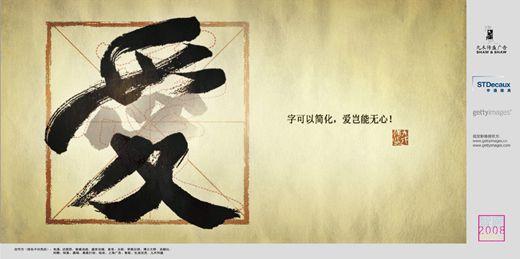
Finally there's what may be the biggest reason, which is that characters are seen as an incredibly important cultural resource. There have been billboards up for years to this effect, showing simplifications that some people take issue with (love 愛 without heart 心 = 爱, etc etc). They have symbolic value in their iconicity. Calligraphy is a major form of art, inextricably linked to classical painting and poetry.
They're just not something people care to get rid of, and whatever desire there may have been growing in the past hundred years there may have been, things like computers have mostly done away with that.
Historically there's also been a rejection of members of the Chinese diaspora's failure to learn Chinese characters in their new homes. In the early 1900s you find criticisms of Chinese Malaysians for not being able to read the script and thus having lost some of their Chinese-ness. Thus again the script presents itself as an important cultural relic.
tl;dr: There's just never been a sufficiently strong enough push for them to be replaced.