I'm reading Bridge of Spies about the U2 that was shot down over the USSR. These planes made overflights (sometimes) right over some of the USSR's most secret sites. The SR-71 seems like it was made to do this same thing but hopefully be less vulnerable because of its speed but I always hear how it didn't do overflights. It seems like a lot of work and money to just get a very limited range of photographs.
it is true that the SR-71 never made an overflight of the USSR. Although the speed of the aircraft was such that it was able to evade the S-75/SA-2 system that downed both Powers and Anderson's U-2s during the Vietnam War, the USAF's leadership was very leery of putting the aircraft against the newer generation of Soviet SAMs of the late 1960s and 70s. When considering the use of the SR-71s over Libya during Operation El Dorado Canyon in 1985, the Libyan's S-200/SA-5 caused considerable consternation because its performance envelope in theory could down the American aircraft.
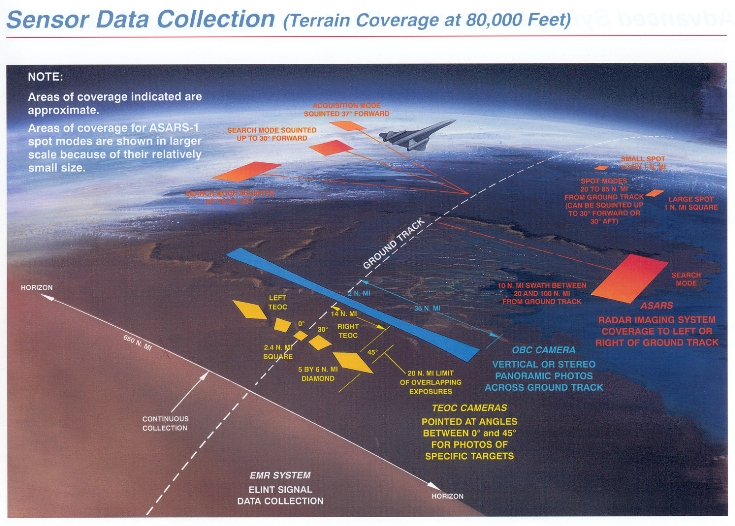
The increasing sophistication of Soviet SAMs limited the SR-71s missions, but in many ways, Lockheed's designers managed to mitigate this threat. for one thing, the SR-71 flew so high that the curvature of the earth was visible to the naked eye. This allowed the aircraft to fly around the borders of the USSR and still be able to get coverage of much of the country without violating Soviet airspace. The Optical Bar Camera (OBC) was designed for oblique shots. other systems were also designed to give both the SR-71 as well as the U-2 a maximum field of vision at altitude- as this picture indicates. The designers of the SR-71 also ensured that its sensor bays were modular, allowing the airframe to incorporate new cameras and sensors as they developed. This was particularly important during the late 1970s and 80s as manned strategic reconnaissance shifted away from film and into the digital age. The Advanced Synthetic Aperture Radar System (ASARS-1) could produce high-resolution radar imagery. Moreover, SR-71 flight operations on the Soviet border often brought Soviet air defense networks to a state of high alert, therefore SR-71 missions often meant they also carried various ELINT packages while skirting the edges of the Soviet border.
But these oblique and digital systems could only do so much, so that meant that the SR-71 was often deployed in areas where geography allowed for maximum coverage. Therefore SR-71 missions tended to cover the Baltic and Barent Sea, where they could get a good picture of Soviet naval forces and military formations deployed along the northern half of the Warsaw Pact, or the Soviet Pacific coast. By the 1970s, spy satellites had displaced manned reconnaissance for capturing the interior of the Soviet Union. Space-based reconnaissance was both safer and legal, albeit more predictable and lacking the romance of the Habu.
Source
Crickmore, Paul F. Lockheed Blackbird: Beyond the Secret Missions. Oxford: Osprey, 2004