Striped shirts like the breton shirt are seen as iconic nautical wear, and so many Navies all over the world have stripes in their uniforms (especially white shirt, blue stripes). I am just wondering the history behind it, and what caused it to become such a widespread thing.
Hey there, you might be interested in this previous answer I gave to a similar question: https://www.reddit.com/r/AskHistorians/comments/2pdr6j/how_did_the_sailor_suit_develop/
To summarize, the "sailor suit" with striped frock has its roots in the British navy, which many navies throughout the world have adopted, adapted and modified it.
For what it's worth- the earliest instance of stripes associated with nautical clothing (that I am aware of!) comes from the c. 1490 Passages Faits Outremer. This depiction of the embarkation of Philip Augustus shows sailors on the far right- wearing what resemble trousers and frocks. All figures are, of course, shown in contemporary dress. I do not know of any other depictions of fifteenth century 'sea-going rigs'-
I would be hesitant in positing any continuity between this early instance of nautical stripes with later eighteenth and nineteenth century garments. In later eighteenth century prints! Sailors wear Striped waistcoats and trousers in their shore-going dress. Red was the more usual color for sailor's waistcoats. However, striped trousers (the stripes almost always vertical) were very common. Indeed, as the century progressed, trousers subsumed the voluminous 'slops' (wide-legged shorts, sometimes shown as being worn over breeches) as the seaman's nether-garment of choice, becoming nigh universal by the turn of the century.
Though you will often read that sailors at this time had no set uniform, and word not receive one til the middle of the next century, sailors received clothing from the purser's stores ('slop' clothing). Seamen's clothing was purchased in bulk, and thus ensured some uniformity among the ship's company. Certainly, sailors had an recognized 'look', frequently depicted in the art of the period.
When in port, the British tar became a flash dresser- in a loudly colored waistcoat and trousers, worn with a many-buttoned, slash-cuffed jacket, cravat, silver-buckled shoes, and be-ribboned hat. No wonder his amorous escapades proved such popular subjects for artists and printmakers!
http://images.library.yale.edu/walpoleweb/oneitem.asp?imageId=lwlpr04743
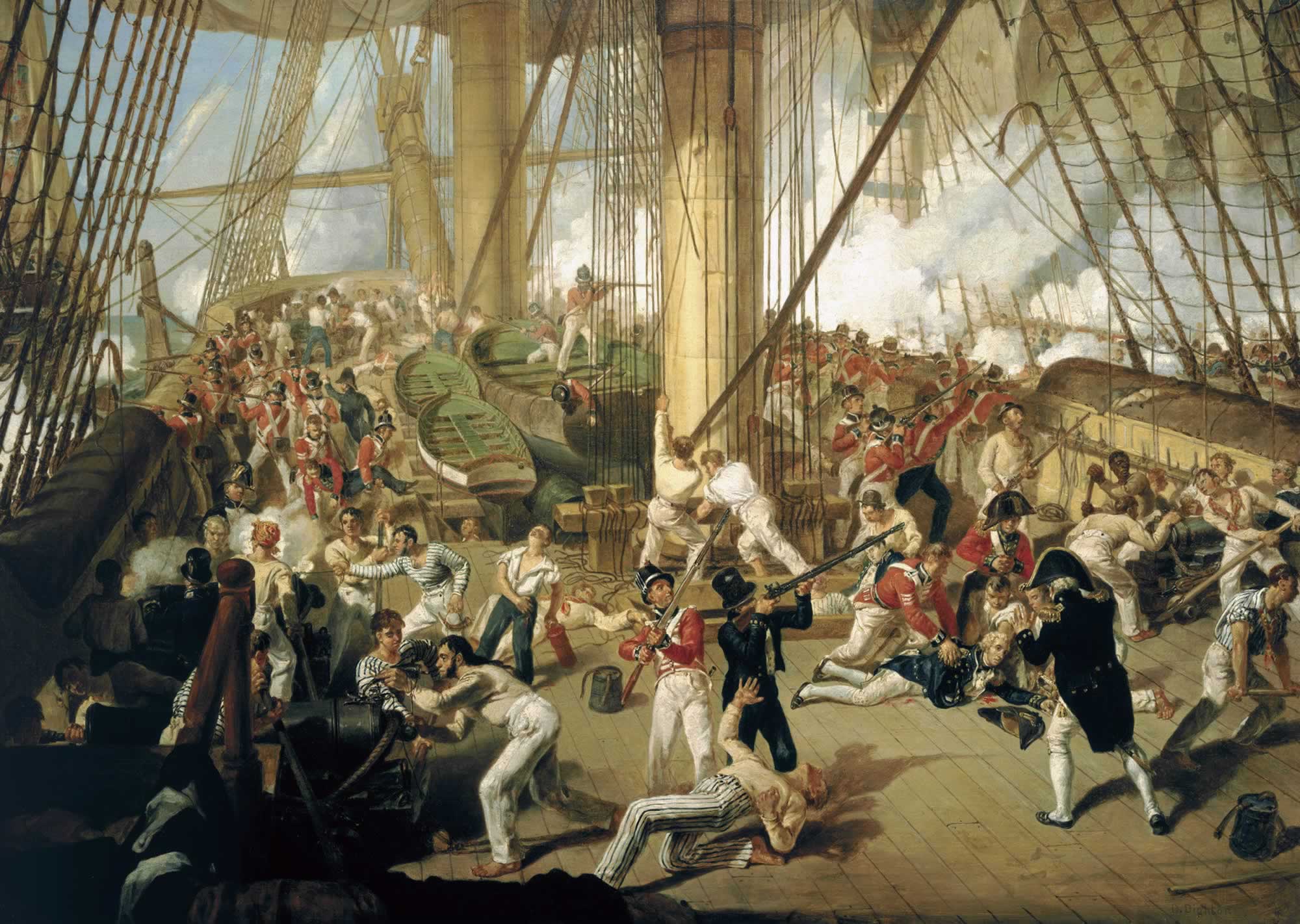
However, the nautical 'jumper' of the early nineteenth century is likely what you have in mind. Though commonly associated with the Napoleonic Wars (thanks largely to the work of Cruikshank and Dighton), the garment is actually post-Napoleonic in origin. I have, as of yet, not been able to fix a firm date on its introduction; however, c. 1820 seems likely. In their essentials, the sailors garments changed little from the end of the eighteenth century through the first two decades of the nineteenth. Waists rose, legs lengthened and widened (though they had not yet assumed a fully bell-bottomed look), the crown of the round hat rose.
For a good view of Sailors' dress at the beginning of the century, see Ibbetson's painting of Sailors Carousing- https://en.m.wikipedia.org/wiki/File:Ibbetson-SailorsCarousing.jpg. Ibbetson shows no striped trousers- emohasizing that, while uniformity existed in sailor's clothing, official uniform was still a ways off. It is equally possible that these may be merchant seamen. Reading the National Maritime Museum's description of the painting in question, the figures are associated with sketches Ibbetson made after the Glorious First of June. They are thus most assuredly sturdy British salts of the Queen's Navee.
For a comparison of sailors' dress of the Napoleonic period with that of the post-Napoleonic (often erroneously associated with that earlier time) see Benjamin West's meticulously researched (albeit fancifully composed) 1805 painting 'The Death of Nelson' (featuring yet more striped linen trousers on the sailors in the far left hand side)-
https://commons.wikimedia.org/wiki/File:Benjamin_West_-The_Death_of_Nelson-_Google_Art_Project.jpg
Versus Denis Dighton's 1825 'Fall of Nelson'- https://upload.wikimedia.org/wikipedia/commons/6/68/Fall_of_Nelson.jpg
Dighton's frequently reproduced painting is also frequently referenced as a source for Naval dress of the Napoleonic period. (in, for instance, Philip Haythornthwaite, Nelson's Navy) As a source, though, the painting is far from ideal. In addition to the anachronistic jumpers, Dighton shows the Marines in trousers (West depicts them in pantaloons) and universally wearing shoulder-straps with white worsted tufts at the end (West shows only NCO's with worsted tufts).
In summary, stripes have a lengthy association with nautical clothing, with striped small clothes becoming increasingly popular in the eighteenth century. Their popularity lasts into the first decades of the nineteenth. However, the striped sailor's jumper is a development of the second decade of the nineteenth century.
Further reading-
Philip Haythornthwaite, Nelson's Navy (Oxford: Osprey, 1993)
Dudley Jarret, British Naval Dress (J.M. Dent & Sons, 1960)