Ho boy, here I go analyzing Indian-Chinese religious interactions again!
So Buddhism had a lot of time to mutate and change before it made its way across the Silk Road and into China itself. If we take Buddism’s own foundational story as-is, It arose largely as an ascetic challenge to the sacrifices and rituals of the Vedic Brahmanism that had been the dominant belief and social structure in the subcontinent. The philosophies that would coalesce into that belief structure, however, are thought to have originated sometime between the 4th and 6th centuries BCE with a man variously known as Siddhārtha Gautama, Shakyamuni, or simply… Buddha, meaning “the enlightened one,” who was born on the Western slopes of the Himalayas in what is now Nepal, but was then known as the Magadha Kingdom of ancient India – notably round about the same time as the great Chinese philosophers Confucius and Sun Tzu (though more modern research has tended to push that date closer to the year 400 BCE, but nevermind). Nevertheless, there was a lot of ground to cover between the Indian kingdoms of Gautama, and the Middle Kingdom, as such we only begin seeing significant mention of travelling monks entering China in the late Han Dynasty of the 2nd century CE… so somewhere between 600 and 800 years worth of changes before it even reached China.
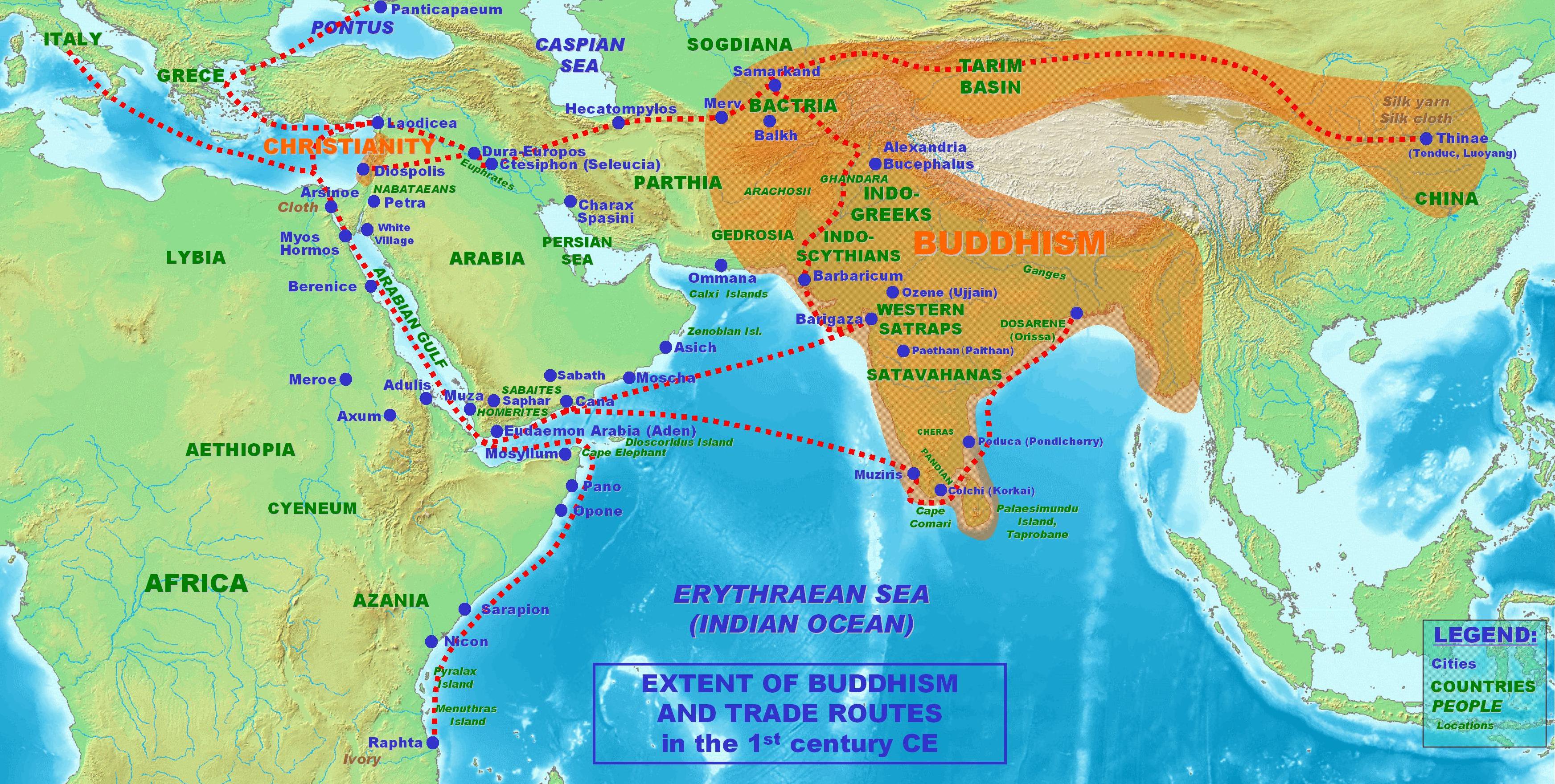
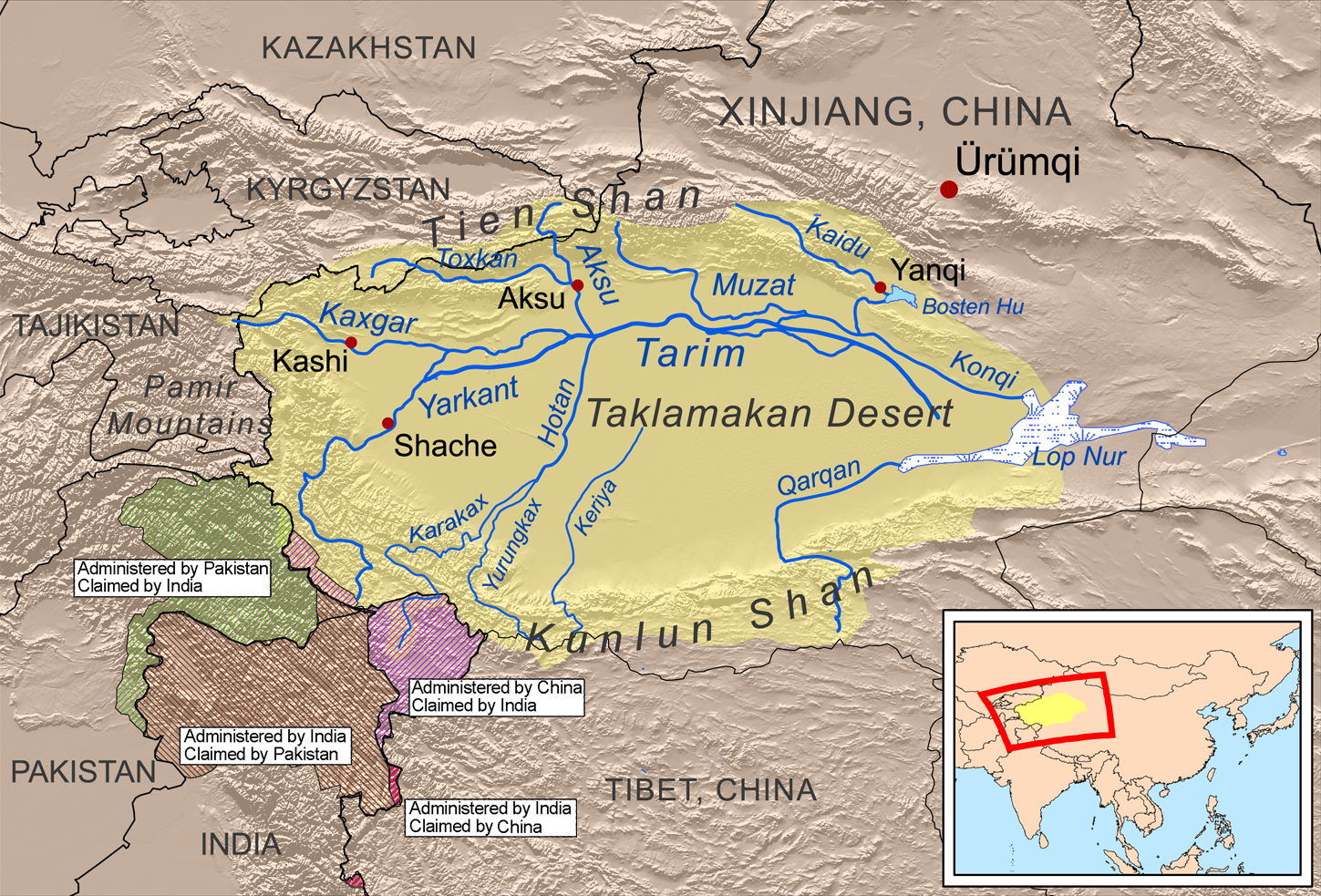
In spite of the physical proximity of India to China, the Himalaya mountains proved a daunting barrier for philosophical transmission between the two cultures, and so it’s somewhat ironic – though not terribly surprising – that Buddhist proselytizers are thought to have reached as far West as Athens and Alexandria decades or even centuries before the philosophy became known in Chang’an or Luoyang (the two most ancient of Chinese capital cities). Nevertheless, the philosophy had been spreading toward China through both Burma in Southeast Asia, and the Tarim Basin, through which the Silk Road passed. When it at last did reach the Han Empire, it is not surprising that it was through the re-established trade route that was the ancient world’s equivalent of an information superhighway, rather than through the densely jungled, largely unexplored and undocumented interior of southern Asia, which China only ever controlled in short bursts, and was never able to culturally integrate into their sphere of influence.
By the time of the second century CE, there had already been several significant schools of thought within the Buddhism sect, but for our purposes the one that’s worth looking at – the school that will find a toehold in Han China – is the Mahayana School. The Mahayana sect, having emerged in the 1st century BCE, differed notably from Gautama’s “Middle Path” philosophies… most strikingly with the assertion that anyone could achieve Buddha-hood – even within this life! – since every living being carried within it the intrinsic nature of the Buddha. To that end, adherents were encouraged to get as many people on the path to enlightenment as they could, and as quickly as they could. You might think of it a bit like Evangelical Buddhism. And it’s very much worth pointing out that it is from the Mahayana school that the subsequent schools of Chan/Zen would arise in due time.
Legendarily, Buddhism might have crept into China as early as the reign of Emperor Ming of Han, between year 57 and 75 CE. According to the Book of Later Han, the story tells us that one night, Emperor Ming dreamed of either one or several golden men. When he told his minister the next day one of them, Zheng Hu, explain as told in the late 5th century Chinese Buddhist classic Mouzi Lihoulun, or “Master Mou’s Treatise for the Removal of Doubts,” the legendary tale of Ming’s conversion goes:
“In olden days emperor Ming saw in a dream a god whose body had the brilliance of the sun and who flew before his palace; and he rejoiced exceedingly at this. The next day he asked his officials: "What god is this?" the scholar Fu Yi said: "Your subject has heard it said that in India there is somebody who has attained the Dao and who is called Buddha; he flies in the air, his body had the brilliance of the sun; this must be that god."
Determined to find the source, Emperor Ming sent a delegation of 18 West to seek the source of his vision and bring him what they could learn from this Buddha. Years later the delegation supposedly returned, bearing an image of Gautama Buddha, as well as the Sutra of Forty-Two Chapters and two eminent Buddhist monks sent to teach the Chinese Emperor of their ways. The next year, Ming ordered the construction of the Báimǎ Sì, the White Horse Temple, to commemorate the who which a bore the sutra to him. Whether or not one buys the story, which was written almost half a century after the death of Ming, and not compiled until the mid-5th century, well it’s debatable. Nevertheless, the White Horse Temple is most often thought of as the earliest Buddhist temple constructed in China.
Whether or not we really buy the legend of Ming’s dream and the White Horse Temple, Buddhism’s initial push into China was really slow going. For one thing, it was alien – both conceptually, as well as just the language barrier between the scrolls and Sutras that might be brought back, and what translators could make of them. The early translations of Sutras tended to be stilted, awkward, and strange, and with much of the deeper allegorical meaning lost in translation. As such, most people in China weren’t particularly interested in this weird little cult and their golden god or whatever. They had Daoism, they had ancestor worship, and they had Confucian philosophy to guide them, thanks very much.
What seems to have been a significant push to change this dynamic was the Period of Disunion. That sounds rather anti-septic, doesn’t it. It’s in fact a roughly 400-year-long running series of vast civil wars that tore China apart… first into the infamous 3 Kingdoms, and then into 16+ Kingdoms, until the empire would finally be reunited in the early 7th century. It’s against this backdrop of constant, grinding, shattering warfare that Buddhism really finds its toehold into China. The wars had been triggered in large part by the fact that more and more non-Chinese peoples from central Asia and the Steppelands of the North had been brought into the Empire – whether through forcible relocation, conquest, vassalage, or simply picking up and moving there. This is a gross oversimplification, of course, but I don’t want to get lost in the infinite weeds of the Era’s socio-political machinations while trying to discuss religion. New people bring, of course, new ideas… and people seeking to change their culture (and dress, language, names, etc) are going to tend to be more opening to hearing about these monks’ little golden gods than, say traditional Han Chinese. That’s not to say that the Han emperors who had been forced to the South wouldn’t also grow significantly more interested in Buddhism as time went on, but the non-Han Dynasties of the North were significantly more open to them, at least at first.
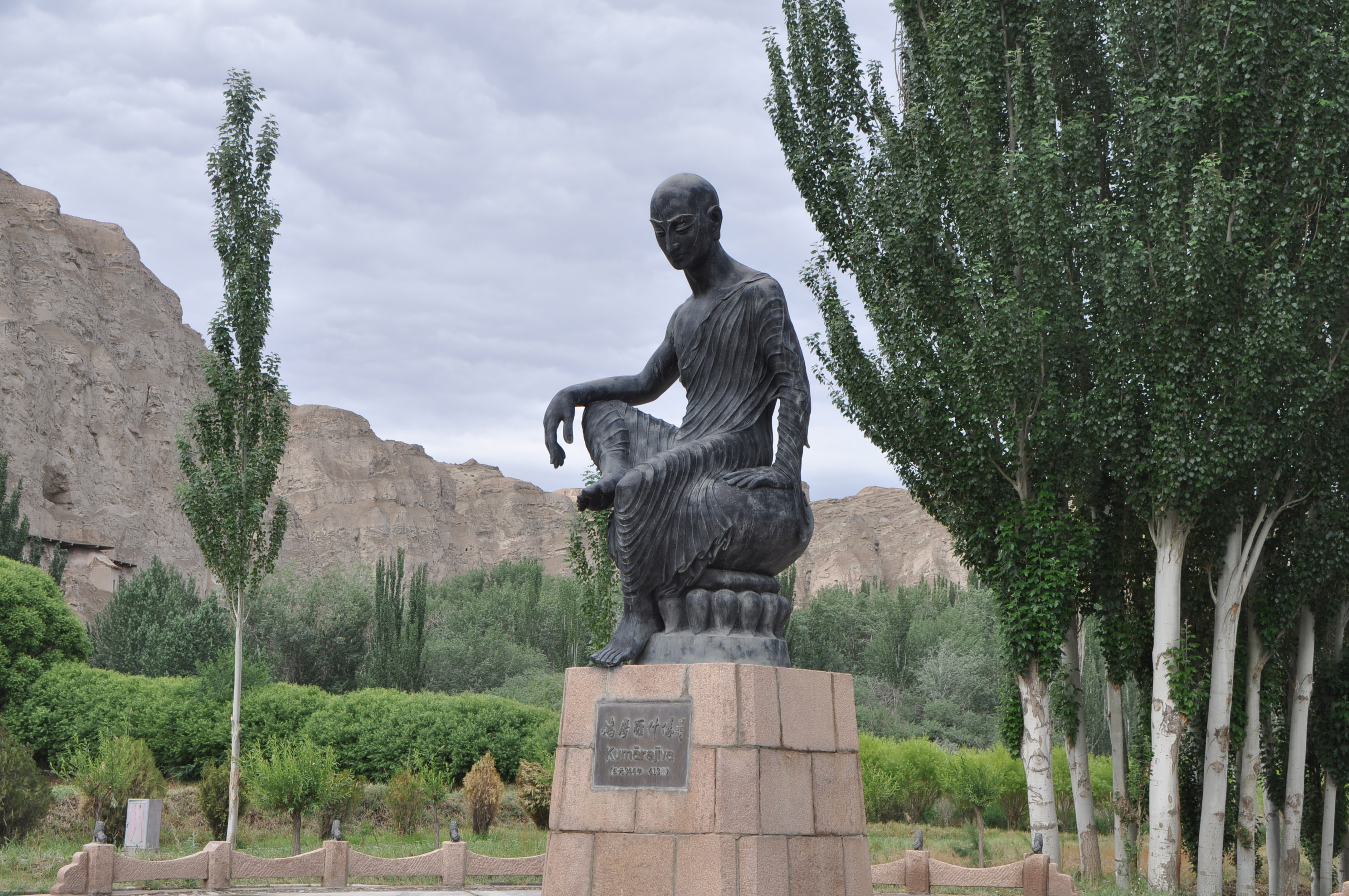
But that still left the language problem. And that wouldn’t really be solved until the later stages of the 16 Kingdoms Period with the arrival into the Northern state of Later Qin in the mid-to-late-4th Century, of the Monk Kumarajiva. He was from the formerly Han-dominated Far West Region, Xiyu, surrounding the Taklamakan Desert. Monk Kumarajiva managed to do for the Chinese what previous monks had found so difficult as to be impossible: effective, beautifully translate the Buddhist sutras into clear, deep works of Chinese literature, which had made the teaching far more accessible and comprehensible to large swaths of the populace. Over the course of the Period of Disunity, the philosophies that had previously acted as a moral guidepost from Chinese civilization – the teachings of Confucius – had lost much of their luster, since Master Kong’s pie-in-the-sky attitude toward “can’t we all just get along” governance and Mencius’ assertions that men were inherently kind and good… didn’t mesh too well with the horror and destruction that China had been facing for more than 200 nonstop years. Buddhism’s central tenants: the life was at its core a cycle of suffering, impermanence, and loss to be escaped… must have seemed a far more reasonable, realistic worldview to the culturally shell-shocked Chinese of the 4th and 5th centuries, so it doesn’t seem surprising that especially now that they could read the sutras it would have spread quickly.
[Continued in Part 2]
Follow up question:
How did the spread from Chan Buddhism effect other schools of Buddhism in China?