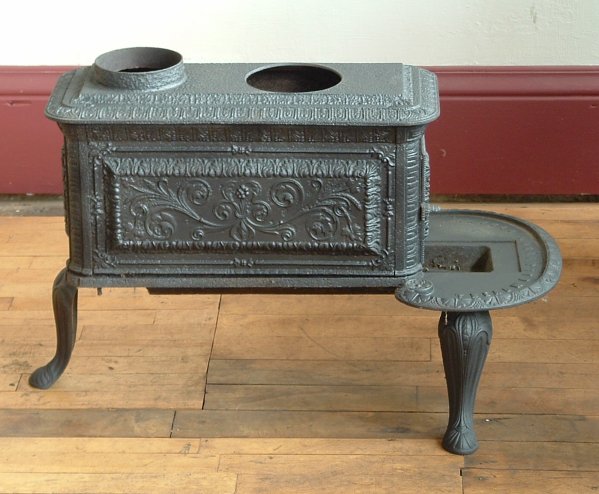
I can't say much about European peasants and how long each and every kind took to start to cook on woodstoves....but I can say something about woodstoves, generally.
It's a bit tricky. There were stoves used for heating in parts of Northern Europe by 9th c. AD, made of clay or tile (search under Kachelofen, and you'll see photos of some old very nice ones). When cast iron became more common in the 18th c., you begin to find cast iron stoves as well: not sure about Europe, but at least one appears in the American colonies mid-century, in Virginia. Surely somebody set a kettle of water on one of these, early on, or a pot of soup. By the early-to-mid 1800's, many were set up with this in mind: so it's quite possible to say people were actually cooking on them from the very beginning
However, the cookstove you might be thinking of, with places for pots to be set into the top, an oven inside, maybe a tank for hot water at the back- this is quite late in coming, at least in the US. The most famous here- the Home Comfort stoves- were only being made after 1864.
Why there was a long period between the advent of parlor stoves for heat and kitchen stoves for cooking is a good question. One possibility is that everyone needed to be warm but mostly women needed to do the cooking. This lag in technology would also be seen in the lag of technology for other domestic chores; notably, doing the laundry. Long after farmers had the advantages of agricultural machinery, most farm women were still doing laundry with a giant pot of hot water and a scrub board ( and, if you ever visit a living museum, like Old Sturbridge Village, any interpreter will tell you that doing laundry is absolutely no fun).
Another possibility, too, is that there was a very large skill-set that had been handed down through generations of cooks for doing fireplace cooking, as well as all the hooks, spits, grills, toasters, kettles, etc. A stove would require new methods, recipes, and new equipment, so there likely was some resistance based on that, as well.