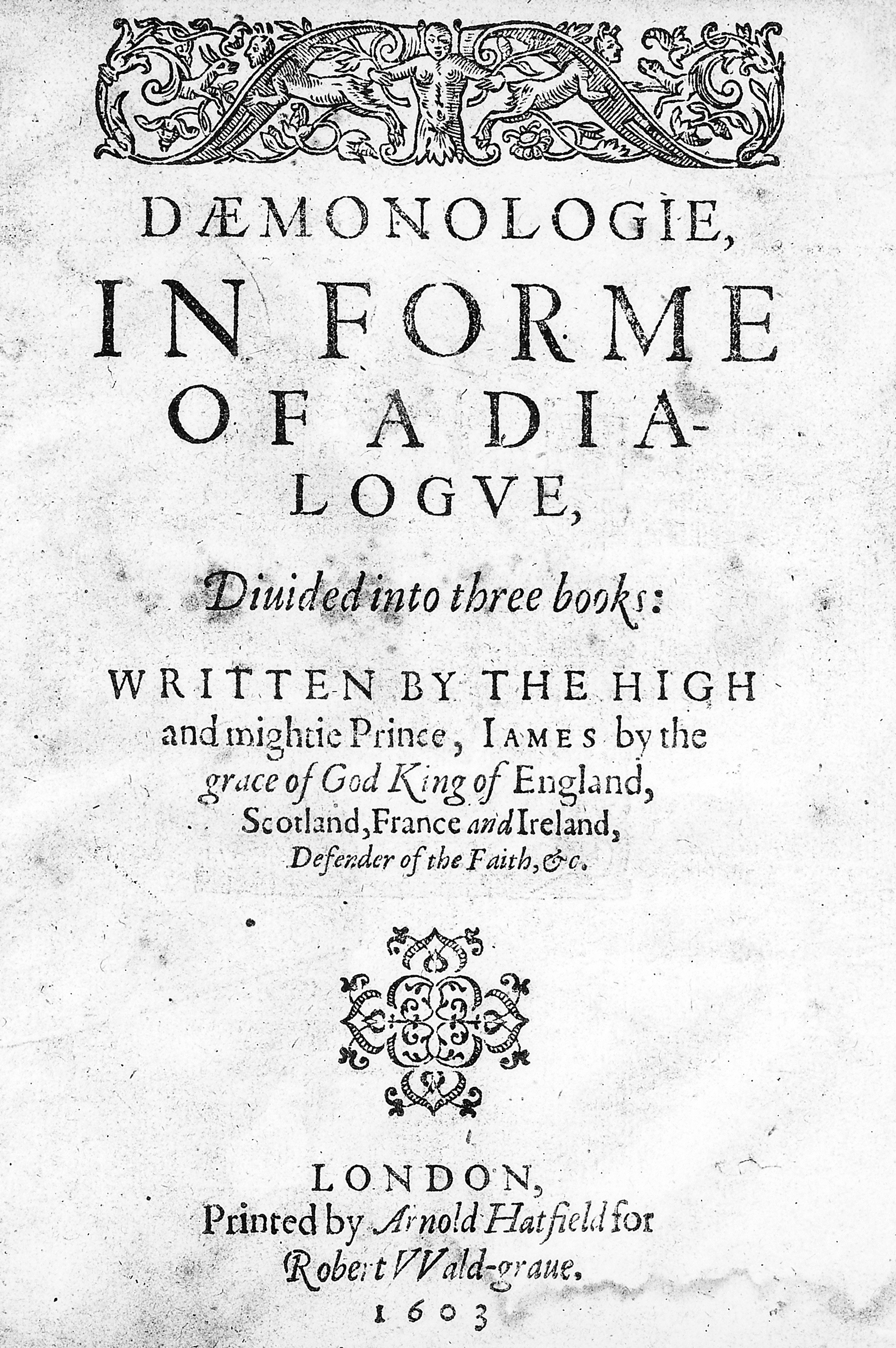
This is the image to which I am referring. It is from a dialogue on witchcraft written by James. Unless I am mistaken, James ruled far later than the period in which England held any major territories in France.
Did other English monarchs also lay claim to this title? If so, why? Wouldn't a public declaration of this nature have made the real king of France angry?
Even after their territory in France had been lost, the monarchs of England still kept up their nominal claim to be King of France. It was understood as being nothing but a title; no one after Henry VI made any effort to realize it - even when actually fighting France. (The one exception was Calais, the one part of English France not reconquered under Charles the Victorious; it was lost under Mary I in 1558, and England never attempted to reconquer it.)
So, until 1801, all English monarchs continued to use the title "King of France." It was finally dropped by the 1801 Act of Union, which formally brought Ireland into the United Kingdom and replaced the three titles "King of Great Britain, France, and Ireland" with the one title "King of the United Kingdom of Great Britain and Ireland."
It is the same reason that China still claims Hong Kong and Taiwan as part of China. Even if the people in Taiwan do not agree and see themselves as a completely different entity. The people in the mainland felt differently. People of England at the time felt France still belonged under rule of the king in their hearts as well.
Some background: France had 5 kings in 12 years...Louis X died in 1316, leaving an unborn son, who died 5 days after birth. The throne was given to Philip V, after jurists determined Louis' daughter Joan could not inherit the throne it had been over 300 years since that line did not have a male heir). Philip died in 1322, and the crown passed to Philip's younger brother, Charles IV.
Edward III made a bid for the French crown after the death of his uncle, Charles IV of France, in 1328. Edward's mother, Isabella, was Charles' sister, both children of Philip IV of France. As Charles died without a male heir, Edward made the claim that he was Charles' nearest male relative. However, French jurists ruled that, as Isabella could not possess the throne, she could not pass on the rights to the throne, either. They gave the throne to Charles' first cousin, Phillip of Valois (who then became Philip VI of France). Edward dropped his claim for a while, then brought it up again, sparking the on again, off again, Hundred Years War.
Cut to 1420 and the Treaty of Troyes, which stated that the sons of Henry V of England would inherit the throne of France after the death of the current monarch, Charles VI. Henry V died in 1422 and his five-month old son, Henry VI, took the English throne. Charles VI died shortly thereafter, and Henry became the nominee to the French throne as well (this was awkward, with the two countries at war with each other). The Dauphin Charles, son of Charles VI, was understandably put out by being excluded from the throne. With some help from Joan of Arc, Charles was crowned king in 1429, and Henry was crowned king of England soon after. Then English were then driven out of France, with the exception of Calais, ending any real chance of retaining the throne.
Since England and France were rivals even if they weren't always at outright war, the English (and then British) throne kept the title as a sort of poke in the eye to France until 1801.