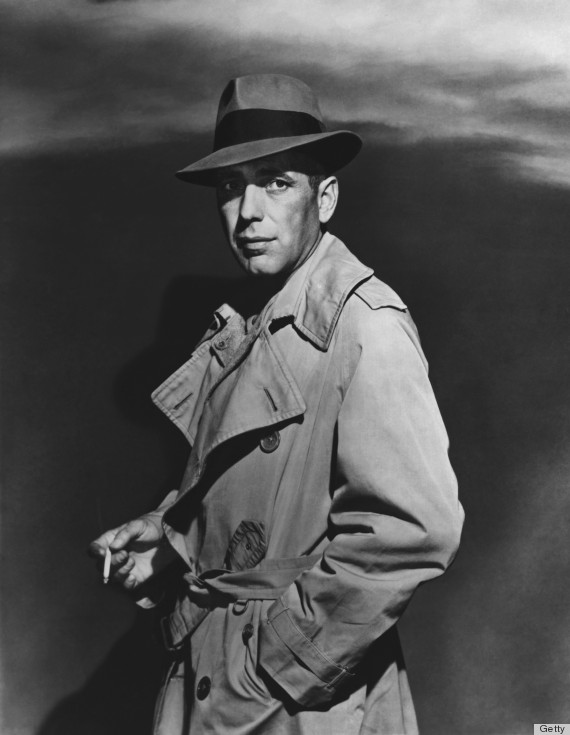
Bonus question: assuming that the idea of a "shady guy" predates the trench-coat stereotype, how would past generations have characterized the typical dress of suspicious characters?
Visually:
The “shady guy” you describe comes straight out of film noir, so “shady” is right on – the genre took its name from all the shadows and darkness on the screen, and in the characters’ moral decisions. The look sprang from German Expressionist cinema of the 1920s – think Cabinet of Dr. Caligari or Nosferatu, while the stories came from the gritty, sordid realism of crime novels and pulp magazines of the 1930s and 1940s.
The typical film noir hero (or anti-hero) was world-weary, capable of violence and acquainted with the moral shortcomings of humanity – which made it useful, from a writerly perspective, to have him be a veteran, or at least to be implied that he was a veteran. I’m not sure if the iconic private detective Philip Marlowe ever comes out and talks about his military experience in any of Raymond Chandler’s novels, but it’s definitely there between the lines – especially in The Big Sleep (1939), where his client is a decadent general (his name is “Sternwood” but he’s reduced to spending his days with his orchids, a kind of literal hothouse flower).
The trenchcoat was named after the trenches of World War I (Smithsonian had a readable history of them not too long ago - they were cut they way they were for British officers’ uniforms, then caught on among Americans and civilians between the wars – then became a standard element in Allied uniforms in WWII.) Marlowe wears one.
He also wears a hat – “hatlessness” is a signifier in The Big Sleep, I think for either intellectualism or a lack of civilization – and Marlowe’s the kind of guy who has a hat, but uses it to punch through windows.
Someone with more fashion knowledge than me will have to talk about the history of the fedora, but between the world wars was when it became a sort of standard part of male dress. One of the things that makes it specifically part of the noir look, though, is that it’s worn at an angle, often concealing one eye. The angle is often described as “rakish” without giving much thought to what that word really means – like a rake, a rakehell (although that might itself come from an old nautical word for an incline, the two meanings are by now really entwined). Anyway, it’s not straight, which is the point.
And, from a cinematic point of view, a hat’s a great source of shadow – whether you’re Edward G. Robinson in Little Caesar or Robert Mitchum in Night of the Hunter or Victor Mature in I Wake Up Screaming. It’s not so much the hat as it is the shade under the brim, in other words.
Sources:
Besides the linked films & novel, I'm not entirely sure the best sources to point you towards - I usually think of David Bordwell as the go-to guy for film history, and The Classical Hollywood Cinema does get into noir, but it's less inclined toward the kind of aesthetic concerns that "shady guy" tropes involve.
I know one book that gets way into it, but I'm not next to my shelf right now and all I can say is that it has a really generic name (like "Cinema and Spectacle" or "Cinema as Image") and a still of Marlene Dietrich on the cover, smoking. Alas.