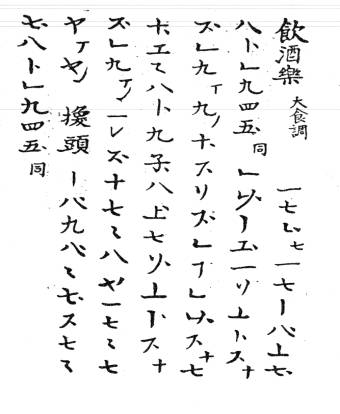
Like this! That's a drinking song, and the notation is actually not the most standard.. Here's a more typical example
The smaller columns of characters are the notes, and the larger sized characters are the lyrics (edit: hand strokes. I was looking at a few of these and got my wires crossed. The second one is a Qing-era guqin songbook called qínxué rùmén 琴學入門 – Introduction to Guqin. It's a stringed instrument with complex plucking/strumming methods). The first image only has notes since it's an instrumental piece.
This is a system known as gōng chě musical notation (工尺譜) which predates the Song (the 11th century) but was popular and in wide use by that time.
The character-to-pitch correspondences are roughly as follows (with exceptions):
上  do
尺  re
工  mi
凡  ~fa
六  so (also 合 for lower octaves)
五  la (or 士, or 乙 for lower octaves)
乙  ~ti
There's considerable variation from musical style to musical style, with different operatic forms having different conventions. While it's not as popular there are still people using this system, with adaptations.
I'm not a musical historian so I can't give you much more information than that, but if all you wanted to know was how it looked, that you now know.