It did! It's just more traditionally confined to the North.
There's not just one Chinese cuisine. Rice cultivation wasn't actually a part of the early Chinese diet at all. There's no word in Sinotibetan languages for rice that isn't a loan. In Tibetoburman they borrowed the vocabulary from Tai languages much later (e.g. *na^1 for wet rice field), and in Chinese the common word for rice 米 is actually originally meaning "millet", not "rice", and was only later shifted in meaning to "rice". This was made easier by the fact that millets had largely been replaced in major parts of the Sinotibetan language family by wheats due to their heartiness in cold climates.^2,3
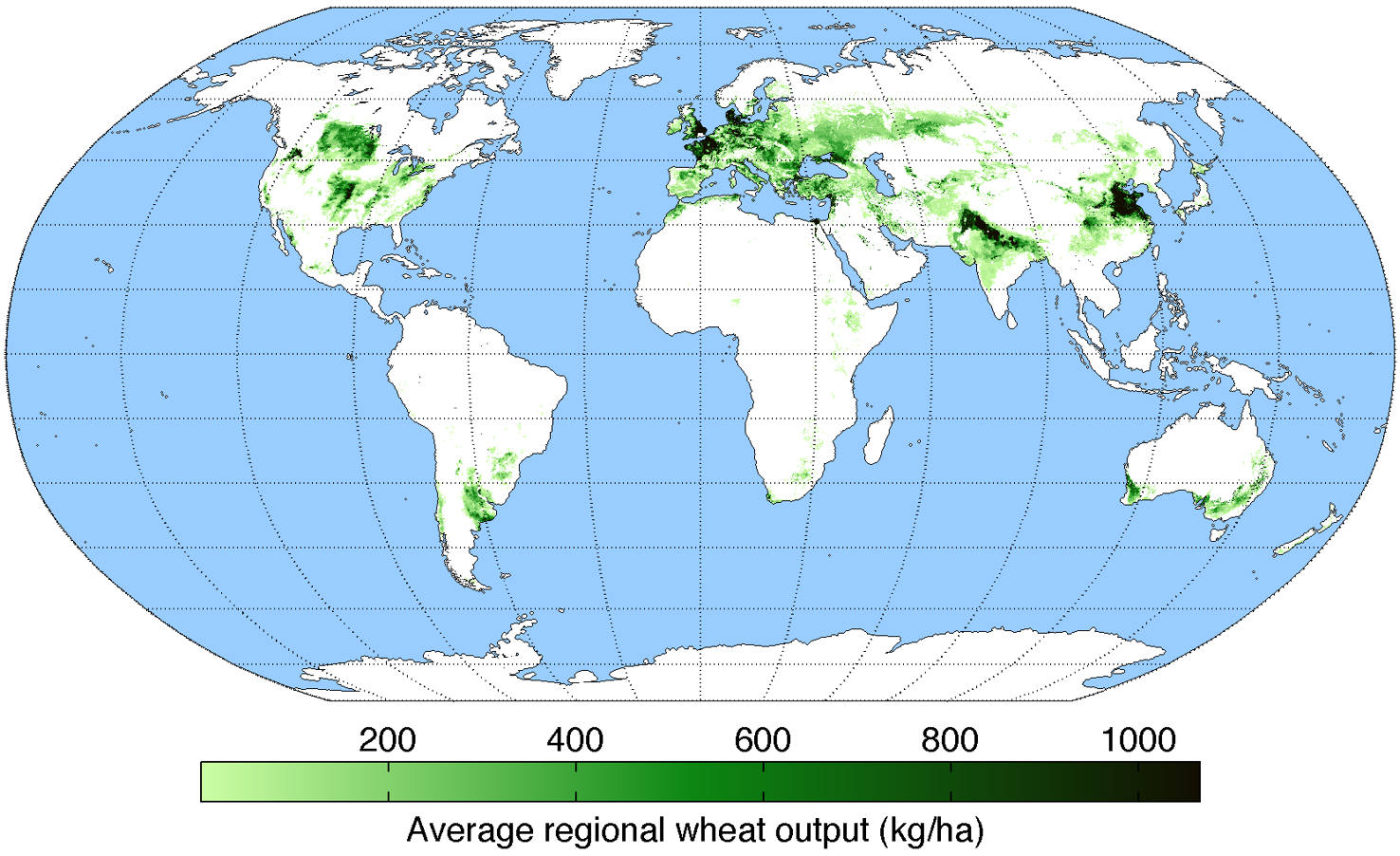
Have a look at this map showing where wheat is grown most. The areas of East Asia that are dark green are places where you're going to find breads. The Shandong Peninsula, all of Jiangsu province north of the Yangtze and a good chunk of Hebei. There's a folk etymology for 饅頭^4 * màntóu*, a popular steamed bread, that it's actually Man[chu] tóu, with tóu meaning "head", because it entered Chinese cuisine through non-Chinese Northern groups. Actually more people will tell you it was invented by Zhūgě Liàng.
This and other similar breads such as bāozi 包子, the stuffed version of màntóu, are popular throughout the region including Korea.
There's also ròu jiā mó 肉夾饃, which is another incredibly popular food in China and pretty much the best thing ever. These are roud breads which are not steamed but instead grilled on a hot plate, and then stuffed with spicy meat and cilantro. They're a notable food from Shǎnxī (Shaanxi) and have become quite popular throughout the Northwest as well as being readily available throughout the country.
There's also spicy and non-spicy onion pancakes which are again cooked on a hot plate and regularly consumed as a snack. There are other similar pancake-like treats as well but some, such as the Shandong wrap (山東雜糧餅) are getting further away from what we might call bread.
Finally in Taiwan there's a sort of steamed bread sandwich called koah pau 刈包. They're awesome but almost certainly a more recent thing in Taiwanese cuisine.
All of these are made with wheat flour, but grilling in a large oven wasn't always a possibility, and steaming/frying was always more common in Chinese cuisine anyway, so the breads that we have in the region tend to be more reliant on these ways of cooking.
In the end, the relative scarcity of wheat in the south and the ease of growing multiple rice varieties has lead to rice being seen as a more typical Chinese food, but in reality it was imported from cuisines of other, non-Chinese, groups.
Matisoff, James A (2003) Handbook of Proto-Tibeto-Burman System and Philosophy of Sino-Tibetan Reconstruction. Univ of California Press.
Guedesa, Jade A d’Alpoim; Lub, Hongliang; Heinc, Anke M; Schmidt, Amanda H (2015) Early Evidence for the Use of Wheat and Barley As Staple Crops on the Margins of the Tibetan Plateau.
Sagart, Laurent (2011) How Many Independent Rice Vocabularies in Asia. Rice, vol. 4, pp. 121–133.
Note that food vocabulary varies considerably throughout Mandarin dialect areas. Mantou isn't always called mantou, and the word mantou doesn't always mean what I'm talking about here.
(edited to expand a little bit more)
As a lot of the commenters have pointed out, there's plenty of bread in the Chinese diet.
Piggybacking on the subject of bread, modern loaves of bread require a lot of things. You need an oven which is pretty labor intensive to make. You also need fuel, a lot of it to achieve baking temperatures. For an average person across most of history, baking bread was a pretty laborious task.
Porridge has always been a popular alternative across most cultures and time periods, as have dumplings and noodles because boiling requires a lot less energy (wood, coal, ect). In Mesoamerica, tamales were an easy way to bake bread wrapped up and placed over coals. Most cultures had some variant of a flatbread cooked over a griddle or a tandoor-style cooking device.
One commonly used solution to the baking problem was to centralize baking in a specific location, giving rise to the professional baker. The Roman dole initially came in the form of measured grain, but eventually a network of state-run bakeries began to churn out bread (stamped with a brand no less).
Speaking to China specifically, one major issue in Chinese cooking has always been access to cooking fuel. This can be seen in the tendency to cook things at a very high heat for a very short time in order to conserve fuel. Because of that, heating up an oven which requires lots of wood to burn, isn't a common feature in the Chinese cook's repertoire.
So, up until about the 1930's there wasnt just one "Chinese" culture. (There still isn't, I know, you don't need to lecture me.) China is a huge and diverse area. Parts are tropical, parts are arctic, some wet, some arid, etc. Etc. The majority of the Chinese population has always lived in the south or east, in the wet areas and/or coast.
Rice grows very well in wet areas that get a lot of rain, and as a result, rice became a staple in Chinese and much of southern Asian culture. Wheat on the other hand, does not grow well in wet places. So it did not grow well in the more densely populated areas. However if you went north and/or west, avoiding the mountains and desert, there are great grasslands. Reasonable temperatures, but little rain. Ideal conditions for wheat.
These areas were less densly populated, but wheat was used in place of rice in these areas. However with the nationalist movement, and the idea of "one china" taking hold almost a century ago, what was "Chinese" was practically set in stone, which is why we think of rice as the Chinese staple, partially because it is, partially because of a unification effort.