On the podcast Revolutions (recommended by this sub, thank you) in episode 3.6 on the Stately Quadrille, Mike, the host discusses the long standing rivalry between France and the Habsburgs. I had never really heard much about this rivalry before. Did France consider the Habsburgs more threatening than the English? Where did the rivalry come from?
The Habsburg dynasty did not only rule Austria. It was famously connected with many countries all over Europe and is rather well known for its history of royal marriages.
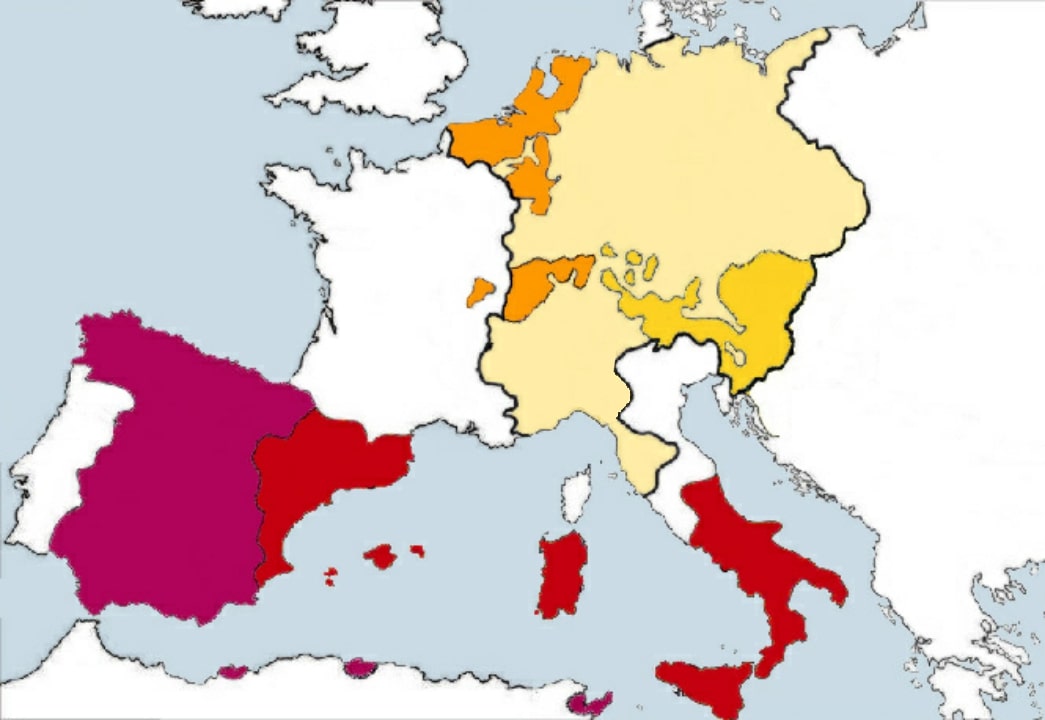
Due to many coincidences and inheritances, the Habsburg dynasty ruled over vast swaths of land - culminating in Emperor Charles V. (HRR notation, in his homeland Spain he was King Charles I.). He was the first to unify Aragon and Castille under a single crown - and also inherited northern Burgundy (modern Belgium, the Netherlands and parts of northern France) from his father. As King of Aragon and Castille, he also ruled over Sardinia, Sicily, Naples and Navarra. When his grandfather Maximilian died, he inherited Austria and the Habsburg possessions in the Holy Roman Empire - and managed to press his claim to the throne of the Empire.
At this point his full title read:
Charles, by the grace of God, Holy Roman Emperor, forever August, King of Germany, King of Italy, King of all Spains, of Castile, Aragon, León, of Hungary, of Dalmatia, of Croatia, Navarra, Grenada, Toledo, Valencia, Galicia, Majorca, Sevilla, Cordova, Murcia, Jaén, Algarves, Algeciras, Gibraltar, the Canary Islands, King of Two Sicilies, of Sardinia, Corsica, King of Jerusalem, King of the Western and Eastern Indies, of the Islands and Mainland of the Ocean Sea, Archduke of Austria, Duke of Burgundy, Brabant, Lorraine, Styria, Carinthia, Carniola, Limburg, Luxembourg, Gelderland, Neopatria, Württemberg, Landgrave of Alsace, Prince of Swabia, Asturia and Catalonia, Count of Flanders, Habsburg, Tyrol, Gorizia, Barcelona, Artois, Burgundy Palatine, Hainaut, Holland, Seeland, Ferrette, Kyburg, Namur, Roussillon, Cerdagne, Drenthe, Zutphen, Margrave of the Holy Roman Empire, Burgau, Oristano and Gociano, Lord of Frisia, the Wendish March, Pordenone, Biscay, Molin, Salins, Tripoli and Mechelen.
Charles biggest adversaries were the kings of France, who feared encirclement by the Habsburgs (who held lands to the North, East and South and whose claim on Brittany was averted by arranging a rather dubious marriage with Anne of Brittany when Emperor Maximilian was occupied with pressing his claims on the throne of Hungary in 1491). This fear of encirclement as well as political interests in Italy led to a series of wars now known as "The Italian Wars", lasting from 1494 to 1559. And while many (if not most) major powers of Europe were involved in these wars, the main belligerents were always France and Spain/The Hasburg dynasty.
This was the beginning of the rivalry the podcast mentioned. It wasn't always full on, open rivalry but France was always very keen on keeping the Habsburg Emperors in check (e.g. when they intervened in the 30 years war when a total victory of the Emperor was close).
Sources and further reading:
Anderson, Matthew: "The origins of the modern European state system 1494-1618", London/New York 1998
Kleinschmidt, Harald: "Charles V: The World Emperor", Sutton 2004
Körber, Esther-Beate: "Habsburgs europäische Herrschaft. Von Karl V. bis zum Ende des 16. Jahrhunderts", Darmstadt 2002
OP mentioned the English. Would England even have been a consideration at this time?