"Chauvet is unique for its grandeur and its individuality of expression. But from the western coast of Spain all the way to Russia's Ural mountains, images of horses abound. You could spend a year traveling from site to site and never see them all. Yet despite these vast distances in both space and time--it's impotant to remember that the phenomenon of Pleistocene art extends over a period of more than 20,000 years--there are a few universals. The images are usually peaceful. Violence is rare. A few images have been interpreted by modern researchers to show animals with hunting spears in them but such depitctions are unusual. Humans almost never appearl when they do, only a few are shown injured. And oddly, landscapes--trees, flowers, rivers, cliffs--never ever appear."
I really enjoyed the book but I wanted if this assertion is true, and if any of the historians have any why this would be the case?
The general consensus of work with Upper Paleolithic rock art in Europe (not to be confused with other rock art from other places and periods) is that depictions of humans are indeed rare. While animals are plentiful and typically shown with considerable realism, the few humans who do appear in the art of the period often have exaggerated features and small heads with stylized features. There are exceptions, but this is the general tendency of the period.
There is more question about any depictions of violence. Early analysis of the art focused on the idea that this was hunting magic. The fact is, without documentation of the artists and/or their societies, we do not really know what the art was about, but in general, most animals do not appear to be "killed" in any way. There are exceptions to this, and bears in particular are often depicted with lines drawn from their noses and mouths: this is often interpreted as spurting blood, but we can't be sure. Regardless, the "hunting magic" hypothesis fell out of favor some time ago.
In short, Wendy Williams is describing the art of the period the way rock art specialists generally view it.
hi! this question is fine here, but questions on early humans are worth also x-posting to our sister sub /r/AskAnthropology
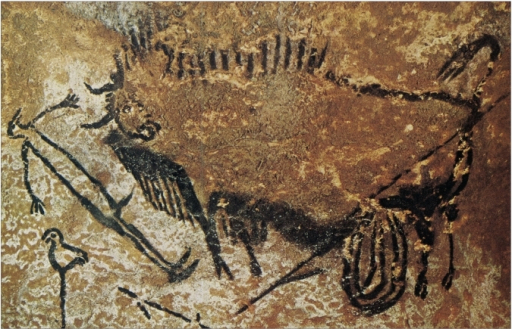
Yes, this is true. And in the rare cases when people appear, they're usually in isolation. In other words, the people aren't interacting with anyone. Here's a rare and famous illustration of a person from Lascaux: https://ka-perseus-images.s3.amazonaws.com/19583ef6218d0aa4fe913226f03e91cd3b51a5d2.jpg This is also a case when a hunting spear is depicted and the person presumably is in a scene with the animal.
A popular subject for cave illustrations in Western Europe, though, is human genitalia. They're all over the place. The earliest illustrations are more literal, but as time goes one, the more recent ones are more stylized.
In sweden, our "rock carvings" often have humans on them. I am no expert but this is common knowledge here. As shown in an image search of "hällristning"