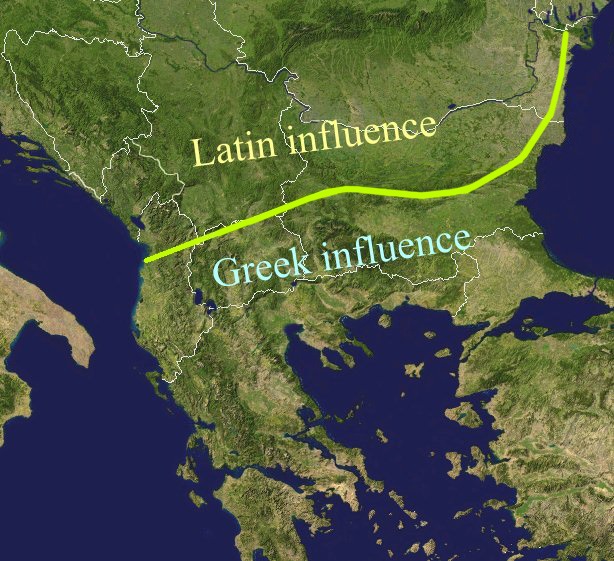
Well, the good news is that Romanian is not the only Romance language in Eastern Europe. It's the only well-known one.
There's also Aromanian (throughout the Balkans and Greece), Istriot (Croatia), Dalmatian (Croatia and Italy), and Megleno (Greece, Macedonia, Turkey).
Okay, that being said, all of those aforementioned languages are near extinction or at least have very small numbers of speakers. Most of this has to do with mass migrations over time and the human landscape of Eastern Europe:
Eastern Europe during the Roman Empire was never as populous as Western Europe, and communities often continued their languages in the niches of mountains unaffected by Latin (Herman 2010). Thus languages like Albanian survived, while Western European languages like Iberian, Tartessian, Gaulish, Celtiberian, Etruscan, etc... were utterly annihilated (save for Basque).
At the end of the Roman Empire, it is likely that most people in Eastern Europe spoke Latin - at least as a second language but usually as a first. If we were to map it out, you'd see that Romance languages still pepper land between Italy and Romania. These tiny communities are survivors of post-Roman Empire immigrations. After the Empire fell, the land was entered by Magyars, a Uralic people who settled in what is today Hungary, and the enormous Slavic nation (broadly speaking, mostly South Slavic languages) that fill in the gap from Poland to Macedonia.
Finally, Latin was never really spoken south of the Jireček Line, where Greek was culturally permissible.
A full discussion can be found in The Indo-European Controversy by Pereltsvaig and Lewis (2014). (Full disclosure: I was a reviewer of their book). (link)
See also:
On the history of all Romance languages: Herman. Vulgar Latin. (2010). (link)
For a linguistic survey of the languages themselves: Grandgent. Introduction to Vulgar Latin. (1907). (link; free)
What exactly do you mean by "Eastern Europe?" Just the former Roman holdings? There would have been variation to what degree latinization occurred across those holdings. There is what's called the Jireček Line which roughly delineates the shift from Latin to Greek influence in the Balkans during that time. Greek language was always fairly common in the eastern half of the empire. The people you bring up, romance-speaking people, are grouped under the name Vlachs. People farther south would have been assimilated more towards Greek language.
The short answer to your question is that Bulgars and Slavs moved into the area in the 6th century and began to assimilate or displace those older, romanized, people. There was a variety of powers to arise in the area. You had the Avar Khaganate from 567-804. There were multiple Bulgarian Empires that controlled the region and threatened the Romans. You also had groups llike Croats and Serbs which began to occupy parts of the region. Farther north, you had the Magyars. Oversimplifying a bit, control of the Balkans swapped between the Bulgarians and Romans until the Ottoman conquests.
I'm not familiar with the modern history of the area, so I can't speak to how that has influences linguistic patterns. But basically, Roman influence was just lost over time. Similar things occurred in the former western lands too. For example, the Lombards, who ruled Italy from 568 to 774, did not speak a romance language. The big difference was that the Lombard lands were later conquered by the romance-speaking Carolingians. This effectively reinstated the legacy of romance languages. In the east, no such romance-speaking power existed. Even the Romans shifted from Latin to Greek.
Would someone care to explain the relationship between the words 'Romanian', 'romance', and 'Roman'? Thank you in advance.