Why is it that women have long hair and men have short hair generally? When did this begin happening, and are there any societies where the opposite was true? Also is there any known reason for this or did it just happen this way?
edit: Thank you for all the helpful answers and resources. It was interesting to read all these answers, and I'll have to check out some of the books mentioned. These Desmond Morris books sound like something I will enjoy reading.
There are two really great books I read in my Anthropology of Sex course some years ago. "The Naked Man" and "The Naked Woman" by Desmond Morris. Each chapter is on a certain aspect of the human body and answer social and cultural whys as to why we look certain ways or how we treat certain body parts.
Long hair for women and short hair for men isn't universal. There are quite a few groups of people where long hair for both genders is the norm (many Asian cultures until the last century, think of the cutting of top knots to denote shame, or Spanish Matadors who cut their long hair when they retire), or where fancy hair in men is the standard (some African tribes think elaborate hair on men is quite sexy, though I can't remember what tribes for certain).
Short hair came in and out of style long before Christianity was a thin. However, a good precedent to set's men's and women's hair was issues by Saint Paul. He did not mince words when he wrote: "Does not even nature itself teach you that if a man had long hair , it is a shame unto him? But if a woman has long hair it is a glory to her, for her hair is given to her as a covering." - 1 Corinthians 11:14
I have no doubt that had some effect. However, we can also take a look at other trends, such a wigs. Not only did the cover bad hair, but also illness and parasites. Egyptians sheared their hair short to help with the heat and lice, but also wore wigs and cut their hair in a fashion to denote fashion and statis.
There are links to WWI and WWII have it's hand on determining male hair length as well. Hair is a fascinating subject that is wildly detailed and cannot really be summed up in a single reddit comment. It varies from time period to time period, and culture to culture.
Hello everyone,
In this thread, there have been a large number of incorrect, speculative, or otherwise disallowed comments, and as such, they were removed by the mod-team. Please, before you attempt to answer the question, keep in mind our rules concerning in-depth and comprehensive responses. Answers that do not meet the standards we ask for will be removed.
Additionally, it is unfair to the OP to further derail this thread with off topic conversation, so if anyone has further questions or concerns, I would ask that they be directed to modmail, or a META thread. Thank you!
are there any societies where the opposite was true?
I can specifically tackle this aspect. Yes, and China (as well as a majority of Confucian-influenced kingdoms) was one of them. Hair has for millennia been closely tied with culture, politics, and even religious beliefs in China. Especially in early Chinese history (specifically the Ming Dynasty and prior) Confucian virtue dictated that the hair - as well as all other body parts (including fingernails) - were sacred and not to be cut under any circumstance, for both men and women. To do so was to show a lack of filial piety, and was used as a punishment, or to mark convicts, outcasts, and in some instances soldiers. Cut hair was seen as uncivilized, barbaric, and un-Chinese... the steppe nomads cut their hair, and look how unruly and brutish they were!
Nevertheless, in the later stages of the Han Dynasty of the second century, Buddhism made its way into China on a more permanent basis, and then really began to explode in popularity in the latter stages of the Period of Disunion. Toleration and later official acceptance of Buddhism brought with it monasteries and of course monks. And with monks came tonsure, the ritualistic shaving of the head. Nevertheless, that was by far the exception rather than the rule, and the general population continued its tradition of uncut, but top-knotted hair. Those would be held in place with pins that could be as simple or ornate as was affordable for the wearer. (And not this prohibition on hair cutting extended to facial and body hair... some of the more disgusting outcomes persist even today... of men allowing a single dark mole hair to naturally grow out ad-infinitum... bleck. And to once again jump to fingernails, a farmer or hard-laborer would typically see their uncut nails naturall ground down, while those at higher social ranks could afford to let them grow out... another holdover you might see in China today... the infamous Chinese "coke nail").
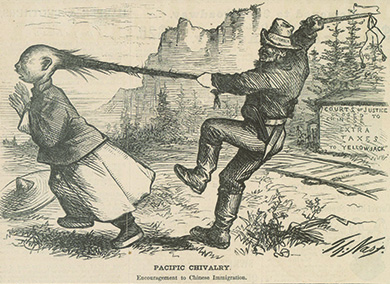
That would all change for the Han Chinese with the ascent of the Qing Dynasty in the mid-17th century. The Qing was only th latest of a long line of conquest dynasties that laid claim to the imperial throne of China... a tradition of Chinese embarrassment and subjugation that stretched all the way back to the Yuan (Mongols) Jin (Khitan) and even many of the Northern states of the 16 Kingdoms (primarily Xianbei and Xiongnu)... but the Qing were Manchu, and they would impose on the Han Chinese the infamous Queue Order (剃髮令) establishing that all men were to henceforth tonsure the front of their heads , and braid the back in traditional Machu/Jurchen style like this. This would, rather ironically, come to be known as the stereotypically "Chinese hairstyle" for Westerners who encountered the Middle Kingdom. And make no mistake: there was no option for any involved. The Queue Order (also called the Tonsure Decree) was used to identify those Han who would resist Manchu order, and as such to sport any other hairstyle than a queue would leave a man marked for execution for treason. (There were exceptions, however, for Buddhist and Daoist monks - who in stark contrast to Buddhists were allowed to keep their full beards and top-knotted hair intact)
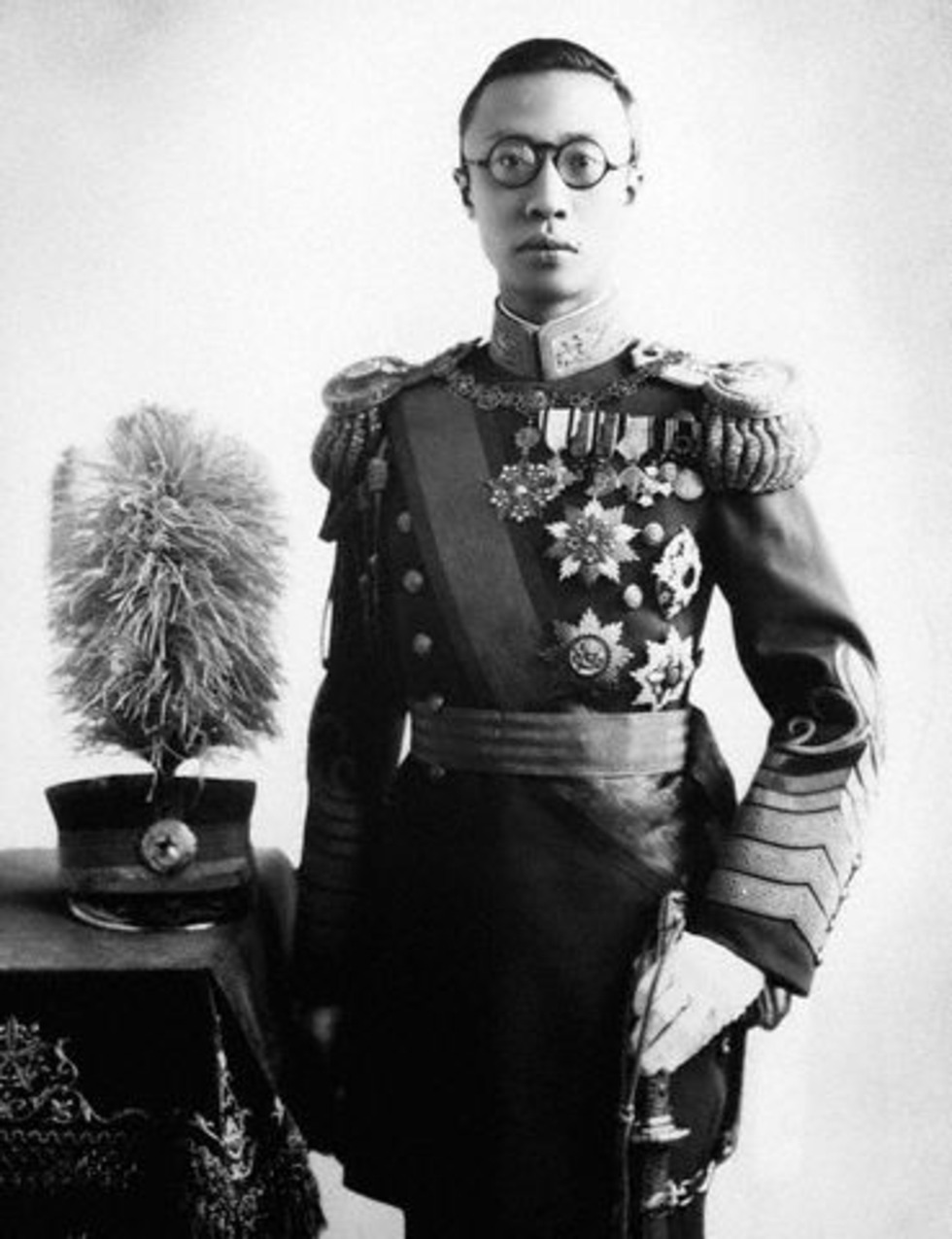
The queue hairstyle would actually (slightly) outlast the Chinese Empire altogether, as some men (including the last Emperor of China, Puyi) would sport the style as late as the early 1920's when he'd finally cut it (though at that time he was no longer the monarch, though he would later be named the puppet ruler of Manchukuo by the Japanese Empire).
But with the fall of the Chinese Empire with the Xinhai Revolution and its replacement with the Republic of China in 1912, so too died the tradition of long, braided hair for men, which was rapidly replaced with western-style cuts. To wear a queue after the fall of the Qing was quickly seen as backwards, or as a loyalist to the overthrown imperial Manchus... not a great idea for anyone living in the very nationalistic China that was once again under the rule of its majority Han people for the first time in centuries.
Hiltebeitel and Miller ed. (1998) Hair: Its Power and Meaning in Asian Cultures
The Spartans wore their hair long. When the Xerxes's negotiator came to talk to Leonidas at the hot gates he found the Spartans doing light exercise and brushing their long hair and generally making a show of not being impressed by the massive Persian army. From the text of Herodotus it is obvious that men with long hair was an exception to common Greek customs. So it really is a cultural thing and dependent on time and place.
In Okinawa?
In the late 19th century this fashion was slowly adopted by the upper classes of the Enlightenment Faction (開化党, Kaikatou) who were pro-Japan and Japanese rule. They were seeking to visibly demonstrate their allegiance and also reap the benefits of conformity to the culture of their colonial masters. Japan, at the time, was in the early Meiji period post-Restoration, and as Westernization spread through the country, so did Western-style short hair (aka 散切り, zangiri), no doubt hurried on by the 1871 Cropped Hair Edict (断髪令, Danpatsurei) which heavily "encouraged" samurai to cut the traditional long-haired top-knot and adopt zangiri.
As the country converted into a military-run empire based on concepts adapted from Western military tradition, such short hair for men was pretty much mandatory. Okinawa was a bit slower, but underwent an intense process of forced assimilation to Japanese culture and young men and upper class men similarly tended to have the short hair more often than not. But even as late as the early 20th century, you could see men with traditional-style long hair.
In short, "short hair = men; long hair = women" in Okinawa is the result of intense programs of cultural assimilation by the Japanese in the late 1800s and early 1900s. The Japanese, in turn, adopted the norm from Western countries whose global influence and authority they sought to adopt for themselves.
edit: Before that time, Okinawan aristocratic men kept their hair long out of custom, put up in buns and fastened with a pin. The pin's metal and design were a precise symbol of rank and social standing, and thus highly regulated by the royal court. This is no doubt influenced to some degree by Chinese customs, which you can read about in the excellent comment here:
https://www.reddit.com/r/AskHistorians/comments/3xyr04/why_do_women_have_long_hair/cy9q7hl
I am definitely NOT a specialist, but I'm surprised no-one talked about the differences in hair health between men and women due to the different hormones.
I think it is well known that men lose their hair way more and way earlier than women, due to hormones, and it can happen in weird patterns (at least in classic european phenotypes, it seems asian men have stronger hair)
Having long hair, with huge bold areas, and generally a poor hair health is a mess, so it only seems convenient to just keep your hair short when they are not easy to keep long and tidy.
I only hope to spark discussion on that area that strangely seems forgotten in this thread.
I'm more interested in how / why short hair became standard for men. Head hair grows naturally to a certain length without care and requires tools and upkeep to keep short, so when did cutting it regularly become commonplace? Or is this something that predates written history?
The reason men tend to have short hair in the modern world is due to military anti-lousing policies going back to WW2 particularly. Desmond Morris is a zoologist that studies human behavior and he covers this in one of his books on human intimacy.
Edit: just opened up the book to take another look at it.
He makes the case that both men and women are long-haired and this developed as a species recognition signal (since no primate has such long growing head hair), rather than a sexual one.
Recently male hair has been cut short as an anti-louse device. Women have always had moderate length hair, but males hair standards have changed vastly through history. Due to the association of long hair with females in recent times it has further ingrained the male with short hair since long hair has become effeminate.
The book is "Intimate Behavior" - Desmond Morris
This may have been going on long enough to affect evolution. Left uncut, the hair of europid males grows to about 30cm on average, while europid females grow to 60cm. This difference suggests some form of selective pressure, but without further evidence it's not possible to say whether this is selection by sexual partners for an a fairly arbitrary trait (in the way that certain birds select mates on the basis of being able to perform a mating dance); or it is an indicator of health (in that hair will only grow long if the person has been well fed and disease free over a long period) and hence a proxy for fertility; or if in some way it is functional (which could be as far fetched as long hair being suitable for bow-strings, hence enhancing survival).
Either way, we should probably be looking for evolutionary pressures interacting with current preference (at least in europids), rather than seeing this as purely arbitrary choice.