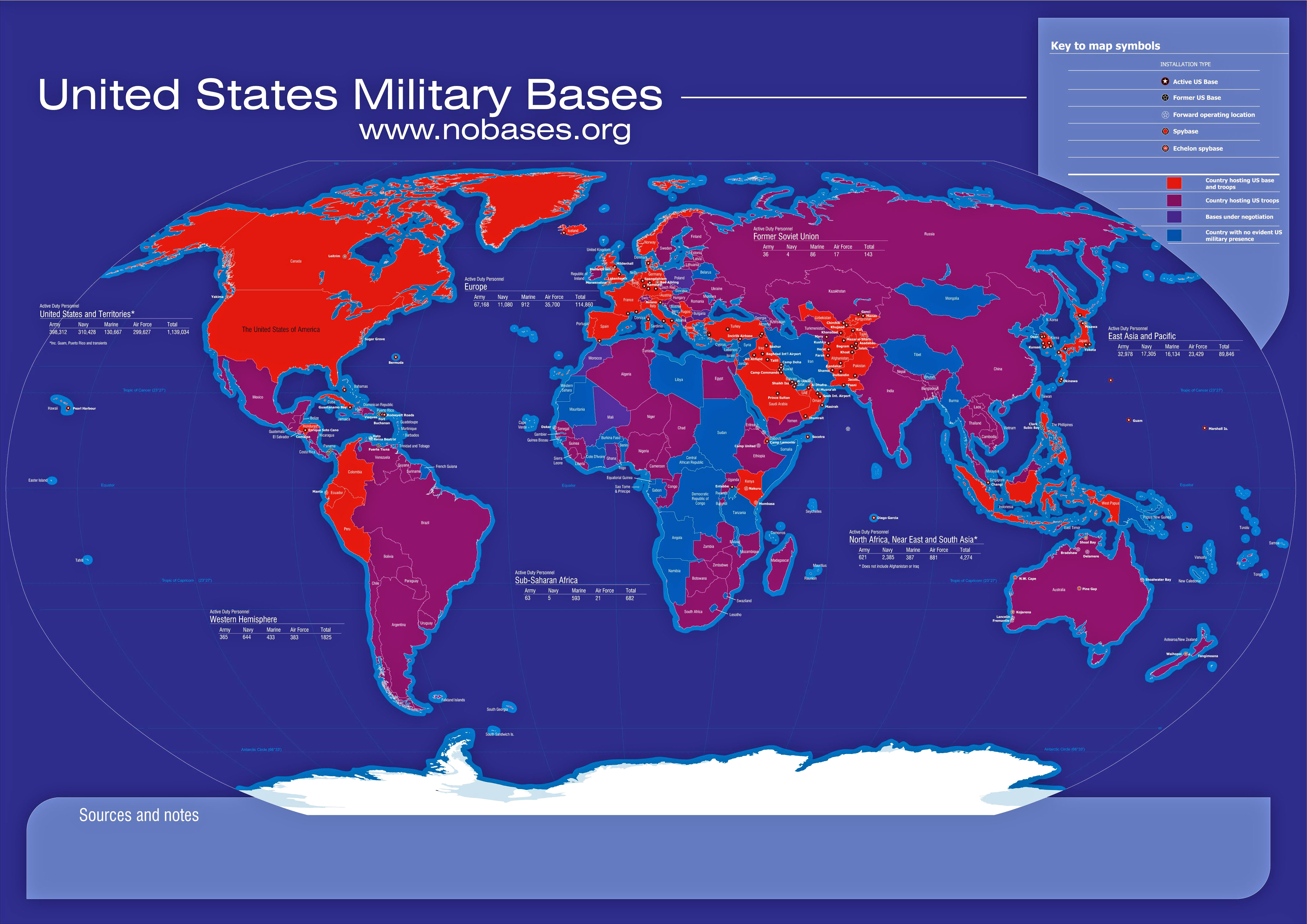
So we know that with her few remaining colonies, the sun has yet to set on the British empire. But given that america has military bases globally, could they start making a similar claim? When did the sun last on american soil?
The expression "the sun never sets on the X empire" has been famously used in reference to a number of empires, but it's generally taken to indicate the expansiveness of the colonizing nation's territory rather than the idea that the empire is fading away. If your standard for determining the size of the US empire is literally whether some piece of US territory is always in the sunlight, that's easy: yes. Guam or Hawai'i are lit by the sun when the US mainland is dark.
Over the past century, the US has moved away from a model of empire in which the "home" parts of the nation take territory and hold it and toward a model of empire that's more oriented toward police action interventions and temporary occupations. Throughout the 18th and 19th centuries, the US engaged in Indian Wars and various other territorial disputes and land purchases to enlarge its territory in what is now the lower 48 states. It purchased Alaska in 1867, the Hawaiian Kingdom was annexed in 1893 and became a US territory five years later, and in the Spanish-American War American Samoa, Guam, and the Philippines became permanent US territories while the US occupied the Philippines through the 1940s. The US also held the Trust Territory of the Pacific Islands (Micronesia) until the 1980s, and maintains a significant presence in those islands today.
But as early as the US intervention in Cuba during the Spanish-American War, and perhaps more fully with the occupation of Haiti in 1915, the US began to pursue a policy of shorter-term interventions rather than taking and holding territory. These interventions have often been motivated by a stated desire to bring political stability to enable US economic interests to operate more freely, to depose an unsympathetic political leader, to prevent the spread of Communism, to fight terrorism, or for some other purpose. These shorter-term interventions, which (like the Vietnam War) have often been extremely brutal and costly, potentially benefit the US government by excusing it from the costs and difficulties of long-term peacetime governance, make the US look a bit less like an empire on the global stage, and leave open the option for the US military to return to some of these places for some future intervention.
So while critically important events like the independence of the Philippines, the Cuban Revolution, or the withdrawal of US troops from all over -- from Iraq to Germany to Korea -- may make it appear that the US empire is sunsetting, that's really not the case. The US just exerts it global power differently from the way it did a century ago, or the way Britain did in the 19th century. As other users have pointed out, the US has maintained a large number of overseas bases since WWII. You can find a map here. Those bases along with aircraft carriers give the US military relatively quick access to "pressure points" all over the world and offer a reasonably good indication that US empire really hasn't shrunk at all -- it's just evolved into a different form.
Does a military base count as american soil?