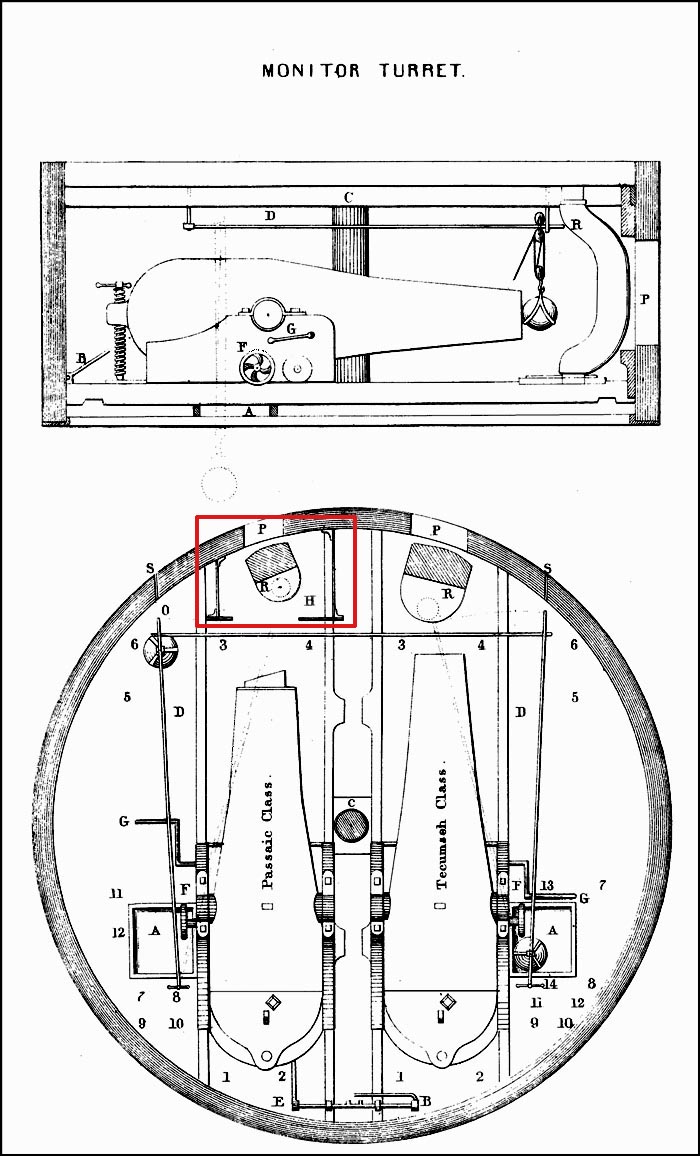
A lot of these huge (12 inch+) guns seem too big to move, and are often placed in turrets and casemates. The muzzle obviously sticks out of the turret by a great deal, the shells seem way to heavy to move by hand. How exactly were these things loaded?
Large muzzle-loaded guns were pulled (or forced by recoil) back from firing position to loading position to be loaded.
While the gun was in loading position, the gun crew would use a whisk on a bar to wet the barrel (to extinguish any remaining smoldering gunpowder remains and cool the barrel a bit) and whisk away any residue. The correct amount of gunpowder would then be placed down the barrel, either in pre-prepared sacks or as loose powder, rammed down and fixed in place by wad (often a greased cotton or wool ball). The cannonball would then be raised by pulley or crane and a clamp and brought to the barrel, be inserted and then rammed down the barrel. Another wad could be placed on top of the cannonball to fix it in place.
To answer your question - the big cannonballs of muzzleloaders were moved by pulleys or cranes, using tweezers or baskets for the cannonball.
For lighter guns and hollow mortar shells, a "stretcher" operated by one or four men would be used, or a bar with a ball "tweezer".
Here's an old photo of two men carrying a hollow mortar shell between them.
They were reloaded through a variety of means, none of which were very fast. On some ships, they were mounted on recoiling or disappearing mounts. These would use the energy of the gun's recoil to bring it back into the ship, where it could be reloaded. Shells were moved using cranes and gantries. On the very biggest turret ships, hydraulic rams were used. The turret was rotated to a particular position, and the guns depressed until they lined up with the hydraulic rams, which were in armoured chambers. The hydraulic rams carried the weight of the shell and charge. This image shows the process aboard HMS Inflexible, armed with 16in guns. This was a slow process - aboard Inflexible, it could take up to 15 minutes to load both guns.
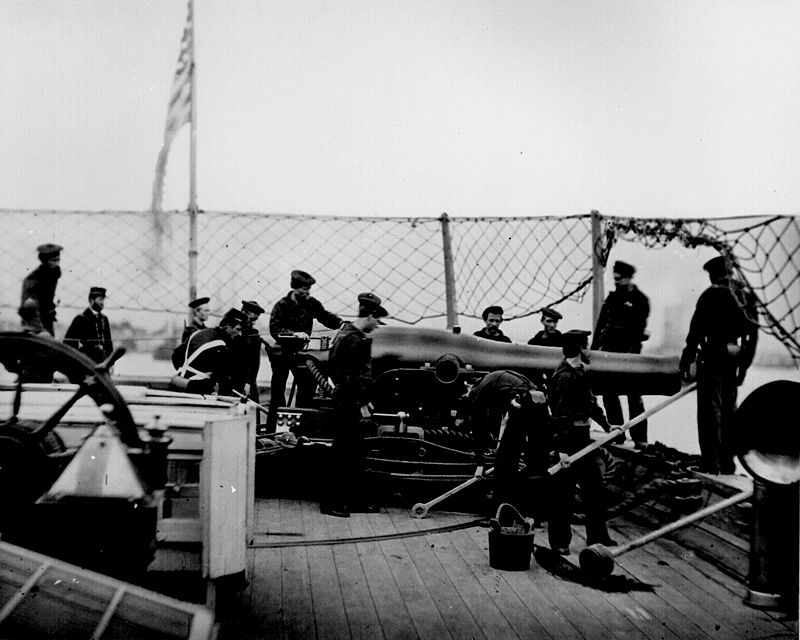
By the late 19th century, the extremely large guns were breach loading. Example being https://upload.wikimedia.org/wikipedia/commons/thumb/3/35/MuseeMarine-canon-1880-p1000439.jpg/420px-MuseeMarine-canon-1880-p1000439.jpg And other naval guns like it. Breach loading was advantagous, especially to naval weapons as it solved the problems such as reload speed and freed room up in ships by allowing the bulk of the gun to be protruding. They were also used as field guns in grpund combat. A good example is the armstrong gun, which was used in the 1870s as mainstay artillery. Even as early as the american civil war, breach loading cannons were being used in combination with rifled artillery barrels(at the time called rifles despite being artillery). Although that being said many smooth bore muzzle loaded artillery still existed and was used at that time. However, by the late 1800's breach loaded artillery became the primary method, especially so in the large naval guns you describe. If these large guns were in fact muzzle loading, the would be on wheels or runners so the recoil would bring them back into the ship to be loaded. https://upload.wikimedia.org/wikipedia/commons/thumb/2/25/Dahlgren_gun_crew.jpg/800px-Dahlgren_gun_crew.jpg Although its tough to see from that photo, the gun is intended to slide with the recoil of the shot to absorb energy and to ease reloading.
They were breech loaders; the first rifled breech loaders were trialed the 1850's by American, French and British. By the mid 1880's, they were proven technology and had pretty much superseded muzzle-loading cannon as the primary armament of a ship.
I'm assuming you're thinking about pre-dreadnought ships (USS Texas, HMS Royal Sovereign, etc), and not the earlier ironclad warships of the 1860's and 1870's? They both mounted 12"+ main batteries and a multitude of smaller batteries, all breech-loaded. In fact, the Royal Sovereign's 13.5" main guns were of the designation "BL 13.5" naval gun", Mk I-IV. The BL stands for breech-loaded. Given their projectile weighing 1200 lbs and the powder charge weighing over a quarter -ton, loading was accomplished with a variety of different mechanical and electrical cranes, elevators, and conveyors.