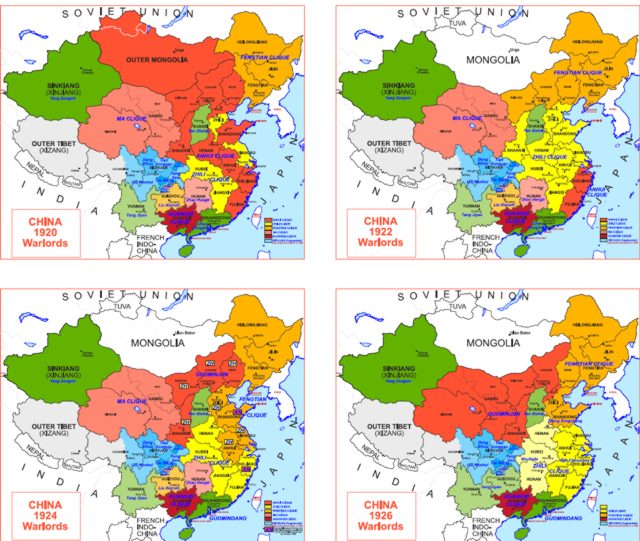
Minor correction in your title: Outer Mongolia is Mongolia. Inner Mongolia is the province in China.
The tempting way to answer this question is to make some comparisons between Mongolia and Xinjiang.
Both of those territories are similar in that they were never "Chinese", they are both steppe territories which no Chinese state had ever turned into provinces in pre-modern times, they were unsuitable for the sort of agriculture practiced in China proper, and they both had very small number of ethnic Chinese by the late 19th century.
So logically both of those regions -should- have being independent following the fall of the Qing dynasty when the central government ruled by decedents of nomadic conquerors in China was replaced by a nationalist, Republican government ruled by ethnic Han Chinese. The role of those regions as a part of the multi-ethnic Qing empire was gone and what sort of role was to be played in a nation state which excluded them was unknown. Yet only Mongolia declared independence in the aftermath of the 1911 revolution.
For several reasons Xinjiang did not go independent from China upon the fall of the dynasty or even when the Nationalist central government was weak and had almost no control over the region during the 1920s-1930s. Furthermore, just as in Mongolia, there were alternatives to Chinese rule: The Japanese and the Soviets both had interest in chipping the region away from China. The Soviets went as far as invading in the 1930s.
But yet Xinjiang was never de jure independent from China, this had to do with several factors as identified by Kenneth Pomeranz:
1) Placate/allying with the local elite, there is a strong line of continuity in Chinese policy from the Qing to the Republican to the Maoist era (sometimes the exact same people were in charge across different regimes) in which Chinese governors of the region mostly (but not always!) restricted Chinese migration as to not provoke the locals (along with other policies of course). A hands-off approach by whichever governor was put in charge of the region was expected. As a result the local elite -preferred- to deal with the Chinese government rather than full on independence. And at least enough of them preferred the Chinese government over the Soviets.
By contrast in Mongolia the Qing government had started to sinonize the region in the early 20th century in an effort to keep control over the region, by doing so they ironically provoked the Mongolian elite into declaring independence and requesting Russian aid.
2) The Chinese intellectual elite were able to convince themselves that Xinjiang was really a part of China: this is especially vital because in the 19th century the region was essentially a buffer state for the Qing Empire and there were serious talks about withdrawing from the region for a while. By the 20th century there seem to be a conviction to make an effort to keep the region.
I think the same could be said with regards to Mongolia at least superficially, but the Chinese Communist government chose to give up all claims to the region. The KMT in Taipei however theoretically still claims Mongolia as part of China to this day.
3) China was able to convince -everybody else- that Xinjiang is a part of China as oppose to a colonial possession like British India.
Obviously, this was not true of Mongolia, but it could be said that it's because China simply lost the territory too soon after the 1911 revolution.
So I think of the three reasons, they key reason really had to do with how the Qing government dealt with the local elite in the early 20th century and threatening to turn Mongolia into an ethnic Han majority province (as they already did with Manchuria) and pushed them into the anti-Chinese camp. Whereas in Xinjiang this process was mostly resisted until the 1980s. Yes, Soviet support was crucial for Mongolian independence, but yet the same sort of armed support was in place for Xinjiang (and was for a period of time during late 30s-40s when Xinjiang was a de facto Soviet satellite). But the local elite never declared independence except for one small separatist group and therefore allowed for China to play the waiting game in the 1930s-40s until they were strong enough to reclaim the region. At the same time, I can't think of too many pro-Chinese Mongolian elites after 1911. The opinions of said elites was the crucial factor in the contest over the fate are periphery regions where the ability of central governments to project power was relatively weak.
I think the OP is operating under the false premise that "Mongolia" was able to fully achieve independence, seeing as how nearly half of it is in another country. Consider a hypothetical reunification of Northern and Southern Koreas, however North Korea is completely annexed by China, therefore leaving only one Korea, that is the South, hence "unified". Seems rather ridiculous doesn't it? There is a country called Mongolia today, but it in no way encompasses all Mongol subgroups or even all of the historical territories of Mongolia Proper.
Well, Xinjiang and Tibet did actually enjoy brief de facto independence periods after the Qing dynasty kicked the metaphorical bucket.
The Tibetan State after the Qing fell was mostly unrecognized, being claimed by the KMT government of China, and recognized as such by most of the world.), but enjoyed de facto sovereignty, although there was some British influence drifting up from India, although I don't know the level to which this was. Tibet, although unrecognized, effectively operated as a sovereign state for about 40 years, until after the Chinese Civil War, when, as part of Mao's goal to "unify the motherland", Tibet was invaded and annexed, becoming the modern day Xizang Autonomous Region. In 1959, the Tibetans ha a brief uprising, with Indian and American support, mainly among the Chushi Gangdruk, guerrilla fighters who sought to overthrow Chinese rule in Tibet. This was unsuccessful.
Xinjiang had two periods of independence before ultimately being absorbed into the PRC. The first, existing from late 1933 to early 1934, started out as an Uyghur rebellion around the Kashgar region, and attempted to found a sovereign Islamic Uyghur Republic, until they were attacked by Hui warlords, who were allied with the KMT, bringing Kashgar back into Chinese hands.
The second East Turkestan Republic was a Soviet satellite state centered around Ghulja or Yining, in Xinjiang's north, modern Ili prefecture. The second republic was born out of a Soviet-backed uprising in Ili, and was effectively a puppet of Moscow. In August 1949, just before the end of the Chinese Civil War, the PLA marched into the ETR, which, at this point, had more or less collapsed, while at the same time pushing the KMT out of Xinjiang. The old leaders of the Republic were killed on Stalin's orders, when their plane was shot down.
(Outer) Mongolia's independence was actually short-lived at first, with ROC forces of the Beiyang government occupying the country from 1919 to 1921, and Mongolia's independence was only revived with the help of Baron Von Ungern's white army, which helped to restore the Bogd Khan, and with it, Mongol independence. Only a few years afterward, in 1924, the MPP overthrew the Khan and made Mongolia a communist state with Bolshevik assistance, making Mongolia effectively a Soviet satellite.
So, why did Mongolia manage to retain sovereignty while Tibet and East Turkestan ultimately fell to the PRC?
The two biggest reasons were probably the matters of recognition and influence. Mongolia was a recognized nation by most of the world, whereas Tibet and the two ETRs were not, giving them legitimacy as a state in the eyes of the international community. The reason of influence, which was probably why Mongolia maintained it during the tumultuous years of early Communist Rule, was that the Mongol People's Republic was backed by the Soviet Union, which, until the Sino-Soviet split, was Communist China's most valuable ally. Stalin had actually adamantly pressured Chiang Kai-Shek to recognize Outer Mongolia's independence shortly after WWII, and when the regime changed in China, Mao's government kept the same position on Mongolia that their ally had forced their adversary to adopt.
EDIT: fixed year of fall of Second ETR from 1959 to 49.
Modern Mongolia was created as a buffer state between the USSR and China/Japan.
It was originally integrated with China in 1206 as a the conquering Mongols. After the collapse of the Mongol Empire, Kublai Khan consolidated the Eastern holdings and founded the Yuan. Mongolia was firmly within Chinese control until 1920 http://www.euratlas.net/history/hisatlas/china/192620TukiunTRZ.jpg
In 1921, as China enters into general chaos (with Japan pushing further into Northern China) and Chinese "warlords" splitting the country into a massive Civil War http://interwars.weebly.com/uploads/2/3/3/6/2336762/9437931.png?391x361
Mongolia takes this opportunity to break away and seek help from the USSR (to protect themselves from both China and Japan), the USSR gladly accepts.
Mongolia achieves independence (in 1921) and is made into a Soviet Satellite State 3 years after (1924) http://www.zum.de/whkmla/histatlas/russia/cccp1924.gif
As a related question, since it's comes up, why did only part of Mongolia become an independent state, and not Inner Mongolia as well?