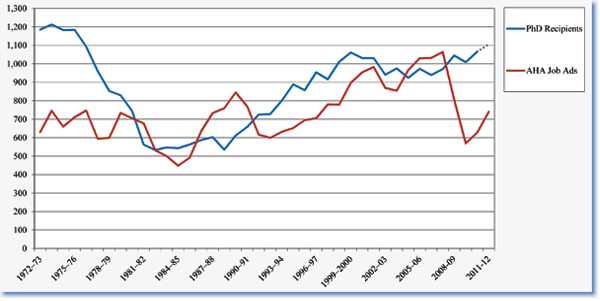
Dear Historians, I am currently in the process of completing my MA in history at a pretty solid university (a plan I devised to make my applications to Ivys, etc more competitive) and I've been trying to determine if my dream to join the historical profession is worth pursuing in the twenty-first century academy. I've read some articles like:
http://northwesthistory.blogspot.com/2011/11/open-letter-to-my-students-no-you.html
which are most optimistically saying that "there was sort of an increase in entry level hiring in 2012, but there was a higher increase in PhDs conferred and the job market is cloudy"
and most pessimistically saying: "the historical field is essentially dead and this is the last generation of conventional, tenured, professional historians in existence."
My teachers in the program give me answers like "the job market is hard, but not impossible." This is the view of middle-career professionals in tenure-track positions at an Ivy league school. I do not know if it is reflective of the field at large.
Tl:dr: Does the job market for history look like it will be heading to 1990s level-crisis, or worse? Is the professional historian an endangered species? Finally, do PhDs from higher-prestige institutions (U Chicago, Harvard, Yale, Columbia, Princeton, etc.) provide any insulation from the hellish job market, or is everyone in this together?
I love history. I really really want to do this. But I have to accept defeat if that's whats in the cards.
Former anthro. PhD student at an Ivy...
Here are my thoughts: a prestige degree used to more or less secure a middle to top tier job after one postdoc. Now, at best, it makes it easier to get a job, though increasingly not one in the top tier or even at a research school, after two to three postdocs.
The one possible exception is if you are working in an in demand subfield (often tech related).
It's still possible to get a good job, but you need to be top of the top or really enjoy teaching (as research gigs are few and far between). And you need to have a partner who is ok with regular moves.
And you need to be prepared to compete for small pools of funding (so it's important to choose a research area that you can get funding in).
It's still possible, but you need to be prepared to worm incredibly hard and not let up for about 10 years (without counting tenure) for very little financial reward or security.
I was in a similar position as you about 9 years ago, having just finished a BA/MA program in 4 years. I had good German language skills under my belt and I was about to apply for a PhD programs. My current program even offered to fund me to finish my PhD at school. Instead, I chose to spend a year away. I thought that getting a bit of perspective would really help inform what was going to be a very important decision in my life.
I spent that year working as a project manager. I strongly disliked my job and the city I was in. After the year was up, I moved home determined to apply to graduate programs. I even took the GRE and scored well. In the end, however, I didn't apply anywhere. Instead, I found myself getting very interested in other things -- marketing, advertising, and programming. I built up those skills and, in the last 8 years have built a pretty good career that I really like.
I still love history. I still read as much as I can, but I made the right choice for me. The non-academia world has challenged and stretched me in ways I would have never experienced had I stayed in school. I have to manage people, deal with deadlines, and am responsible for a product that has nearly 1 million active users a month. It's pretty cool! And, while money isn't everything, making six figures for the past few years has really helped me. I can travel. I can save. It's very nice to not be worried about money or moving or anything like that.
Friends I made during my combined BA/MA stayed in the program to finish their PhDs. I believe all of them have now found jobs, but none are tenure-track. One works in publishing. Another teaches. They seem to be happy.
You can definitely make it work if you want to, but I'm certainly glad that I put some thought and time into my choices before diving in. At the time, I felt boxed in. I felt like a PhD was my only true path forward. I'm very glad I got out of that mentality.
The problem is that nobody can really predict what the market is going to look like in 6 or 7 years, when you have degree-in-hand and are a competitive candidate. Try imagine how you would project this graph forward. Is that "lag" of PhDs without jobs going to just vanish? Or are they just doomed to endless adjunct (non-tenure track) positions? Is the number of PhD graduates going to drop anytime soon?
Having a high-prestige PhD does help but it is not insulation. It gives you an advantage against those without such degrees. But there are many people with high-prestige PhDs competing against one another for every job. At my high-prestige institution, we were acutely aware (circa 2010) that we were competing against our peers down the hall for every job. It made for a stressful environment. It also meant we had all the same recommenders and that diluted their ability to have an influence, as well. Having the prestigious degree helped (but did not guarantee) that we made it past "the first cut" (that is, we got some sort of early interview), but after that, there are no guarantees.
I don't think the "historical field is essentially dead," or we're at the last generation of tenured professional historians, etc. That's nonsense. But we are in a phase where more and more labor is taken up by adjuncts, and the number of tenured lines is low. That means that there is going to be huge risk involved in taking a PhD in history. It does not mean that people will not be willing to take that risk. But a lot of people are going to get PhDs and not be able to get tenure track jobs. The jobs just do not exist for all of them — it is a mathematical impossibility — but a few of them will still get jobs. As long as universities can still convince some students that grad school is a good idea (and they show themselves good at that), there will be a pool of applicants, for better and worse.
Anecdote time: I started grad school (at a prestigious Ivy) in 2004, so was mid-way through the degree when the crash happened. Of my subfield's cohort of eight, three ended up with tenure track jobs by 2015 (and of those 3, only one had the job within 4 years of graduating), two at prestigious schools, one (me) at a less prestigious one (though I would posit that prestige can come with its disadvantages, for junior scholar).. The others did not fall off the Earth and die, of course, and some of them are, I know, very happy with their jobs (one basically runs a museum at this point, another works for the State Department). Some have somewhat marginal employment (e.g. adjuncting). Those aren't great odds, but they're not apocalyptic. But that's how things are at the top, at least for people who graduated about 5 years ago.
Anti-anecdote time: When you talk to people who have tenure track jobs (like advisors), you are already talking to people who have succeeded at the system. My experience is that many of these people conclude that things "aren't so bad" or even that "the system works" once it has validated their own decisions/choices. (It is easy to do this, when you make a narrative about yourself — to say that you did things "right" as opposed to "got really really lucky because it can be extremely arbitrary.") In my experience many advisors are pretty removed from the real-world realities of the job market (they write letters and try to help students, but they aren't actually facing that uncertainty themselves, or are as strapped for cash as an endlessly-adjuncting postdoc is), and are entirely removed from knowing what kinds of options there are outside of academia (because frankly they haven't usually had to pursue any). This isn't really their fault, but it is a limitation. Take their input (and mine, too!) with a grain of salt.
Anyway, it's not "dumb" to pursue a PhD. It's not "dumb" to try and become a professional musician, or artist, or dancer, either. But you should have a good understanding of what you're getting into if you decide to do it. It's not an easy ticket to a straightforward, middle-class career. There is a lot of uncertainty involved.
A few things are relevant to consider, beyond getting into a top-tier school. Your stepping-stone strategy is actually the same as mine was: I went from part-time community college, to regional public university (BA), to big state university (MA), to public Ivy (PhD). I'm now freshly tenured at a PhD-granting university, and we recommend the same thing to most people who are dead set on applying here for graduate study: we will admit some MAs outside of our two or three strongest fields, but we make it clear that we expect them to move on to a better-fitting PhD program if that's their aim. We also do a lot of dissuading of those applicants who will not benefit from having a history MA from us, or those undergraduates who want to continue on but can't improve their standing.
One thing that matters is what your subfield is. Some, like Islamic history, have a pretty good ratio of qualified applicants to jobs. Others, like 20th-century US diplomatic or Soviet labor history, are either extremely crowded or shrinking in terms of opportunities. I do not mince words when I get a student who is interested in studying something that is too competitive or simply dead in terms of hiring. You should have a good plan B on the skids anyhow. Your professors are right that the market's not impossible, but I do think it's harder than a lot of them may realize.
If you do go on to a new program, the standard advice applies: don't go to places where they don't offer you enough multi-year funding with dedicated research support to avoid debt, or to programs that are not within the top ten in your particular field. This doesn't always mean Ivy League proper; public upper-tier schools like Michigan, Wisconsin-Madison, UC-Berkeley, Rutgers, and so forth have specific programs that have excellent placement. Your MA advisor should be able to tell you more. Shop carefully, make direct contact with potential advisors and programs, and verify that the fit is a good one. Too many people just launch sheafs of applications into the wind and end up somewhere that they're miserable. Grad school is stressful enough without those worries, as you already know.
So in your hopeful field, can you find a good advisor with pull at that top-tier school? How's the department's placement in your field, and specifically for that advisor's students? This is relevant if you're really set on the academy as the only thing that could possibly make you happy. That pull is more important than most of us realize in terms of networking. For Africanists, for example, the Wisconsin Mafia is multigenerational; I had three Madison grads on my committee, and search committees included people who knew them personally more than a few times. That fact gave their letters and phone calls a lot more heft. Finding a job should be all about merit, but in practice, networking is at least as important. Luck is the other big factor, though you can help to tilt the odds by publishing and becoming an active and innovative scholar in other ways (public history, digital humanities, unique additional qualifications, etc). I actually landed my job during the terrible, awful, no-good job year that /u/restricteddata talks about below--2008-2009--because of all these factors plus the generally better odds of being an Africanist.
You should also bear in mind what others have mentioned, that an increasing number of other opportunities exist for PhD recipients in history. Had I not landed a tenure-track job, I was lined up to continue in editing and annotation for a documents project, which would have been OK. Friends from grad school ended up as paralegals or, in one case, actually going into law. Another became a documentary film producer and independent author on environmental subjects, and has done extremely well compared to those of us who stuck to academia. The skills you will acquire, and the new kinds of exposure to ideas and subjects, have a wider application than most academic advisors generally realize. The failure to adequately diversify grad professionalization is a major problem for our program as well as many others, but we are working at it.
In general, I feel that while the job market is certainly better than the crash of 2008-2009, it's still worse than the 1990s overall. The promised "wave of retirements" we expected going into grad school never came, and many replacements took the form of exploitative contingent (adjunct) labor. I think the gloomiest predictions about the end of the professoriate are unduly alarmist, but at the same time the profession's profile continues to change in unfavorable ways for aspiring scholars. Pursuing the PhD is risky, and full of pitfalls, but I'd encourage you to talk to people you might work with at those other schools before writing off the option entirely--you will probably never have the freedom to pursue that path again, so you should make your specific decision with the best knowledge you can. Good luck!
I'm a PhD student in History at a top 20 school with a very good placement rate. I came at this with just a BA from a small lib arts college, so I'm in a different position than you, but I'll give my two cents. If bad job prospects are enough to dissuade you from applying, don't apply. You need more motivation than just practical considerations because as a practical matter--financial security, free time, not being miserable--grad school absolutely isn't worth it. Even if you get a tenure-track position, things don't get easier at that point. But it seems like you should already know these things as an MA student... I know that different programs are different intensities, but if five more years of your current existence sounds bearable, and if you actually do want to be a professor, then you should apply. If you want to be a healthy human being with stable job prospects and an income above the poverty line, maybe it's not for you.