And in such a circumstance would the average person in a village know about it? What about in a city?
according to NASA:
...
The diameter of the Earth's shadow at the distance of the Moon is over 12,000 kilometers across. This makes predicting lunar eclipses a very forgiving enterprise even when you do not know the precise details of the orbit of the Moon. For total solar eclipses, however, the shadow of the Moon upon the Earth's surface is only about 300 km across. At the distance of the Moon's orbit, this subtends an angle of less than 1/20 of a degree of arc. To forecast a solar eclipse, you would need to know the details of the lunar orbit to at least this degree of accuracy.
...
Only after the lunar orbit was observationally determined, and the changing speed of the Moon and the Earth in their orbits, were established, could total solar eclipses be reliably forecast to within the nearest month or less. This level of astronomical sophistication was apparently reached by ancient Greek astronomers around the first century BC, and several centuries later by Chinese astronomers based on surviving records. http://image.gsfc.nasa.gov/poetry/ask/a11846.html
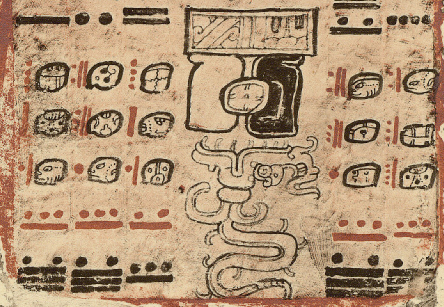
Alongside Greek and Chinese astronomy, Maya astronomers independently developed a method for accurately predicting solar eclipses. In particular, there is a very accurate table in the Dresden codex that predicts eclipse dates to within a few days during the 8th century A.D (though the written copy of the codex we have probably dates to much later, in the 14th-15th centuries, it likely was copied from an earlier work).
During the approximately 33 years between November 10,755, and September 6, 788, all of the 77 solar eclipses affecting the planet occurred within three days of dates appearing in the table. Although most of these eclipses did not affect the Maya area, the table itself provides a mechanism for recognizing and discounting irrelevant predictions.
This is an image of part of the table. Note the symbol above the open snake's mouth. That is the glyph for "sun" (k'in in Maya) with the addition of a dark right half and white left half, representing an eclipse.
As for who would have known, we don't really know that, but the people who would have been calculating the dates of eclipses would most likely have been priests or other religious officials. How far down into society that information trickled is up for debate.
Source: Bricker, Harvey M., Victoria R. Bricker, Anthony F. Aveni, Michael P. Closs, Munro S. Edmonson, Floyd G. Lounsbury, Eric Taladoire. 1983. Classic Maya Prediction of Solar Eclipses. Current Anthropology, 24(1):1-23.