Media has shown that ancient currency was often coin but even valuables could be used as currency, such as a silver goblet being a 'piece of silver'.
Is this an accurate representation and if so what happens to said items? Do they get melted down and repurposed as coins? Or could these items have still been used as currency itself?
To answer your question, let’s look at ancient economic exchange and the rise of coinage in the Ancient Near East.
Prior to standardized coinage, economic exchanges used weighed measures of silver, in broken pieces called hacksilber. As King and Stager write in "Life in Biblical Israel":
weighed metal (usually silver) was used as "money" for transactions in the Ancient Near East (p. 174)
The silver hoards that we have found archaeologically are basically full of pieces of silver, pieces of jewelry, and cut pieces, all small. These would have been placed one by one into a scale pan, and weighed against a stone or lead weight of standard measure (usually measured in "shekels", which was a basically standardized weight across much of the Ancient Near East), much like this weight with a shekel marking. If the silver pieces were too big or heavy, they would be cut to size, so that the appropriate weight of silver would exchange hands. The scale weighing process would have looked something like this, with the standardized weight on the left, and the silver pieces on the right.
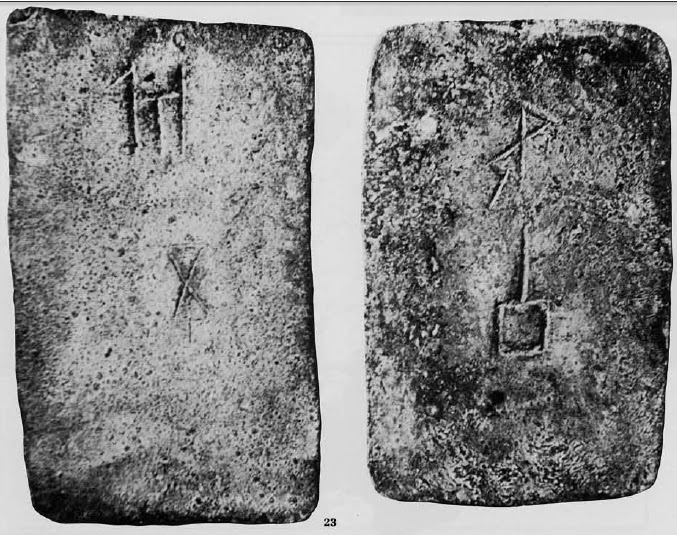
Eventually, people decided that they could cut out all that annoying cutting and weighing by making their metal into standardized pieces marked with their weight. They were already doing this with ingots of raw materials (such as copper/bronze, glass, tin, etc), so the concept wasn't that much of a stretch. The practice appears to have originated among merchants, as they used small silver blobs or "dumps" as a sort of pre-coin, but had to be stamped in order to help with acceptance as a mark of standardization. It was these metal quasi-coins that began to gain prominence, gradually and through use over time, until the rulers of the Anatolian kingdom of Lydia developed official examples of standardized weights of precious metals for use in economic exchanges, minted and marked with official markings to approve their value (Glyn Davis, History of Money p. 62). This occurred approximately 550 BC, though the concept of coinage took some time to spread throughout the Ancient Near East and fully supplant the hacksilver weighed metal system. Coinage was a logical next step after the practice of weighing a certain amount of metal out for an exchange. It was much easier to simply possess small pieces of metal which were already weighed and marked by the government to ensure their accuracy and trustworthiness. It was much easier to conduct transactions with pre-weighed pieces of metal which had been certified by a public institution than have to weigh out bits of metal. Note that values of money were still based on the value of the money within the coin itself, rather than an agreed-upon “face value” of the coin.
Other ways of purchasing remained alongside the coins for a long time. Other groups did not begin using coins for hundreds of years. The Romans, for example, did not start using coinage until approximately 300 years after the Lydians, and therefore international merchants would have had to be able to deal with not only the coinage currency, but also hacksilver.
Now, I’m not sure where exactly you’re getting “Piece of silver” from, but it would probably be referring to a pre-measured amount of silver, such as a coin. Prior to coinage, as we have seen above, silver would be measured in weights, rather than numbered pieces, so a purchase might cost thirty shekels of silver, not thirty pieces of silver. Once coins were introduced, and the “pieces” were standardized official measurements (generally after 300 BC, to give a VERY general date), then one might get discussions of “pieces of silver” used in transactions as opposed to weights. Perhaps from an art perspective, you might get cups or bowls or other silver articles to be referred to as “pieces”, but in an economic framework, such inconsistency of value is not practical.