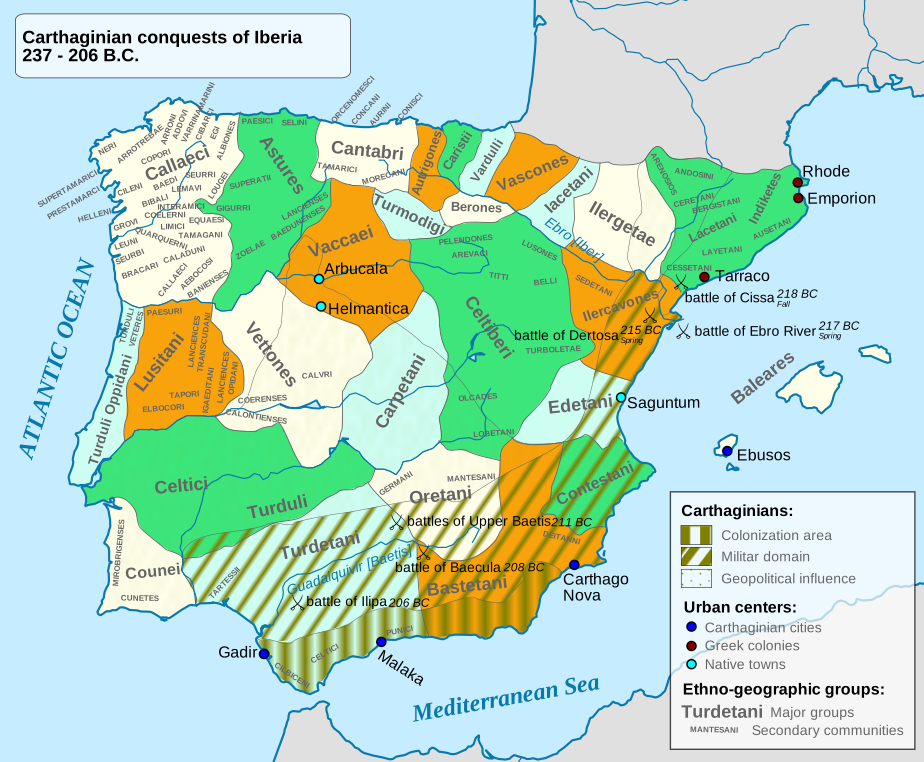
I was brushing up on the Punic Wars and saw a Wikipedia map that shows Roma and Carthage. It shows Spain to be under Carthaginian control surprisingly far inland.
What was the Carthaginian presence in Spain like up until the Punic Wars? Was it like Roman colonization where Romans went there to live as well as improve on and extract the resources of the region, or was it more like Spanish colonization in the 1500's where the colonizers came mainly just to extract resources? Also how firmly was Spain conquered?
You may find something like this map to be a better representation of the complexities of Carthaginian Spain.
Carthage did have true colonies in Spain. But they were limited to the SE coast between Gadir and New Carthage. They also had a band of conquered territory. This was populated by native Spanish peoples, with very few Carthaginians present on the ground. This area was largely conquered in the period between the 1st and 2nd Punic wars. So Carthaginian rule was recent. And this conquered area was largely still directly ruled by local Spanish elites. Their loyalty was insured by relatives held as hostages in the true Carthaginian towns. There was also a third area where Carthage had influence, if not outright control. This was maintained through a complex web of alliances, trade agreements, etc.
Even this map I have linked doesn't really show the complexities on the ground. All of this was done on an ad hoc basis. One town might be Carthaginian, one neighbor ten miles inland might be conquered. Another town between them might be allied. And the truth of the matter is we don't really know the details. Records from the area are sparse. Archeological digs can only tell us so much. If we find Carthaginian coins in a town that lets us know they were part of the Carthaginian sphere. But it doesn't tell us if they were a Carthaginian town, a conquered town, an allied town, a trade partner, or something else. So these bands designating different territories on the map should be taken as estimates at best.
There had been a Phoenician/Carthagenian presence on the peninsula already way before the Punic Wars, and the Barcid expansion on the 3rd century. Like Greeks and Massioliotes, they had founded colonies in Spain during 7th and 6th centuries BC already. We don't have literary sources to this period, so it's difficult to say, whether the Phoenicians had some 'grand strategy' and weather the colonies were somehow controlled from a Punic center in Africa, but I believe they were comparable to Greek colonies: independent states, that had links to the mother-states mainly through culture and trade. Phoenician ruins do not really survive from this era, and we know their presence mainly through grave goods. It looks like the Phoenicians were mainly driven by the rich natural (especially mineral) resources of Spain, and 7th century grave goods have been found in tombs from Gades (modern Cadiz) and Sexi (modern Almunecar), and it is likely that Abdera and Malaca (Phoenician settlements) were also founded on this early era of colonization. We don't really know what kind of relations Phoenicians had with the indigenous peoples of Spain, but the Phoenicians seemed to have been quite content in their little settlements in a limited area and so any sort of imperialist expansionism wasn't really happening during this period.
So, by the time of Carthaginian active expansionism in Spain started, it cannot really be called 'colonization' in the European 1500's sense as they had lived on the peninsula for a good 400-300 years already. The Carthaginian state found newly incited interested in the Iberian peninsula in the 3rd century after their loss by Rome in the first Punic war (264-241), the problems caused by the harsh war against Carthage's own mercenaries in Libya (241-238) and the loss of Sardinia to the Romans (238-237). Sardinia had been an immensely important source of resources to the Carthaginians, never mind strategically crucial in their conflicts against Rome, so, they needed a new economic huddle to call their own.
In 237, Hamilcar Barca was sent to Spain, where, accompanied by his son Hannibal, he 'recovered', according to Polybius, 'Carthaginian possessions in Iberia', by a combination of war and diplomacy. (Polybius 2.1.5-9; I'm not really sure why he uses the word 'recovered'; perhaps in the meaning of establishing state-control over the existing Carthaginian settlements?) Later sources (eg. Diadorus, Appian, Livy) ascribe to him a policy of ruthless plundering of the helpless Spaniards, and of torturing to death their leaders while enrolling their men in his own army - but, it's a bit difficult to say whether this was actually the case or just typical Roman anti-Punic character assassination. The truth is that the Carthaginian 'control' was often actually just close relationships with the Spanish nobility, and most of the 'conquered' territory wasn't ruled by the Carthaginians. In general, it's really difficult to assess the Carthaginian enterprises and relationship with the Iberians, as our only sources are Greco-Roman. Here's a crude timeline of Carthaginian expansionism: (I'm paraphrasing this from J.S. Richardson's Hispaniae, p. 19 ff.; Richardson is my academic crush when it comes to Spanish antiquity. <3)
During the nine years Hamilcar Barca commanded the Carthaginian forces in Spain, he succeeded in bringing the Baetis valley under his control and in extending his power up the eastern seaboard as far as the modern Alicante, which he founded and established as a fortified post on the coast nearest to Carthage.
Hamilcar was succeeded by his son-in-law Hasdrubal, who continued the policy of extending Carthaginian control in southern Spain. The sources indicate that he relied on diplomacy as well as on warfare; Diodorus states that he married the daughter of an Iberian king and was acknowledged as supreme general by 'all the Iberians'.
Hasdrubal strengthened the Carthaginian position on the Mediterranean coast by the foundation of a town called Carthage, known to the Romans as Nova Carthago, today Cartagena. This is sited even more advantageously than Alicante for contact with African Carthage, and has a magnificent harbour. Here he built a strongly fortified city, including a 'royal palace', which may have lent further credence to the view, elaborated by the near-contemporary Roman historian, Fabius Pictor, that he was aiming at the establishment of a dynasty in Spain. Certainly the Barcid family were intimately connected with Carthaginian rule in the peninsula. When Hasdrubal was murdered by a Celtic slave, he was replaced by Hannibal, who also married a Spanish princess. The link was continued after Hannibal's departure for Italy in 218, for he left his brother Hasdrubal in command in Spain, and subsequently sent a third brother, Mago, to reinforce him. Mago was the last Carthaginian commander to withdraw from Spain in 206, following the victories of Scipio at Baecula and Ilipa.
What was the nature of the Carthaginian reign, then? Direct quote from Richardson, p. 20:
Without going so far as Fabius Pictor, and imagining a private kingdom being set up by Hamilcar Barca and his family, there is no doubt both that the Carthaginians established control of at least the Baetis valley and the east coast south of Cabo de la Nao by military and diplomatic means, and that the main executants of this policy were the Barcids.
So, if we date the 'Barcid expansion' from the arrival of Hamilcar in 237 to the expulsion of Mago in 206, the Carthaginians only really had an active expansionist policy in Spain for about 30 years. However, the Second Punic War broke out in 218 BC (not going to go into details why because that's a long answer of it's own, but, shortly simplified the reasons were exactly the tensions brought about by the growing Carthaginian power in Spain, culminating in the sack of Saguntum), and so the last 12 years of the Carthaginian Spain were really about trying to defend their existing territory in Spain, campaigning in Italy etc. rather than expanding in Iberian peninsula.
As an addendum to what's already been said, Spain was colonised by Carthage but only for a relatively short time (575 BC - 206 BC; 369 years) from the end of the first Punic war (specifically the " Battle of the Egadi Islands") until the Carthaginians were defeated again in the "Battle of Ilipa" the decisive battle of the Second Punic war.
5 years after Carthaginian defeat, in 201 BC a peace treaty was signed between the Carthaginians & Romans. In this treaty Carthage were forced to hand over control of Spain to Rome turning it into the Roman province of "Hispania".
3 years before the handover of Spain, in 204 BC Roman general "Scipio Africanus" took the war to Africa & specifically Zama (What is now "Tunisia") where Scipio defeated Hannibal the war would now take to the sea & the coastal lands of Ilipa. Once the handover had taken place Scipio founded the city of "Italica" (in the modern-day "Seville Province"). Journalist & Author, Simon Sebag-Montefiore states that the Romans preferred Hispania to the rest of their republic, Sebag-Montefiore stated that the romans called it "more Italian than Italy".
~ My entire knowledge of Carthaginian Spain's rise, fall & the creation of Roman Spain comes from Simon Sebag-Montefiore's BBC documentary series Blood & Gold: The Making of Spain which chronicles 2,000 years of Spanish history from it's relationships with Carthage & Rome to the Islamic conquest, the Spanish Inquisition up until the end of Franco's regime in 1976.
You can watch the 3 part series here: episode 1, 2 & 3. This series was produced in partnership with the Open University who have a page detailing more on what's discussed in the series, you can view that here