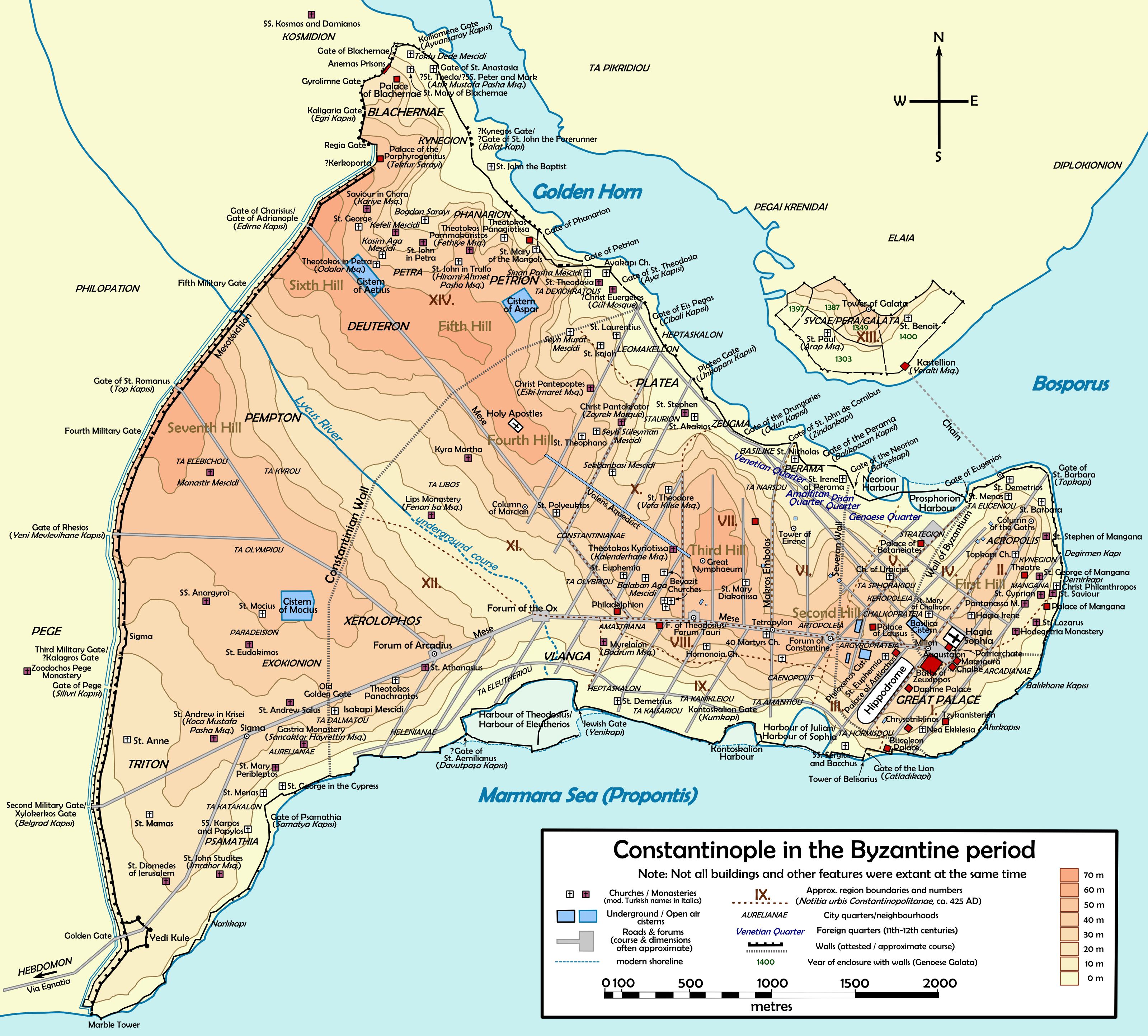
Seems there were a lot of churches active in Constantinople during the middle ages. Granted, not all of these were active at one time and "medieval Constantinople" stretches over a thousand years, but what determined where Average Joe Constantinopolitan went to for services? Did people attend their local community churches? (was there such a concept)? Who went to masses at Hagia Sophia? Was it just reserved for the higher echelons of society? Did people go to services at some churches for some events and others for others?
Did the Orthodox churches in the city have any sort of hierarchy (aside from the Patriarch?)? Were masses uniform in any way (I know there's a liturgical calendar, but were there any attempts to unify the contents of, say, homilies?)
I'm sorry for the bazillion questions. This is a topic I'm finding myself suddenly particularly interested in learning more about.
I don't feel sure enough to answer all of these questions completely, but I might be able to elaborate on a few points.
1.) Did people attend their local community churches?
The idea of a parish (paroikia) existed in the East just as it did in the West. We know from monastic typika (rules) that monks were expected to minister to nearby communities, including work as priests or spiritual tutors. After being ordained, priests (and presumably other orders of the clerical hierarchy - see below) were theoretically bound to their parish. One problem is in defining what exactly constitutes "local" in an urban environment like Constantinople. Byzantines and Latins both remarked on the number of churches in the city; there would seem to be plenty of options to choose from if you just happened not to care for the one closest to you. There may have been churches frequented by specific nationalities: we know that the Varangians had their own church in Constantinople (as well as further afield, like Crete and Taranto), and that at one point there was even a mosque (though that was more of a political statement than a religious one). Provincial parishes could certainly complain about unsatisfactory prelates, implying that they did (or simply had to) go to the most local church and weren't happy about the current situation - but I'm not sure if the same is true of Constantinople, simply because it had so many choices to offer.
2.) Who went to masses at Hagia Sophia? Was it just reserved for the higher echelons of society?
The Hagia Sophia had huge symbolic and religious value for the city as a whole. It wasn't the only imperially-sponsored church in the city - the Church of the Holy Apostles was originally built by Constantine I, and the Church of Blachernai dates at least to the time of Leo I in the 5th century - but it was close to both the Hippodrome and various imperial residences (e.g. the Boukoleon, the Great Palace, the palace of Mangana, etc.). There were certain occasions on which more of the "common" populace might make it inside (like great feast days, thanksgiving services, or installing a new emperor) - but the population of Constantinople could be relatively high for a medieval city, and the Hagia Sophia is only so many square feet.
3.) Did people go to services at some churches for some events and others for others?
Absolutely. The most obvious example I can think of for such a practice is the apparently miraculous icon of Mary in the Church of Blachernae: according to Michael Psellos the icon's silken cover regularly levitated away each Friday evening to reveal the icon to the faithful crowds who gathered to witness the event (you can read about it here, in paragraph 5.4). Other icons, which were held in churches (monastic or otherwise), could be carried around in processions from church to church, e.g. the Tuesday procession of the icon of Mary Hodegetria, instituted by John II (r. 1118-1143), from the Hodegon monastery through the city to the imperial monastery of Christ Pantokrator (the burial place of John and his wife). Even though these events were usually sponsored by the elite, they would be followed, if not participated in, by the rest of the populace of the city. Certain extraordinary events could also lead to assemblies at important churches: when Michael V was deposed in 1042, the Constantinopolitan mob (at least according to Michael Attaleiates' History 4.8) summoned the exiled empress Theodora to the Hagia Sophia, where they acclaimed her as their new ruler. Though churches were primarily places to celebrate the liturgy, as time went on, they naturally acquired the roles of a kind of community center as well.
4.) Did the Orthodox churches in the city have any sort of hierarchy (aside from the Patriarch)?
Yes. The Patriarch is the Bishop of Constantinople, the apex of the Orthodox ecclesiastical hierarchy. The emperor was nominally responsible for confirming the election of the Patriarch, but whether or not the emperor and Patriarch got along varied wildly from case to case. After him in descending order are archbishops (only the most important bishops: Rome, Alexandria, Antioch) and metropolitans (heads of episcopal sees that are also secular provinces, e.g. Athens, Thessalonike, Ephesus), which are somewhat interchangeable and vary over time; bishops (who confirmed the ordination of, and whose ordinations were confirmed by, metropolitans); arch/priests (the cleric who specifically celebrated the Eucharist, and who, unlike in the West, could get married); arch/deacons (also allowed to marry, responsible mostly for baptisms and assisting priests, though the deacons of the Hagia Sophia could be quite influential) and deaconesses (who mainly existed to baptize women, but who seem to have disappeared by the 12th c.) and even subdeacons; last of all is the reader or anagnostes, whose job is exactly what it says on the tin (reading the non-Gospel readings to the congregation during the Liturgy). Each of these orders had distinctive office dress, and was in practice open to both "bearded" men and eunuchs alike, though (aside from special cases like deaconesses) not to women.
5.) Were liturgies uniform in any way? Were there any attempts to unify the contents of homilies?
Homilies were one area of the liturgy that could differ substantially from celebrant to celebrant. A great deal of extant Byzantine literature actually consists of homilies, many of which are now available in English translations, which could be used to showcase personal piety and rhetorical skill. Of course there's no accounting for taste, but most of the ones I've read have been at least intellectually challenging (or beautifully written) enough to hold my attention - though presumably if this weren't the case the homily in question would never have been preserved. The main liturgy used by the Byzantine church was the Divine Liturgy of St. John Chrysostom, but it was far from the only one: the next most important was the Divine Liturgy of St. Basil the Great, which (after the 10th century) was only used a few times a year (Sundays in Lent, New Year's/St. Basil's Day, etc.). I grew up Catholic, so Byzantine liturgies seem to me to be basically similar to the structure of a Mass: an introductory service and initial preparation of the bread and wine, readings from the Old and New Testaments, and then the Eucharist, though there's of course a lot more fine detail that distinguishes the Orthodox service. There were different services for different times of day (though the services for a given time were more or less identical), e.g. Vespers and Orthros (Matins). I'm not sure how often Byzantines would go to services, but the Eucharist was not normally received daily. Monastic services seem to have differed from "lay" ones mostly in that they were by far more frequent - the Divine Office consisted of service at Orthros; Prime, Terce, Sext, and None; Vespers; Apodeipnon (Compline); and Mesonyktikon (the Midnight Office).
All of this feels a bit rambly to me, so if there's anything I haven't expressed clearly, or anything you'd like further information about, please don't hesitate to let me know. If you can get ahold of it, I heartily suggest Marcus Rautman's Daily Life in the Byzantine Empire (Westport, CT: Greenwood, 2006) - it's not unreadably academic, but it gives a good overview of this sort of thing, both in Constantinople and for what we know of the provinces, across most of the empire's history (plus a wealth of other information on day-to-day life that was immensely gratifying to a curious younger me).