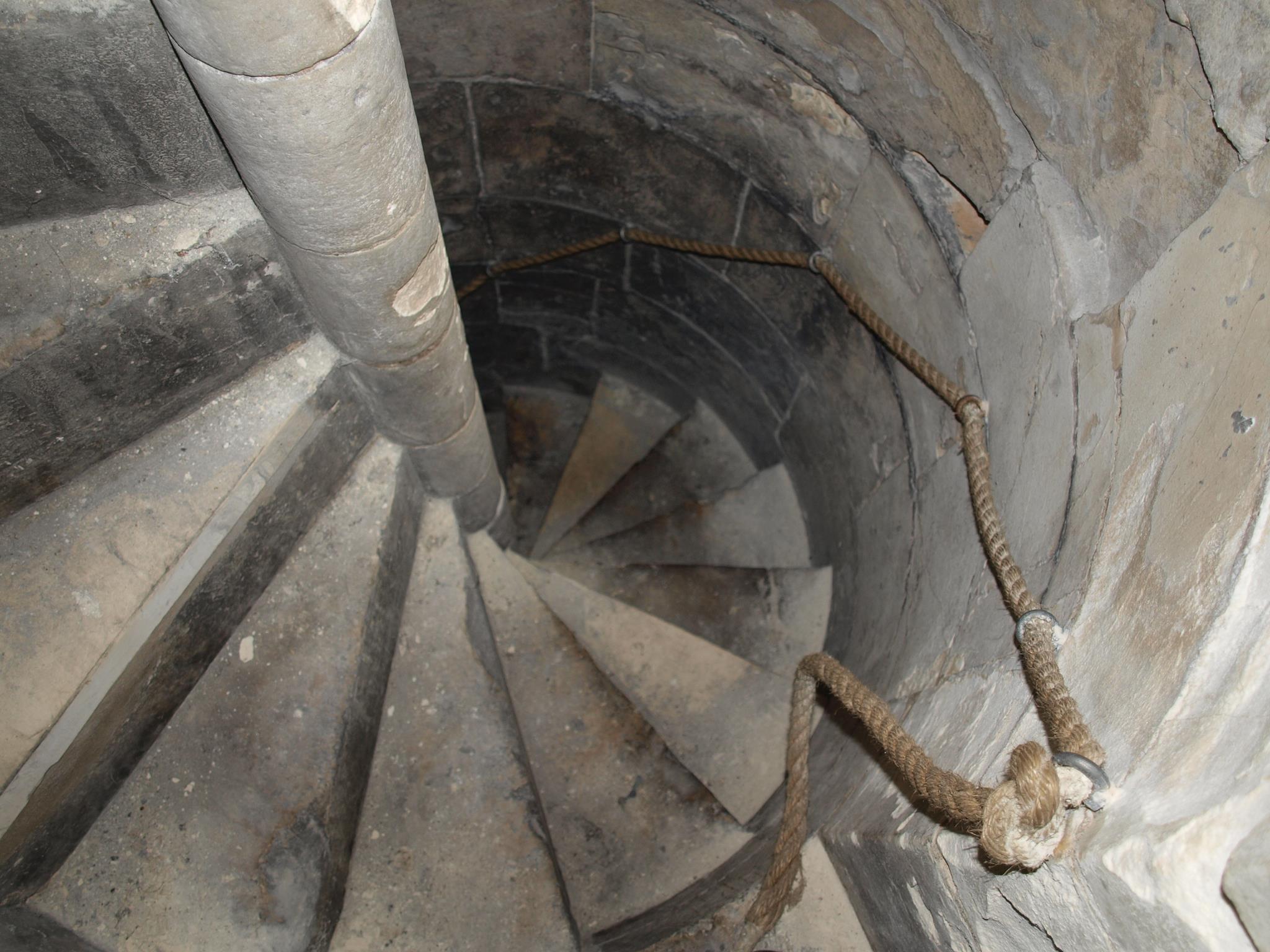
There's a theory floating around on the internet that states the stairwells in medieval castles were narrow and curved clockwise deliberately to impede sword use.
According to it, if you're heading up the stairs, with a sword in your right hand, this design would limit your ability to swing swords.
This seems a bit odd, especially considering you can just stab people.
Is there any truth to this at all?
It is true that most spiral stairs in castles spiraled upwards clockwise, so that a right handed defender could strike downwards with his sword, and right handed attackers, climbing, would be hampered, though left handed attackers less so.
http://www.castles-of-britain.com/stairs.htm
You can see, from looking at this picture of the spiral stairs in York castle:
http://yorkwalls.org.uk/wp-content/uploads/2013/03/Mystery17.jpg
that a right handed defender, retreating upwards, would be able to shelter behind the central pillar, and still stab or strike down at attackers, while a left handed defender would have his sword arm hampered by the pillar, or would have to expose more of his body.
There were castles, however, which reversed the spiral, Famously, those built by the Kerr family in Scotland.
The Kerrs were famous for being prone to lefthandedness. Their castles have the spiral staircases spiraling in the opposite direction from most spiral stairs in castles. This was to enable left handed defenders, retreating up the stairs, to have an unobstructed strike from their dominant arm.
Most spiral stairs in castles across Europe spiraled clockwise upward, which allowed a right handed defender the freedom to hack downwards with his sword, while hampering right handed attackers trying to climb upwards. The Kerr family castles in Scotland had stairs with a counter clockwise twist going up, which freed the dominant hand of a left handed defender, (but also allowed more freedom of attack to a right handed climbing attacker).
Here are some quick and internet accessible accounts of the Kerr family and their castles in Scotland:
http://www.ferniehirst.com/home.htm
https://www.scotweb.co.uk/info/kerr/
http://www.rampantscotland.com/clans/blclankerr.htm
http://www.scotclans.com/scottish-clans/clan-kerr/
The last two, in particular, have some detail on the left handedness that was prevalent in the family, and the reverse spiral of the stairs in their castles. (Ignore the diagram in one of these links, they got it wrong.)
From what I've read, it's up for debate. For a long time it was assumed that castles served a primarily military function, in which case the clockwise ascending stairs made for a nice defensive feature. However, since maybe the 90s research has questioned this assumption, favoring instead the view that castles were designed to express the owners' identity, and were set up to emphasize their superior social stature, level of wealth and conspicuous consumption, and yes, the noble class' military dominance, especially for those households that had a reputation for strength and prowess. Castles, in this theory, were made to look intimidating, and remind visitors of all classes of their place relative to its inhabitants.
This theory too is now being challenged as some scholars have looked at the castellation records in border areas, northern and western England especially. Many of the castles being built belong to already powerful nobles, rather than the up and coming who have something to prove. Why would they make the considerable expense of building another castle when they already have one or more good ones, and why here, in contentious territory? Perhaps castles weren't so exclusively performative spaces after all.
This is just a quick summary. A lot of this is pulled from the latest issue of the Castle Studies Group Journal, where you can find PDFs of that issue's articles. I'll post some links soon when I get off mobile.