I don't want to overstep my knowledge on this subject, so I'll limit my answer to what I know, namely the general background of Roman syncretism and the adaptation of the Celtic God Sulis by the Romans at Bath (which was populated, partially, by Celts.)
The Roman religion was quite flexible when it came to gods and religious practices. Often, when the Romans colonized a place, they would often adopt local religious practices. There was a tradition of syncretic gods, wherein aspects of a Roman deity would be conflated with aspects of a local deity, resulting in crossbreeds such as Mars Loucetius (a syncretic god of healing that probably originated in Gaul) and Sullus Minerva. (Cunliffe 214). In Roman Britain alone there were 65 name paired deity, usualy with one Celtic and one Roman name, but in some cases with one Roman and one Gaulish name, as was the case with Mars Loucetius (Mattingly 216).
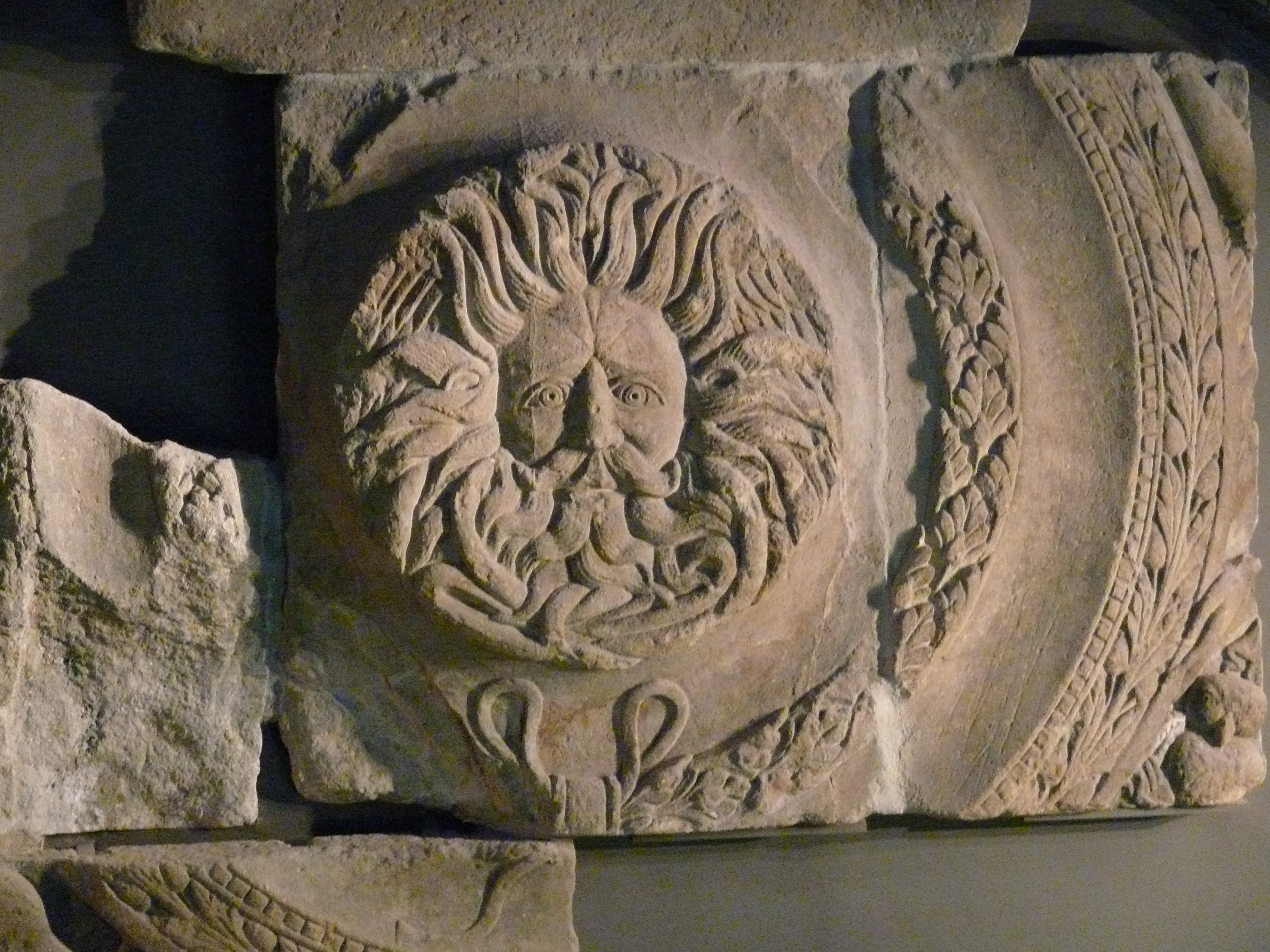
There seems to have been a significant amount of Celtic influence on some Roman religious structures in Rome, such as the Roman baths at Aquae Sulis, now the city of Bath in the UK. The temple pediment is notable for its relief of a head, which some scholars believe is meant to be a gorgon (picture ). If you know a bit about Roman traditions involving gorgons, the head might strike you as a bit odd. Gorgons were almost always female, and here we have what appears to be a male gorgon's head.
A few scholars have come up with different interpretations, such as Hind's assertion that the head is actually Oceanus, and set on the temple at Aquae Sulis to commemorate the Roman conquering of the god when they crossed the sea to Britain. I think this interpretation is a bit weak, and that its more likely that the pediment is supposed to represent a male version of the Gorgon, an unusual and relatively unique depiction probably largely due to Celtic influence. Perhaps the gorgon is also conflated with the Celtic god Sul, who was a significant presence in Britain before the coming of the Romans, but its really very hard to say for sure, due to the small bit we know about Celtic gods (we only really know anything about the religious practices of the Celts by looking at Roman sources, which of course were written after the Roman colonization of Britain.
By far the most important god at Aquae Sulis was Sulis Minerva, a conflation of the Roman goddess Minerva, and Sullis, who seems to be a local Celtic water goddess (or goddess of healing. Or a feminized version of the sun god Sul. Its sort of difficult to tell.) Usually, when you have syncretic gods in the Roman religion, the Roman god's name came first, to indicate the submission of the local god. Sulis Minerva is a unique inversion of that, and its interesting that some worshippers who came to the hot springs of Aquae Sulis left dedications solely to Sulis. What's interesting is that while we might expect these dedicants to be local Celts (who perhaps rejected the Roman Minerva, or considered her a separate goddess entirely.) However, one of the dedications that was found at the temple of Sulis Minerva was left by Lucuis Marcius Memor, a Roman haruspex. I’ve put an English translation below.
To the Goddess Sulius, Lucuis Marcius Memor, Haruspex, gave this gift”
A haruspex was an auger in Roman religious tradition who predicted the future through animal entrails. Originally an Etruscian art, haruspexy was adopted by the Romans, and a school for it was established in Rome by Augustus. There were a set number of haruspexes in the empire at any one time, and as such, they were highly respected. That a Roman haruspex would come to Aquae Sulis indicates the importance of the site not only to Romans in Britain and Romanized Celts, but its importance throughout the empire. It’s even more striking that his dedication is left to “Sulis” alone, and not to Sulis-Minerva. This indicates that in some circumstances, Celtic gods may have been adopted wholesale into at least the local branch of the British religion.
I know this answer is a bit limited in scope, but I hope it gives you some subjects for further research. Martin Henig’s Religion in Roman Britain is a bit dry, and is missing some important and could be a bit more thorough, but it provides a great overview of the influence of Celtic mythology and religious traditions on the Romans.
References
Hind, John. “Whose Head on the Bath Temple-Pediment?” Britannia, Vol. 27 (1996) p358-360.
Henig, Martin. Religion in Roman Britain. BT Batsford LTD: London, 1984.
Mattingly, David. An Imperial Possession: Britain in the Roman Empire
Cunliffe, Barry. Roman Bath Discovered. The History Press: Stroud, 2009.
Aldhouse-Green, Miranda. “Gallo-British Deities and their Shrines.” In A Companion to Roman, edited by Malcom Todd 193-219. West Sussex: Wiley Publishing. 2006.
Are you referring to Gallo-Roman culture? Within Gaul the usual intermixing of Roman and native culture took place much as it did in other areas that were conquered.