As far as I understand, the system of ships traveling close for mutual protection was successful during World War I. In The Battle of the Atlantic, the allies let months pass and hundreds of ships be sunk by German Uboats before implementing the system again. Why did they wait so long if the idea worked before?
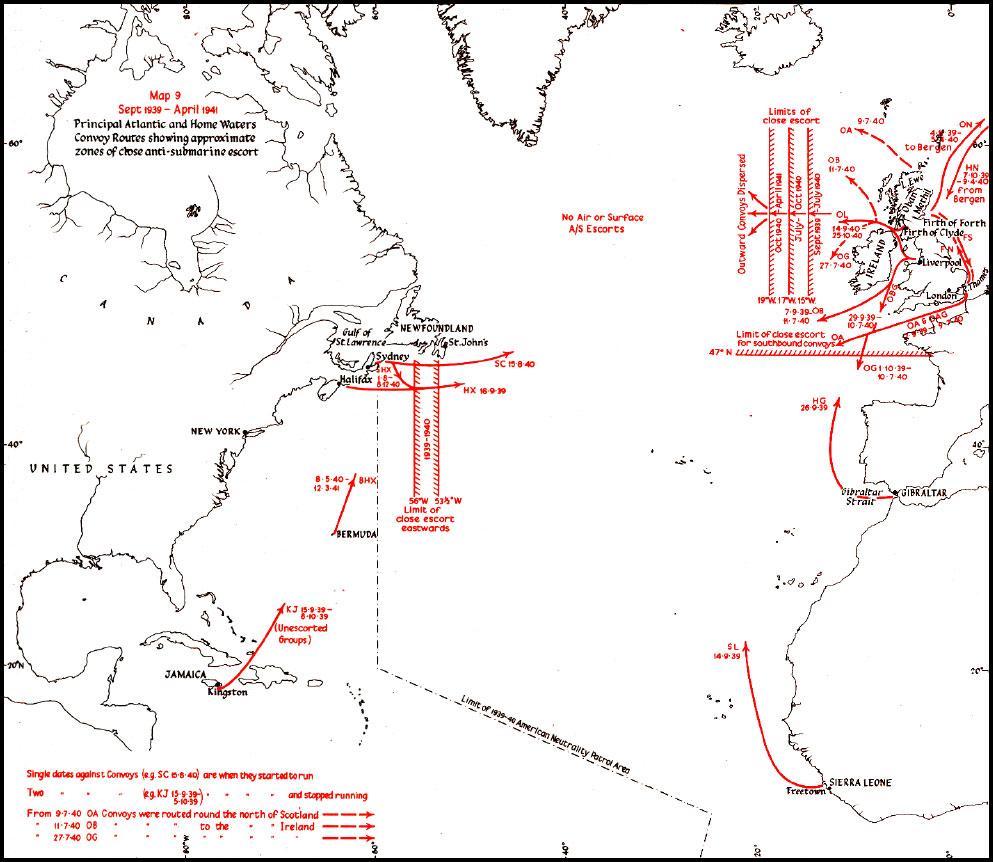
Convoys were used from the start of the war. Convoy shipping on the Atlantic routes started on the 7th September 1939. However, they were initially non-compulsory and frequently underescorted. In addition, ships that were faster than 15 knots, or slower than 9 were excluded from convoys. It was thought that the faster ships could not be caught, while the slower ships would slow the convoys down too much. There were several reasons why convoys were underescorted. It was partly due to a shortage of escorts. The RN had far too few ocean-going escorts for the convoys it needed to protect. Most of the ships it did have were short-ranged, so had to turn back at a particular point, rather than escorting the convoys through their entire passage. This map from the RN's official history shows the limits of the RN's ability to escort convoys. In addition, many of the destroyers available for escort duty were redirected to U-boat hunting. It was thought that U-boats would only be vulnerable in transit - they had to travel on the surface, which made them an easy target, compared to a submerged U-boat stalking a convoy. However, this proved wrong in practice. U-boats could spot the hunters before the destroyers could spot them. The use of carriers in this role was tried at the start of the war, but they lacked any real way of killing a U-boat, and it made them vulnerable, as the sinking of HMS Courageous showed.
However, you might be referring to the First Happy Time. This occurred after the Fall of France, which gave U-boats much greater access to the North Atlantic, in the areas between the eastern-most limit of escorts from Canada, and the western-most limit from the UK. Before then, ships tended to sail unescorted and dispersed through these areas, as there was an almost minimal threat from U-boats there. However, these ships could not be escorted until more long-range escorts became available, whether it was through further construction, or through things like the 'Destroyers for Bases' agreement with the US.