This article seems to indicate that the push inland was thanks to a few soldiers who made small attacks against the German defenses by going around the bluffs, not climbing the shingle and getting behind the defenses. According to the article, a few boats were destroyed before reaching shore, a few boats lost all their men the second they landed, and of those that who it out of the boats, few could move up the beach at all. I read a quote somewhere from a Captain that indicated that on his boat, the first man disembarked unscathed while the second through sixth men were mowed down; the seventh man was the next to make it out.
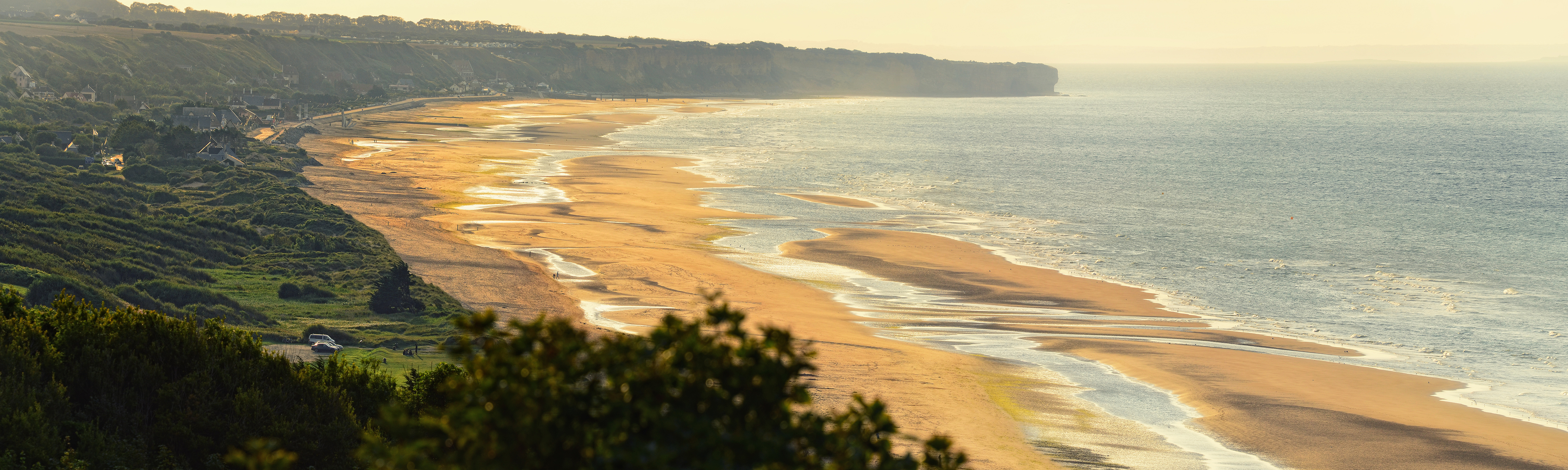
I know there are various popular depictions of the assault. Saving Private Ryan has a short beach with very high pillboxes and bluff. The Longest Day depicts a longer beach with gradually sloping hills, but during the assault casualties seem sparse. From what I've read, the beach was a quarter mile from ocean to shore with bluffs sixty feet high with 100% casualties for some units, contrary to popular depictions.
Is it true, as the article suggests, that the Omaha beachhead was successful only due to a small pocket of American resistance?
The article's author, S.L.A. Marshal is a combat historian famous for his method of interviewing groups of men in the immediate aftermath of a combat action. The "fading notebook" the author alludes to is the notes he took in those interviews.
Obviously his method is useful to later historians, but shouldn't be interpreted as any kind of ultimate authority, and he says as much in the article. The historians he criticizes (mildly) in the article were working from a different source material, usually official documents like the battle diaries of battalions, regiments and divisions. It's natural when using two different methods to deduce two narratives.
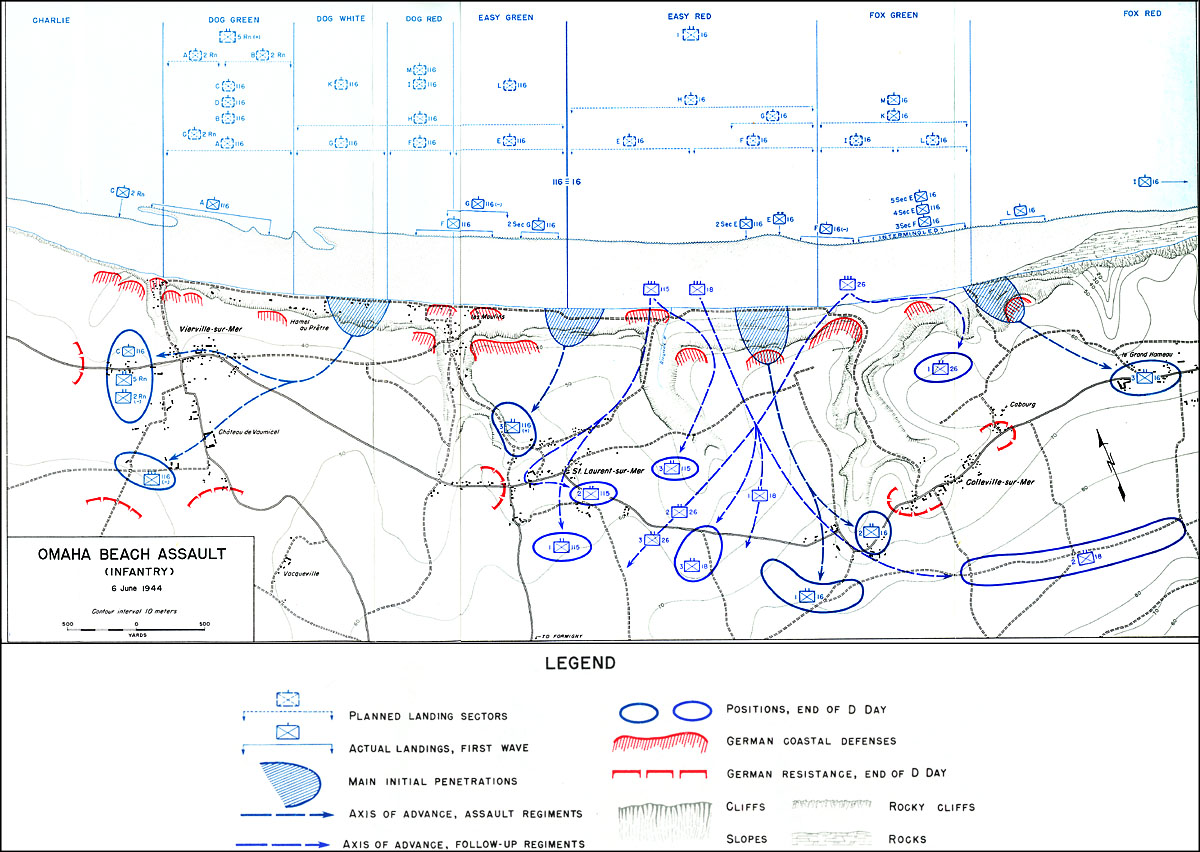
The official history might summarize the history depicted in the article as "A and B companies of the 116th were stopped on the beach by German fire and took significant causalites." The the official history might move on to describe the penetrations in the other sectors, glossing over the horror of what "intense small arms fire took toll of about two-thirds of Company A and more than half of the Ranger company before any reached the comparative shelter of the sea wall or base of the cliff." actually means. It doesn't mean that every single company or battalion was stopped on the beach. There are actually [four places on Omaha beach where the troops managed to cross the beach and ascend the bluffs] (http://www.ibiblio.org/hyperwar/USA/USA-E-XChannel/maps/USA-E-XChannel-XII.jpg) then drive out the German defenses for the rest of the beachhead.
Furthermore, the units that were caught and decimated by fire were not totally slaughtered in vain. They fixed the attention of German forces and allowed the more successfully units to receive less fire and prevented the Germans from reinforcing breakthru sectors and hold the whole force on the beach. They helped reveal the locations of German positions and allowed naval bombardment to degrade and demoralize German gunners who ultimately broke and fled inland after being flanked and pounded.
Later authors have attempted to integrate both narratives, both the horror of a failed attack and the tactical successes that enabled the overall beachhead to be accomplished. Rick Atkinson for example, had the privilege of being able to write 40-50 years after Marshall, Ryan, and the Army official history published their work.
Sources:
U.S. Army Official History "Cross Channel Attack" http://www.history.army.mil/books/wwii/7-4/7-4_8.htm
Atkinson, Rick, "The Guns at Last Light"
I know there are various popular depictions of the assault. Saving Private Ryan has a short beach with very high pillboxes and bluff. The Longest Day depicts a longer beach with gradually sloping hills, but during the assault casualties seem sparse. From what I've read, the beach was a quarter mile from ocean to shore with bluffs sixty feet high with 100% casualties for some units, contrary to popular depictions.
Well, tides are a consideration but needless to say, when you have to cross open ground with effectively no cover 10 yards of beach may as well be 10 miles.
I wish I could find a good (legible) map but you were looking at several hundred yards of open beach. The cliffs were anything from 40 meters to roughly 180 meters high. Assuming I'm reading this correctly. Text is rather small.
Is it true, as the article suggests, that the Omaha beachhead was successful only due to a small pocket of American resistance?
Yes and no. Some figures make it seem like the fight was much less significant than it actually was- 3000 casualties from an army of 43,000?- so reading into it helps. The brief answer is that almost nothing went according to plan, the first wave was smaller (meaning fire could be concentrated more effectively than on later waves), didn't have the kind of support weapons present in the second wave, and most of the surviving troops had found themselves leaderless.
Whether or not the success at Omaha was a product of these surviving troops, or if such results were expected, that's up for debate. I'd say the survivors were necessary to maintain cohesion and establish the pinky-sized foothold necessary for the second wave to make some impact.
Where the article fails in terms of context is the scale issue. It's looking primarily at the actions of two companies from the 116th Regiment. There were seven other companies from the same regiment which landed on the first wave, nine other companies from 1st Infantry, a Ranger battalion plus elements of a second, at least one artillery battalion, and two amphibious tank battalions. Elements of the last two were particularly important for knocking out some of the fortifications that held up the infantry advance, as related in Balkoski's history of the 29th Division.
And note the above does not yet count four additional regiments (36 companies) still waiting on the ships from 1st and 29th Infantry Divisions that would be landed in subsequent waves.
The article's contention that all of these other units didn't do anything and were just slaughtered is quite simply a distortion (as noted by the key role played by the tanks); and a rather sensationalist one at that based on a failure to read other similar situations.
When faced with strong defenses most attacking units in fact often find themselves pinned down and unable to press forward - see the later battles in the Sigried line for instance. Forward movement is usually restored by small groups finding weaknesses in the enemy defenses; forcing the defenders to deal with unexpected attackers from the flank and rear. Indeed, the latter is exactly what the Germans would call Stormtrooper tactics - and would have been nothing new in 1944 since they had been implementing them a whole generation before in the First World War way back in 1917.
Marshall's primary thesis had always been that a few led the fight for the many, and I think there is now widespread agreement on this point especially when we look closely at how other successful armies operate. But his methods had always been controversial because of his methodology; in that he is too reliant on ground-level personal accounts and conflating them to the whole army instead of looking at a wide variety of different examples from different armies.
Edit: Clarifications.
I'm very interested in this also, I've never been to Normandy but want to know what the landscape looks like. I do know there were several sectors of landing with varying levels of resistance so I can't imagine the amount of beach was the same for everyone.
https://en.m.wikipedia.org/wiki/Normandy_landings#/media/File%3ANaval_Bombardments_on_D-Day.png
I recommend reading "The Dead and Those About to Die" by John C. McManus. Gives a pretty good look at the failures and successes of the Omaha landings.
All this good information, but no actual answers
I've never seen "The Longest Day," but the beach you describe as being depicted in it sounds like Utah Beach, which was west of Omaha Beach, and much more forgiving, terrain-wise, than Omaha.
There were actually five beaches hit on D-Day: Omaha, Utah, Sword, Gold, and Juno. Utah and Omaha were the responsibility of the US Army, Sword and Gold were the responsibility of the British Army, and the Canadians took Juno. Sword, Gold, and Juno were east of Omaha.