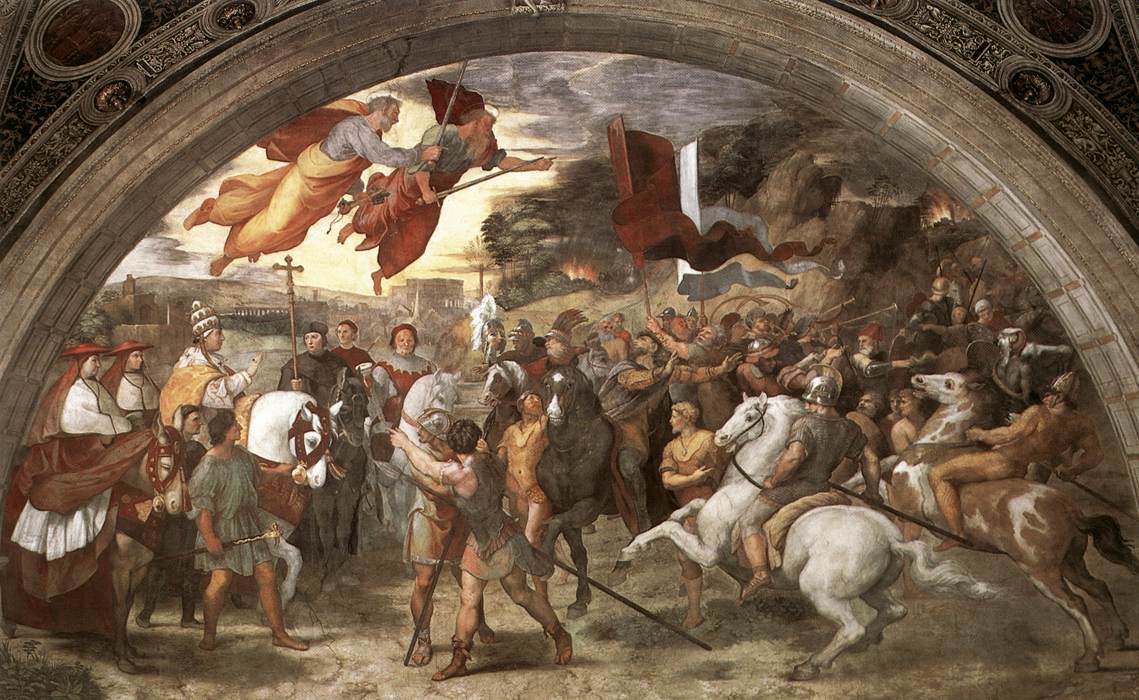
According to Orosius (375-418 AD), Alaric the Goth in 410 was said to have spared the churches. However Orosius was a Roman propagandist so his reliability is questionable;
It was no easy matter to persuade such men that the world was, in fact, changing and that it was no longer they who automatically held the whip hand. Even the sack of Rome by Alaric and his Goths in 410 could not dispel the confidence of some. The Christian apologist Orosius, for example, writing his History Against the Pagans from Rome-held Africa in the year 417-18, sought to counter the claims made by pagans (and which pagans such as Zosimus would continue to make) that the rise of Christianity was responsible for the stark decline in Rome's fortunes evident from recent military events. Rather, Orosius argued, the pagan past had witnessed far worse calamities, from which Rome had nevertheless emerged triumphant. In particular, he attempted to downplay the actual distructiveness of barbarian assaults. Although the fall of Rome in 410 had been associated with considerable bloodshed, at least Alaric's Goths, Orosius emphasised, had spared the city's churches and holy men. - Extract from Peter Sarris, Empires of Faith
Geiseric in 455 sacked Rome because the assassination of Valentinian III effectively broke his son's betrothal to Valentinian's daughter. Procopius writes that at least one church was burned down in 'The Vandalic War' in The History of the Wars, but that Pope Leo had persuaded Geiseric against violence.
Attila never made it to Rome as a combination of Aetius, malaria and his wedding night stopped him. I read that (I have no recollection of the source but it could be Peter Brown, The Rise of Western Christendom) Pope Leo went to Attila's camp, paid him off, and warned him about attacking the city. It is said that two Roman pagan gods appeared before Attila and also warned him not to attack. Although Raphael (16th Century) paints Leo, St Peter and St Paul fighting Attila
Procopius writes that Tortila in 546 went to a church to pray, killing anyone on the way, but in the context of a siege that's hardly controversial.
It really depends what sources you read. Different writers will have a different agenda, like Procopius writes that Justinian went to war with the Vandals in 530 because Gelimer (Arian Christian) had deposed Hilderic (Catholic Christian).
Several barbarian kings also looked to emulate Roman Catholicism, like Clovis I in 507;
"Clovis received an appointment to the consulship from the emperor Anastasius [491-518], and in the church of the blessed Martin he clad himself in the purple tunic and chlamys, and placed a diadem on his head. Then he mounted his horse, and in the most generous manner he gave gold and silver as he passed along the way which is between the gate of the entrance [of the church of St. Martin] and the church of the city, scattering it among the people who were there with his own hand, and from that day he was called consul or Augustus. Leaving Tours he went to Paris and there he established the seat of his kingdom." - Gregory of Tours, Histories 2.38
Gregory of Tours wrote decades after Clovis though and it could be possible that he was commissioned by a royal family to promote Clovis as Catholic, instead of writing an unbiased royal history.
Really, Rome is sacked only a few times (410, 455 and 546 AD), and there's only a handful of writers and sources. The kings in these attack were Arian Christians and used the churches themselves, but obviously could not stop odd acts of violence or killing the defenders of Rome on the way.
Sources:
Peter Sarris. Empires of Faith: the Fall of Rome to the Rise of Islam, 500-700. (Oxford, 2011)
Peter Brown. The Rise of Western Christendom. (1997)
Procopius, the History of Wars
Gregory of Tours, Histories
My problem with this question is that "the Vatican" wasn't a thing back in the age of sacking Rome. Vatican City was created in 1929. The Vatican hill outside Rome has been named since the founding of the city. The area had vineyards, temples, and the Circus of Nero, from which the Vatican Obelisk suvives. It wasn't until 326 that they began the Constantinian Basilica of St. Peter, supposedly over his grave. They still had to share the hill with the temple of Cybele. The earliest papal palace there was constructed around 500.
So while there was a basilica, there wasn't a bunch of papal buildings as have accrued by now. For the first two sackings, the Pope probably wasn't at the basilica.