Do we know how they recruited, trained, armed, provisioned, and organized their armies? How did they typically fare against Qing armies? In The Warlords, it seemed like Taiping troops were pretty well trained and armed.
Taiping Military Structure
The Taiping modeled their military structure after the Zhou Dynasty (1046-256 BCE). According to the Chinese Encyclopedia, 中華百科全書:
太平軍的基本組織為軍制,故以軍統政,以軍屬人。其制仿自周官,以五人為伍,設伍長一人,伍卒四人。五伍為兩,設兩司馬一人,轄伍長五人,伍卒二十四人。四兩為卒,設卒長一人,轄一百零四人。五卒為旅,設旅帥,轄五百二十五人。五旅為師,設師帥,轄二千六百二十五人。五師為軍,設軍帥,共管一萬三千一百二十五人,合師帥、旅帥共一萬三千一百五十五人。一軍中有伍卒一萬人,伍長二千五百人,兩司馬五百人,卒長一百二十五人,旅帥二十五人,師帥五人。
軍帥以上,復有監軍、總制。 監軍每軍一人,分火、水、木、金、土,以五行配正副天干數目以次推算,共監軍一百人。平時軍帥統軍,每出師以監軍監之,受總制節制。總制以上有將軍及指揮七十二人,檢點三十六人,丞相二十四人。再上為前、後、左、右、中五軍主持,另有御林侍衛,分為日干、氣節二種,職位在總制上,而直接統屬於天王及正軍師,全軍最高統帥為正軍師,正軍師請命於天王行事。
Translation:
The Taiping Army's basic structure is the jun zhi, which uses the army to govern and count population. Their organization follows The Rites of Zhou. Five men would forms a squad, under the the command of a corporal. Two squads forms a liang, under the command of a sergeant. Four liang forms a zu, under the command of a lieutenant, totaling 105 men. Five zu forms a brigade, with a captain in charge. One brigade has 525 men. Five brigades form a division, under the command of a colonel, with a total of 2,625 men. Five divisions form an army of 13,156 men, together with colonels and generals would give a total of 13,155 men. An army has 10,000 infantry, 2,500 corporals, 500 sergeants, 125 lieutenants, 25 captains, and 5 colonels.
Above the generals are army supervisors and central regulators. Each army has one supervisor, separated into fire, water, wood, gold, earth, using the five elements and the ten heavenly branches to calculate and divide into principle and subordinate, in total there are 100 army supervisors. In times of peace, the general commands the army, but when the army goes on an expedition, the army supervisor supervises the army, and is subordinate to the central regulator. Above the central regulators are 72 senior generals and commanders, 36 examiners, and 24 chancellors [tr. - it is important to note that the Taiping's Chancellors did not play the same role as dynastic Chancellors]. Above them are the forward, rear, left, right, and central Five Army Directors, as well as Yulin Guards [tr. - Imperial Guards], divided into Ri Gan and Qi Jie, their ranks are above those of central regulators. They are directly controlled by the Heavenly King and the Principle Military Counselor. The entire army's highest commander is the Principle Military Counselor, who takes his orders directly from the Heavenly King.
See also, Jonathan D. Spence's God's Chinese Son, p. 127 and Ian Heath's Taiping Rebellion, 1851-1866, p. 9.
The Taiping military's core was composed of Hakka, a Han subgroup whom Hong Xiquan and many of his followers belonged to. There were also many other minority groups such as the Zhuang who joined the Taiping forces, though as their territory expanded, many Han generals and soldiers were incorporated as well. The Taiping army was very disciplined and carried with them a high level of fanaticism, which allowed them to defeat Qing forces multiple times.
Provisions and Arms
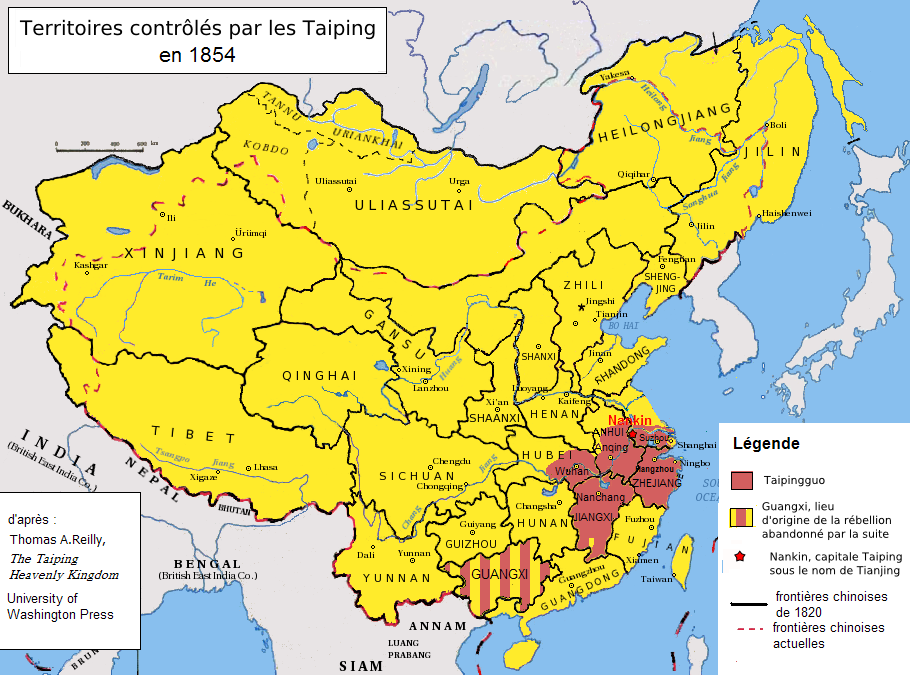
The Taiping army started out very small and poorly armed, I think they were only saved from total destruction by their discipline and fanaticism in battle. As you can see from this map, the rebellion began in Guangxi province, where a lot of Hakka and Zhuang people lived, but they had to abandon Guangxi and move northwards. I don't have the book with me, but Spence's God's Chinese Son goes over this in detail and contains many charts and maps showing the Taiping's northward migration.
The Taiping army's weapons were initially very primitive, mostly swords, spears, bows, outdated gunpowder weapons, and primitive grenades. Most of their supplies and arms came from Qing forces they defeated along the way. Many Qing commanders did not destroy their weapons stockpiles, supplies, and gunpowder caches when their cities fell, which allowed them to fall into Taiping hands. Eventually, the Taiping were able to gain rifles and cannons from foreign traders as well, but supply was always a problem. The foreign powers eventually decided to side with the Qing and Qing forces were constantly blockading Nanjing, and the desire to gain foreign weapons was one of the major motivating factors for the Eastern Campaign against Shanghai.
I recommend you look into Spence's and Heath's text for more detailed information.
Effectiveness
I think this one speaks for itself. The Taiping Rebellion went on for almost a decade and the Taiping foothold in southern China was very strong. The Taiping general Shi Dakai led an army which penetrated deep into Sichuan, a Taiping army came within a couple hundred miles of Beijing, which sent people fleeing from the city, before they were defeated. Even relatively late into the rebellion, with Qing forces blockading Nanjing, the Taiping army was still able to capture Hangzhou and Suzhou. Their expedition against Shanghai failed, though, and this was one of the factors which contributed to their decline.
The Qing initially used the Green Standard Army against the Taiping, but the Qing army was corrupt, undisciplined, and poorly armed. This resulted in a series of defeats at the hands of Taiping forces. Eventually, regional militias such as the Xiang Army of Zeng Guofan, the Huai Army of Li Hongzhang, and the Chu Army of Zuo Zongtang became much more effective in fighting the rebels. These armies were funded privately by local nobles and gentry (and later with government support), were much more disciplined, and were better armed. There was also the Ever Victorious Army, which was a Chinese army trained and commanded by American and European officers. These forces were instrumental in putting down the rebellion (which was aided by the Taiping's internal struggles) and they later formed the core of the Qing's new armies. The use of regional forces also led to the increase of regional Viceroy's powers and later the rise of warlordism.
Edit: Spelling and grammar.