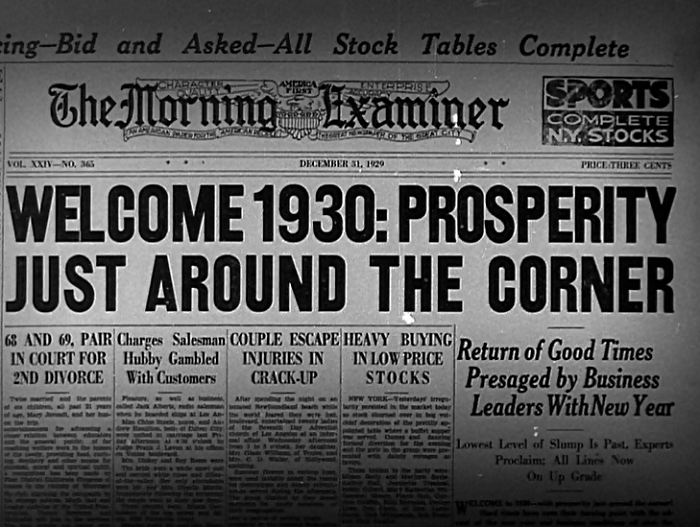
Despite the fact that the economy has been pretty rotten the last few years, the press has kept a relatively sunny and optimistic outlook. Did this happen in the aftermath of the 1929 crash and the next decade or so of The Great Depression? Will we look back at this period of time as the Second Great Depression? How was it reported on to the general public over time?
After the sensational Wall St crash headlines I don't think it was realised until the 1931 European financial crisis just how deep, general and prolonged the real downturn was going to be. There'd been two recessions in the 1920s and a deeper but brief depression at the start of the decade, and initially the 1929 slump looked like another such episode. Business leaders and the doomed Hoover Administration were understandably keen to talk up the economy's prospects (there's a wonderful example here), and stocks indeed recovered half of their lost ground by April 1930. But the March 1930 unemployed protests seem to have brought the scale of suffering and discontent into the headlines despite their widespread dismissal as Communist agitation. In 1931 the big news was about Europe, but by 1932 there was no escaping the depth of the catastrophe.
Was it a case of downplaying? Not necessarily: news and information about the "real economy" weren't so developed then as later (GDP was over a decade away and we still haven't an official one for 1928). The Crash had been news because it was so dramatic and measurable, but the real Depression was a gradual spiral whose duration and extent couldn't be foreseen.
Hi there! Just a reminder for folks coming here to comment: we've already removed a couple of comments that deal with the recent economic downturn. We did that because this sub explicitly forbids discussion of current events, which we define as happening less than 20 years ago.
So if you're coming here to comment, please confine your answers to events of the 1930s Great Depression.
Thanks,
-- the AH Modteam
You have to remember that "mass media" was very different during the years of the great depression. News Papers were just stating to really utilize photographs, and the great depression is actually a notable point in the history of photography.
Dorthea Lange is usually discussed during this era of history in regards to visual media, because her work with the Dust Bowl Farmers, among other things, really propelled photography and ultimately visual media as an important aspect of the media. Prior to this point, media was essentially text based as photographs were not exactly widely accessible, and they were simply a fairly new form of media. However, as it was discovered through Lange's photographs, the image was much more powerful in invoking sympathy from the viewer then merely reading text. Many of these photos are still well known today, for example https://en.wikipedia.org/wiki/File:Lange-MigrantMother02.jpg.
Lange was not the first, or the only documentary photographer, but her work is definitely up there with some of the more influential along with photographers like Ansel Adams. She was taking the first steps in what we consider very typical today, but at the time was extremely significant with how the world communicates.
So, in regards to your question, in photography specifically, and its use in News Media, it was not downplaying the Depression. If anything it was trying to appeal to the readers sympathies by showing the unfortunate situations of the people most negatively impacted by the Great Depression.