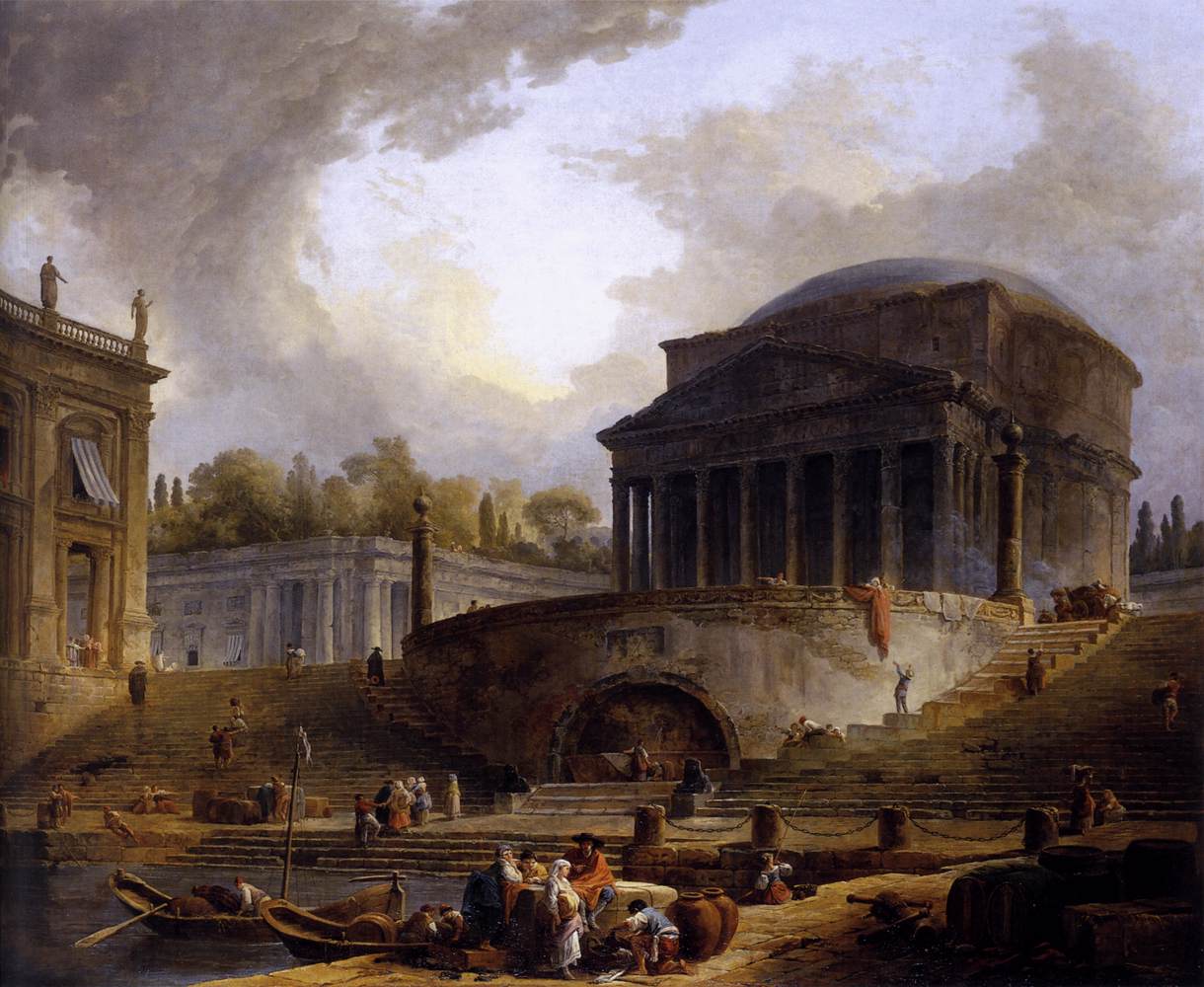
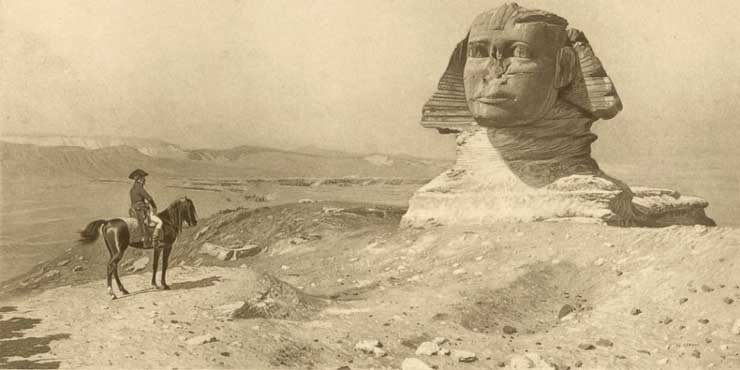
I am asking this because I have seen a lot of paintings that depict archaeological sites as abandoned and forgotten ruins.
I'm Italian and this baffles me, as our main source of tourism is - aside from natural scenery - given by archaeological sites as in Rome and Naples (Pompeii and Herculaneum being the best examples).
Is this interest for archaeology something recent or did people actually care back then?
It looks to me that the interest began in the late 1700s and exploded at the end of the 19th century, but I'm no historian, so I'm asking you.
EDIT: To add more, even supposedly known things, like the sphinx or the pyramids were forgotten, same with the parthenon.
I can't really delve into any detail, but basically archaeology didn't really become a thing until the mid-19th century. Antiquarianism was around for about 100 years before that, but it was really just about collecting interesting things as historical relics, and not about scientific inquiry or trying to understand the past through archaeological sites and artifacts. It's not that people did not care about archaeological sites, but rather that they just saw them as ruins or old buildings and did not really see them as important places for learning about who and what came before. They may not have even recognized them as ancient places at all.
The case in Italy must surely be different because the history of the Roman empire was well known by 1700 and people must have known that these ruins were built during the Roman Empire, but I don't know much about Italian archaeology or its history. In other parts of the world places that are now considered archaeological sites probably were not seen as anything special and were not recognized as the ruins and artifacts of societies that came thousands of years before. At least not in Western thought; I can't speak for how non-Western people viewed such ruins.
I've also heard that until the 19th century there was no true concept of the passage of time in Western thought. There was the Biblical age, the Classical age, and the modern age; that was it, the world would then end. People of course experienced lifetimes and knew that time passed, but there was no sense of any real change or that a stone celt was actually made by a pre-Biblical culture 8,000 years ago. That concept of long-term change and abandonment just didn't exist, and certainly the concept of deep time did not exist (until the 19th century people knew that the Earth was ~6000 years old). I find this concept very hard to wrap my head around, but that's because I've grown up in a world where deep time exists and things are always changing.
A great source for all this is Bruce Trigger's "A History of Archaeological Thought". The first two or three chapters go over the early development of antiquarianism and archaeology, and how Western thought changed to allow for deep time and the recognition of non-Western pasts (the rest of the book is about how thought within the discipline has changed over the 20th century). Trigger was a true master of archaeology and although this book is long and kind of dense, it is also very accessible to a non-specialist.
You might also find Barbara Bender's "Stonehenge: Making Space (Materializing Culture)" interesting. It is about Stonehenge, obviously, and about how the public perceives and uses Stonehenge. She talks about the history of Stonehenge as a monument, too, including some descriptions of it in the 12th or 13th century A.D. I can't remember exactly what she said about how it was viewed then, but I remember it being very interesting and pretty different from how it is perceived today.
People never forgot Rome's ruins, they just moved on with their lives. We replace and tear down old buildings all the time. Cannibalizing the Coliseum for a 7th-century Roman would be no different than tearing down an arena in a modern city if the team moves or wants to upgrade. Roman ruins were tempting because they were made of really good materials that could be reused. For example the Baths of Trajan and the Theater of Pompey in Rome now exist only in outline because more recent buildings used their walls. Temples were useless and offensive once Christianity became popular and they were dismantled (S. Maria in Trestevere got its capitals from other temples) or reconsecrated as Christian churches (like the Pantheon). These requisitions began even before the fall of Rome. The friezes on the Arch of Constantine were taken from an earlier monument.
Rome's ancient monuments were very popular in the middle ages. In the 12th century someone wrote a visitors' guide to Rome describing the monuments and stories associated with them called the "Mirabilia Urbis Romae" produced particularly for pilgrims (while the monuments described were from the pagan era most of the stories associated were Christian events. Even Augustus was portrayed as a protochristian). The link to ancient Rome was an important part of medieval politics so you also have some attempts by popes and Holy Roman emperors to maintain their links to the past by keeping monuments standing. A third party in that competition were the people in Rome who wanted to found a commune (technical term unrelated to Marxism that refers to a city not under a lord) ruled by the people (aka landowners or wealthy merchants) not the pope. They viewed monuments as a link to the past and they claimed their right to govern the city from that past. So by the 10th century or so you have these three groups pointing to ancient Rome to claim certain powers and they thus had an interest in preserving monuments as they were and preventing their re-use (this is only true to a small extent).
At the height of the Italian Renaissance families like the Borgias and the Farneses hunted for ancient works of art because it was very trendy. In the process they excavated a few monuments and scraped off some frescoes and mosaics. Their biggest find was the Baths of Caracalla (the largest building in the ancient world but it was mostly brick and already looted by Christians in Late Antiquity). Hence the statues from the Baths of Caracalla (known as the Farnese Marbles) followed the Farnese line to Naples where they now wait for tourists brave enough to go to the National Archaeology Museum in Naples on their way to Pompeii (a really great museum and it has all the goodies from Pompeii but anyone in Rome will look at you like you have a death wish if you tell them you want to leave the train station in Naples).
A truly gigantic change in antiquities happened with the excavation of Pompeii which basically started in 1748. The timing was fortuitous as well because Europe was finally starting to get its act together after centuries of endemic religious wars. The more structured wars of the eighteenth century actually may have encouraged Europeans to travel in the same way that American GIs left the World Wars with an appreciation of Europe. Italy was also a huge mess during the middle ages suffering one invasion after the other compounded with constant warring between the major cities. The Roman ruins and Pompeii were considered essential destinations for any gentleman who could afford them. You really couldn't be considered a gentleman if you didn't return from your trip to Italy without a lovely landscape by Canaletto or his ilk with which to remember the sights you saw. You could also "cheap-out" and buy prints or lithographs at the sights.
So Pompeii, the relative peace of Europe and Italy encouraged a lot of elite tourism beginning in the eighteenth century. This created a reason to keep ancient buildings around which is still powerful today: a tourist economy. With steam travel and then with emerging middle-class and now especially with modern workers' rights and globalization that economy has grown a lot since then.
Edit: To answer your question more specifically: people did not care for archaeological sites purely for the sake of the past until much later and I do not know too much about that process. I imagine it has a lot to do with German antiquarian scholarship in the 19th century (I say that because it is where modern archaeology and historiography emerges).