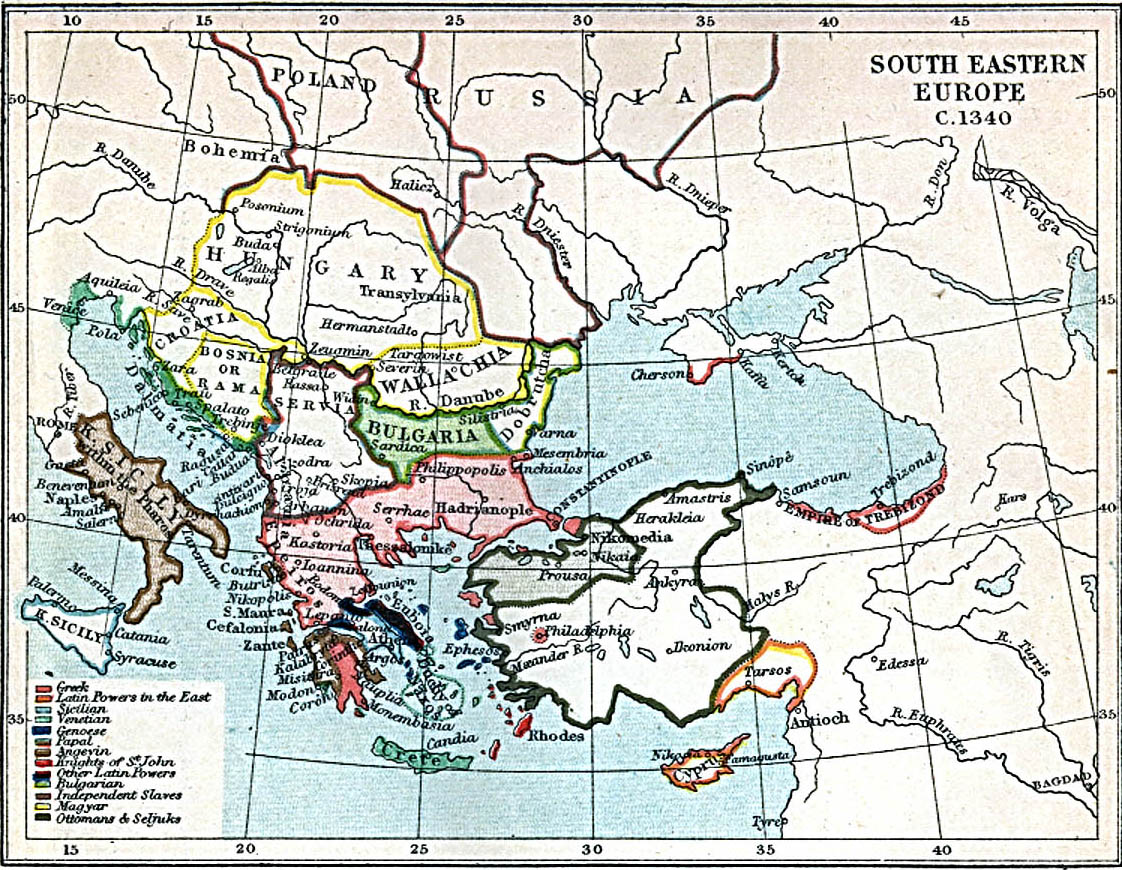
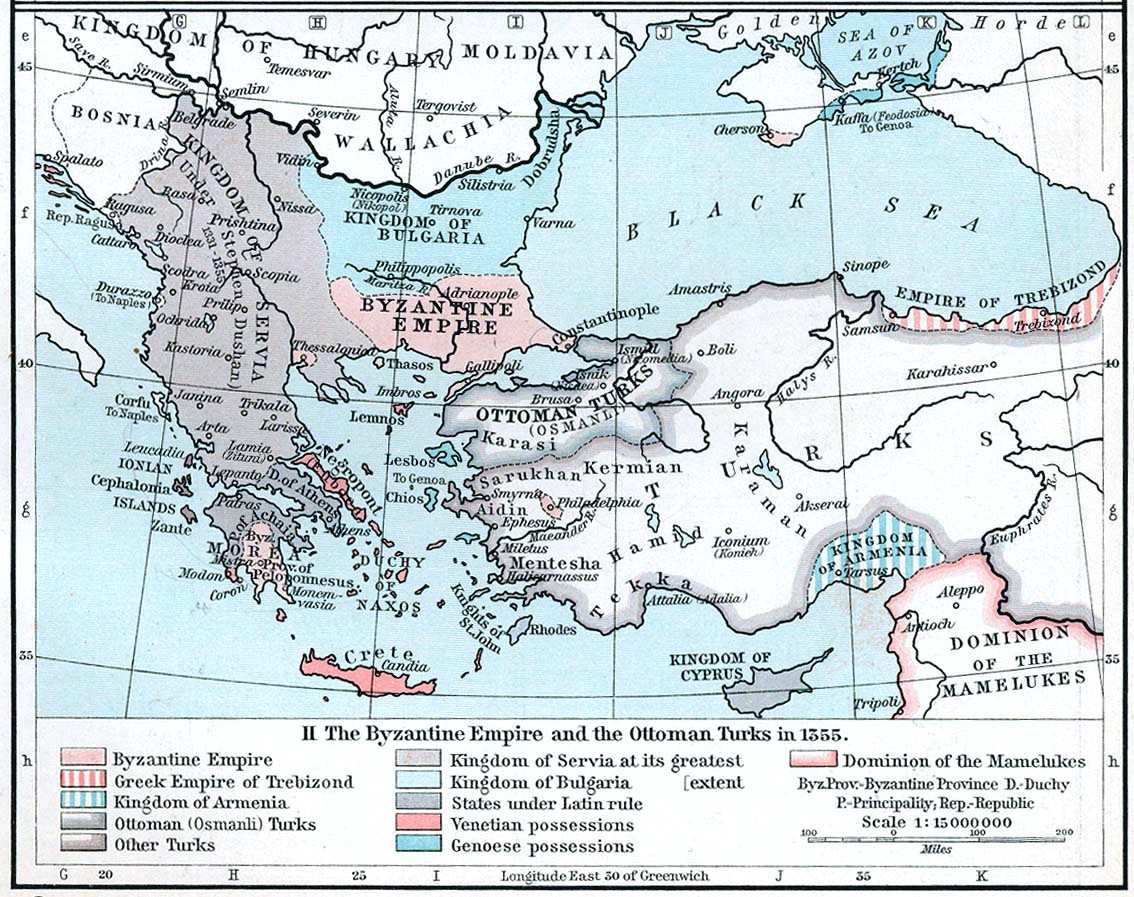
Yes. This map can visually show you just how desperate their situation was
Historians have argued multiple times that the Byzantine Empire's decline commenced, ranging from the 6th to the 14th century.
By 1453, the Byzantine Empire was essentially a vassal state of the Ottoman Empire. 1329 marks the final attempt of the Byzantine's to drive the Turks out of Asia Minor (Battle of Pelekanon).
Now keep in mind, the threat from the East was not the only threat the Byzantines faced. In fact, it was when the Byzantines were engaged in a war on only one front that they were able to reassert their power (historically that is), the essential issue was that they would be fighting simultaneously on their Eastern, Northern and Western frontiers (2 at a time at least).
To illustrate this, using the above example, the Byzantine underwent a civil war in 1341. The Serbian Kingdom (soon to be Empire) took advantage of this, and conquered territory as far south a Thessaloniki and the Peleponnesus. Even prior to this, the Serbs took territories in 1331-1334 The Turks capitalized on the Byzantine's preoocupation with the Serbs, and in 1331 and 1337 took Nicaea and Nicomedia respectively. Bulgaria capitalized too, though they were essentially a vassal state of the Serbs at that time. Perhaps an interesting side note the Serbian Emperor was actually marching on Constantinople when he suddenly died.
For a visual illustration: Byzantine Empire in 1340 and Byzantine Empire in 1355.
I personally subscribe to the belief that what did the Byzantine Empire in for good was the Latin conquest/sack of Constantinople and subsequent occupation 1204-1254. It seems that after this, they were simply unable to recover, and started a long decline that could not be reversed until their final collapse in 1453 (with Trebizond falling shortly thereafter). Others disagree, with the other most popular opinion being that the Byzantine-Arab wars of the 7th century marked the beginning of the end. For me, that seems like far too lengthy a decline though.
As for the reasons for the decline...well, there are many, you can literally write (and many have) a novel about it. The rise of the Ottomans, the Arabs, internal strife, overreliance on foreign troops, lack of reforming the military (read: modernizing), the Crusades. As I stated, the one that I believe to be most accurate, is being constantly plagued by war on multiple sides (in addition to civil wars) and the neighbouring states (I use the term states lightly here) taking advantage of this. The Turks, IMO, simply happened to be the power that managed to capitalize the most. If they hadn't or they just hadn't existed, then likely Serbia, Bulgaria, Venice, or some third party would have taken Constantinople in the near future.
This question is phrased rather strangely. Osman (the dynasty, Osmanoglu, often Anglicized as Ottoman, is named after him) arrived in Anatolia early in the 13th century. The Ottomans would then fight a string of wars with neighboring Turkic and Greek states until finally solidifying power in the mid 14th century. Shortly thereafter, in 1362, the Ottomans crossed the Sea of Marmara and conquered Adrianople, which was promptly renamed Edirne. The Ottomans would progressively carve up more and more of the Byzantine Empire and lay siege to Constantinople at least three times (1411, 1422, and finally in 1453).
The Byzantines had been on a steady decline for a rather long time before this, though. Between the collapse of the western half of the Empire in the 5th century and the rapid rise of Islamic powers in the 7th century, the writing was pretty much on the wall. And by the time you get to the decisive Seljuk victory at Manzikert in 1071, which even the rather remarkable Komnenoi dynasty failed to reverse. The general region was pretty much complete chaos throughout the 13th century (the Fourth Crusade splintered the Byzantines in 1204, the Mongols showed up a few decades later, and by the end of the century Anatolia was a patchwork of competing warlords). And the only party that really gained from the chaos of the 13th century was what would become the Ottoman Empire. Anyone else that achieved any sort of localized power (like the Karamanids of Anatolia) were inevitably crushed by the Ottomans.
But to answer the second posted in the topic title: I think they could have. The interesting thing about the Byzantine Empire is how unusually resilient it was. This state, which we call Byzantine for our own convenience, was ultimately just the (Eastern) Roman Empire. The line of emperors that was extinguished with Constantine XI in 1453 can trace its ancestry, with a few hiccups that are inevitable in a length of time that vast, all the way back to Augustus. To put that into perspective, there's less time separating Augustus from the Minoan Civilization than there is separating him from Constantine XI (probably -- but dates that far in the past are sketchy, which ought to tell you something). All of which is to say that, if we were talking about any other state, I'd say that they were doomed regardless. But the Byzantines had a knack for survival and, had they weathered the storm of 1453, I would genuinely not be surprised if they lasted even longer.
There are a lot of great answers on this thread and a great resource if your interested in much deeper inspection of this topic: /r/Byzantium