I'm interested both in (1) what policy makers thought of it in terms of its effect on the Cold War and the ability of the Soviet Union to exploit the cultural shift, and also (2) how the movement was interpreted by Soviet scholars of Marxism.
Follow up question and my apologies if it has already been asked: Where did the USSR get their soldiers (not during a major war)? Did they have a draft like the US?
Why am I being downvoted?
Expanded from an earlier answer.
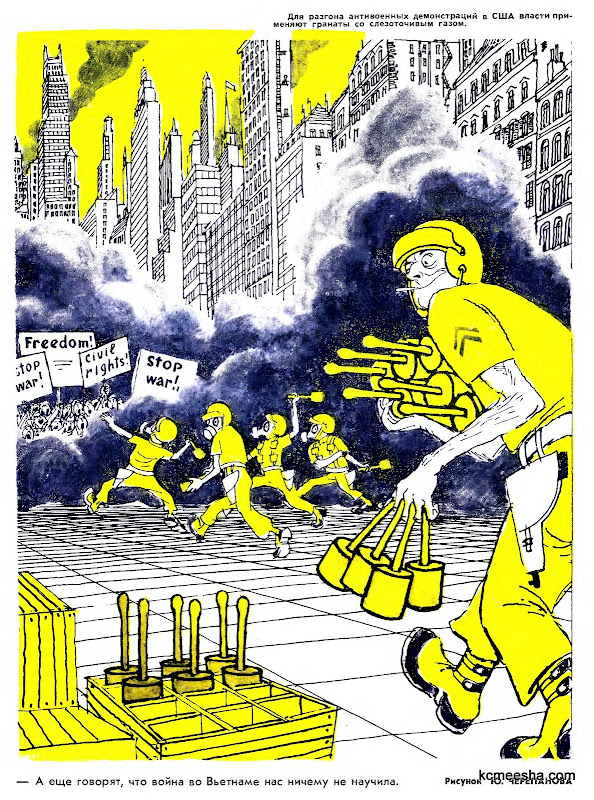
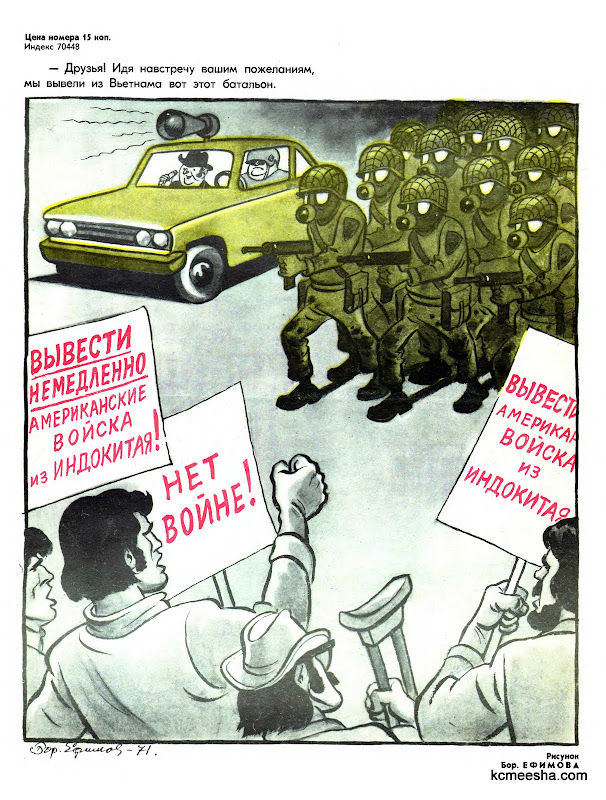
One of the salient points of the Western counterculture of the 1960s was that it was a much more diverse movement than the popular stereotype of long-harried flower children. While the latter certainly existed, they also cohabited a movement of a new breed of politically-engaged intellectuals (often called the New Left), the antiwar movement, and other people seeking to transgress the existing social order. When faced with the rise of this movement in the West, the Soviet leadership was quite confused as to what to make of it. For example, these two Soviet cartoons 1 2 show solidarity with the war protesters as true representatives of the struggling masses that the USSR was on the side of. In contrast, this cover "Distinguishing Badges" of the 1969 Soviet satirical Krokodil mocked the West's fashion of long hair and androgynous clothing as does this Soviet cartoon which presented the stereotypical hippie garb in a less than flattering light.
The New Left was one of the more vexing aspects of the counterculture for the Soviet Union's leadership and cultural figures. In general, the Soviet leadership was ambivalent about the New Left and this mirrored the generalized ambivalence the New Left held for the USSR. Although the New Left espoused a harsh critique of American society, their ideological focus was more in line with younger communist movements and leaders like Mao, Ho Chi Minh, or Che. Brezhnev and other Soviet leaders had experience with this type of ideological independence with both Tito and Mao during the 1940s and 50s and that had led them to be leery of ideological movements that deviated from Marxist-Leninist orthodoxy. The fact that the SDS did grew out of an American progressive milieu instead of the American Communist Party added a further layer of skepticism for Soviet leaders.
Moreover, the New Left would also occasionally critique Soviet actions; one of the precursors of the New Left in Britain, the Communist Party Historians Group, which included such luminaries like E. P. Thompson and Eric Hobsbawm, openly critiqued the Soviet invasion of Hungary in 1956. There were similiar sentiments over the Soviet's crushing of Prague Spring. Graffiti both at Berkeley's and Chicago's1968 protests drew explicit connections between American police actions and Czechoslovakia. While this graffiti (welcome to Czechago) was more about thumbing the eye of the anticommunism of the West, it was not a celebratory picture of the USSR either, especially in contrast to how the "Old Left" romanticized the Soviet worker state in the 1930s.
The transgressive cultural precepts of the New Left, especially its liberal stance on sexual mores, were at odds with the social conservatism that typified Soviet leadership during the Brezhnev era. One of the odder quirks of Soviet state attitudes towards music in the late 1960s and 1970s was they felt that rock bands exemplified by the Rolling Stones, The Doors or Jimi Hendrix were a cultural plot by the capitalism to sap the revolutionary vigor of youth through an appeal to hedonistic excess. The Soviet state was very quick to repress its own counterculture that arose in this time whose hippies took their cues from the global movement (long hair, sexual freedom, etc.).
Writing in 1975, the German journalist Klaus Mehnert observed:
The New Left is not one of the perennial topics that Soviet writers have to write about, rather it is a marginal phenomenon in Soviet writing [emphasis original]. Therefore, it is studied only by those especially interested. Seldom have I found anyone in the Soviet Union who even knew the New Left’s name.
Menhert found that although the Soviet state published extensively about the New Left and student protests, the state was more interested in the fact that the New Left was protesting than what in fact the New Left was actually saying.
The same could be said of Soviet response the wider Western counterculture movement. When the counterculture threatened to upend cultural mores and practices, the response of the Soviets was to treat such a movement as distinct and separate from the true interests of the toiling masses. The state would accordingly quarantine aspects of the counterculture like rock music it deemed harmful to the Soviet body politic. But when the counterculture was useful for Soviet interests, especially when it portrayed the Americans in a less than flattering light, Soviet media would position itself as their self-appointed champion in the global stage. The problem for the USSR was that few in the Western counterculture movement wanted this patronage and often had a vision of the future that departed from the Marxist-Leninist orthodoxy of the Brezhnev era.
Sources
Dworkin, Dennis L. Cultural Marxism in Postwar Britain: History, the New Left, and the origins of cultural studies. Duke University Press, 1997.
Katsiaficas, George N. The Imagination of the New Left: A Global Analysis of 1968. Boston, Mass: South End Press, 1987.
Mehnert, Klaus. Moscow and the New Left. Berkeley: University of California Press, 1975.
Risch, William Jay. The Ukrainian West Culture and the Fate of Empire in Soviet Lviv. Cambridge, Mass: Harvard University Press, 2011.
I've wondered this myself. Also, was the general Soviet population aware of the cultural movement?
here's a pretty interesting article about bootlegged music in the soviet union
While the movement wasn't as widespread as in the west, I can tell you that western parts of the Warsaw pact were certainly aware atleast from my experience.
I can tell you that western music was widespread in the Soviet Union and Warsaw pact, you can find any western classic also in any North Korean library from John Lennon to the Queen.
What really didn't affect the Warsaw block population was the political meaning and active protests that characterized the western world. There wasn't a Vietnam to protest against.
Certainly hippy movement was present in the Warsaw block but it was less spread among young, we as Poles certainly enjoyed the sexual freedom-music movement, the will of peace, you had people dressing like "children of flowers" ecc, but it never came to open opposition to authorities to create a more free world.