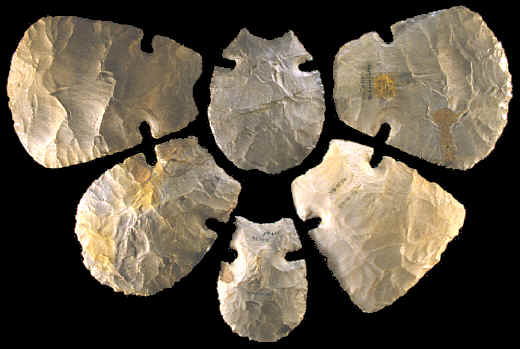
The short answer is "both." There's variation over time and with regards to specific resources. For example, Cahokia's agricultural system utilized chert hoe blades. These blades were made from Mill Creek Chert mined in quarries in southern Illinois and disproportionately sent north to farming villages associated with Cahokia. At Mill Creek sites like Dillow's Ridge, we see evidence for at least part-time specialization in the production of hoe blades and Ramey Knives (also made from Mill Creek chert) for export. While it was usually the finished product that was traded, whole slabs were sent west to Powers Phase sites in southeastern Missouri. As for Cahokia itself, it has workshops for processing raw materials into finished products, but they're largely focused on a luxury items such as shell beads and copper.
At the Turner Earthworks near Cincinnati, we see the opposite situation. Near the Earthworks is the Turner Workshop, a prominent site for the production of flint blades by the Scioto Hopewell between roughly 2000 and 1700 years ago. All the flint used at this site was non-local, with the overwhelming majority coming from Flint Ridge, also in Ohio, about 200km away. A small amount came from sites in central Indiana and eastern Tennessee. One of the things that makes the Turner Workshop interesting is that the blades and blade-cores (the stone from which the blades were made) have a little standardization and a seemingly high number of mistakes. Were the people at the Turner Workshop simply at as skilled as similar toolmakers (if so, why?), or did they carry their successes away somewhere and leave their mistakes behind for archaeologists to find in higher than normal numbers? That's a question Ohio archaeologists are still trying to figure out.
Sources