TL;DR boyfriend doesn't think visiting historic sites is beneficial, and I'm at a loss for understanding why it's matters to me.
I'm an upper division undergrad studying history. My boyfriend doesn't have a similar interest in history as me, and I'm actually really glad because my goal is to be a teacher who simply gets students to appreciate history. He and I often get in discussions about the elements of history that 'matter'. We were just discussing why it matters to physically visit a historical place. His argument is that most times pictures are enough, and that the laymen history you receive at those places is easily accessible online. He and I agree that preservation of historically significant places is important. Thing is, I am having trouble understanding my own argument. I emotionally feel that visiting historic sites is beneficial, but can't seem to out arguments together as to why that is.
So, asking all historians, do you think physically visiting historical sites benefits us? If so, in what ways?
Sure you can look at a colonial farmstead or town and see that everything is a good distance apart, or that there is a good deal of manual labor, but that the layout promoted interactions and cooperation, you can see that on the map.
But to then go to Williamsburg, or a living history museum and see that walking from your house to church you pass the baker, the blacksmith, the pub, the cooper, and the courthouse, and people you are intimately interconnected with gives a real sense and physical appreciation for frontier communities you wouldnt get from just a map.
There is a phenomenological argument as well - being able to stand in the place a historical person did, feel the climate around you and see the things they did from the same varieties of perspectives may help you understand a place or time better. Pictures are limited because they only show you one perspective of a place, and even a good set of photographs can't convey all the other experiences of being in a place like sound or temperature or bugs attacking you, etc. Those might not be important qualities depending on the kind of history you are interested in, but if you are interested in history as human experience then this kind of approach is very appropriate.
Edit: I'm writing an article about Chaco Canyon in New Mexico at the moment, and I could easily write the paper without having ever set foot in the canyon itself because I have all the data I need at hand in reports. That said, I think it is tremendously helpful for me to have actually visited the canyon (and indeed camped there overnight) and seen the historic buildings I'm writing about. The data I am using (including photographs and maps) are necessarily abstractions that don't reflect the entire experience of being in that place or the details of the place itself. That you can only get by being there.
Seeing a picture of the aftermath of say a Civil War battlefield and then in real life seeing the spot that picture was taken does several things. First and I think most import, seeing the contrast between the battlefield covered in death and destruction and the idyllic peaceful park you are standing in is a great lesson in the terrible things people do and a reminder to not repeat them. It also makes the whole thing more real to see the space in person and in full color as opposed to a grainy colorless photo. It's similar to how a color photo is easier to make a connection with than a black and white one, only intensified. By standing in the same spot where huge historic events happened you are having something of a shared experience with the people who were there.
His argument that a picture is good enough could be applied to anything. If he really believes that, then why go anywhere? By that logic a person could never leave their house, have anything they needed delivered, and just look at pictures of the world on the Internet and claim they're a world traveler who know's exactly what the world is like. Maybe history isn't his thing. Maybe it's walking in the woods or playing sports or whatever. The point being that actually seeing something with your own eyes and actually being there is very different and offers new insights and new ways of thinking and feeling that can't be gained from only a picture. The one compliments the other.
I'd add to some of the answers here that pictures can frequently mislead, or even outright lie if the photographer or commentator is careless. I'm currently preparing to do some work over the summer on epigraphical evidence for Republican and early Imperial collegia, and while we have hundreds, if not thousands, of surviving inscriptions, they are often in situ and unavailable in a physical form. Thus, we must rely on transcripts, photos, and casts. Casts are nice, but labor-intensive, and most inscriptions are not important enough to enough people to warrant it--obviously buildings and archaeological sites as a whole cannot be copied as casts either! Transcripts are alright, but they often make mistakes and they cannot copy the orthography and organization of an inscription. Photos are the best alternative to both, but they have a serious flaw. Photographs do not accurately represent a three-dimensional object, even if you've got a bunch of them. Changes in lighting, the positioning of the camera, etc. can all result in radically different emphases. There's a famous example of an inscription from the Principate (as I recall it records a legal text, it'll be some time before I can get my hands back on the photo and transcript) where the inscription, casts, photos, and transcript of the text all disagree with each other. There was a mistake in the cast, causing someone's name to read incorrectly and casting a lot of confusion, since the name that was recorded on the cast is not attested anywhere else. Then the transcript was done lazily, resulting in a number of errors where the text simply did not read what the inscription did, partly because the orthography is difficult to understand in places. Then finally the photograph was taken under less-than-ideal lighting conditions, causing it to be unclear what parts of the inscription said. There are other cases in which, for example, photographs of inscriptions don't show cracks in the stone or flaws in the orthography because of lighting, or fail to indicate the surroundings of the inscription because the photographer is so focused just on this little inscription.
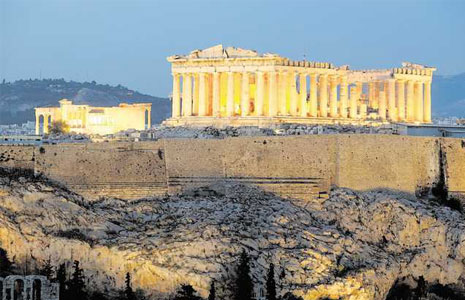
This is a very specific example, but photographs are not the be-all-end-all of examining a historical site. Photographs can mislead our idea of the size of a space--just think of how a football field looks much bigger on TV than it does if you're actually watching--and they can fail to encompass all the surroundings of the site, which are just as important. For example, most photos of the Parthenon make it seem like there is basically no space on the Acropolis besides the temple itself. In reality, however, the Parthenon only takes up about a quarter of the space on the Acropolis! Actually being there helps one comprehend the enormity of the entire site, and it's hard to understand just how big a lot of the buildings that have since been stripped down to their foundations were from photos alone. To take the Parthenon still as our example, photos either must focus on a site as a whole or they must focus on the details within the site. Photographs of the Parthenon either present the entire building, or else a face of it, or they present zoomed-in pictures of the various pediments and structural features. That's all very nice, but it's rather difficult to position those details in relation to the site as a whole--where the hell is the "west pediment," and what does that part of the building look like?!
For years as a history student, people told me that visiting the places seeing the archaeological objects I study was important, and while I never disagreed, I also didn't understand why this was true until I'd done it. Afterall, if an archaeological site is well published, what more will you learn from visiting the field where it was located, or looking at the objects in person?
The answer, I've found, is complicated - but there's enormous benefit from seeing things and places in person. I think it hinges on the question of control and mediation. When you read a site report, or look at photos of a place, you get a specific story that's been shaped by research question of the archaeologist writing the report or the photographer photographing the landscape. They control what you see and experience, and even if you think you're getting the whole picture, you're really just getting one person's version of it. So you read multiple things and get multiple perspectives, you do your research online or in the library - that helps broaden your perspective. But you're still getting everything mediated through the observers you're forced to rely upon. And because everything is mediated, your questions aren't always answered, and - very crucially - the place itself (or the artefacts themselves) don't get to speak to you directly.
Places and things talking to you sounds very mystical and fuzzy, but it's actually not. Landscapes are full of sensory information, and it can't all be captured by film, sketches, descriptions, etc. when you stand in a place, the physical experience of the topography, the angle of the sunlight, the feel of the air - all contribute to your experience of what it means to be there. And that understanding can interact in rational and emotional ways with your understanding of the history that hapoened there.
Seeing the Thames in flood, hearing the water rush, feeling afraid that you might slip on the wet grass and fall in, and then thinking about the ritual activities people performed in and around the Thames all adds up to an understanding of why people do magic at rivers that you can never really understand unless you, also, have seen a river in all its anger.
Standing on Hadrian's Wall, feeling the cold wind, looking out toward Scotland, experiencing how difficult it is to climb the hills, and seeing what the wall looks like from its foot all makes the logic of the Roman frontier much more viscerally and rationalyy obvious, and helps you understand how effective it must have been at communicating the awesome wealth and logistical power of the Roman state. You can read about it in a book, but it's hard to fit it all into your imagination off the page; being there is like mainlining the experience straight into your blood - the experience heightens your focus, shows you why ancient and modern authors reacted they way they did when they were faced with the site, and helps you fit your knowledge into a full-body experience that, as embodied humans who developed to engage with a material rather than abstracted world, just makes more cognitive sense.
And when you see places and objects in person, you always find important things that other people haven't noticed, or that they commented on but you overlooked because you didn't understand why they mattered. The first time I picked up an early medieval spear, and then an early medieval sword, in a museum's collection, completely changed how I think about these weapons - once you hold them, feel their weight, and understand what they felt like to the people who made them, lots of preconceptions that made sense on paper fall apart. And when you visit places or look at objects other scholars have seen, you start to understand how and why their research questions developed in the directions they did (I'm looking at spearheads this week that, I now realize, were very influential in shaping a previous scholar's assumptions about early medieval technological development; many things he argued make sense now - including some points where he's wrong and I wondered where his wrong ideas came from - now that I'm seeing what he saw, organized in the same museum drawers that he experienced). Sometimes scholars explain how research contexts shape their ideas; but pften, you have to go there and experience it yourself to really understand.
But also, and this is the most important thing: it's just really fun. Part of why we love history is that history brings the past to life, and visiting historical places brings it alive, and makes it feel real, better than almost anythi else. That alone is reason enough to visit historical places. Comic book fans go to cons (why don't they just read comics at home?), beer lovers go to brewery tours (why don't they just drink beer and watch videos of how it was made on youtube for cheaper?), and football fans like going to the game (why? No really, I don't get sports). If you love history, don't have to justify your enjoyment of visiting where it happened.
Pictures are a very limited, and often misrepresenting, version of reality. If I walk through a 400 year old house and take pictures, I'll pick and choose not only what I personally find interesting, but what can translate well. What looks good. The gaps in the floorboards that allow for the servants to see into the master bedroom from their quarters just doesn't photograph at all. Neither do the creaking, almost spongy floor boards. The smell of a fire going, or the damp wood, or the wool coverlet can't be communicated any other way. The etching in the glass by a small child centuries ago can't be photographed well no matter how hard you try. The sun is always at the wrong angle through that window. But as you stand in that spot and stare outside you catch the limited view that long-gone child did of the summer garden stretching out to meet the fields, dotted with crops of massive trees. It's not practical to have a picture taken out of each window, so you loose the ability to see the house as those living it would have. You can't sit in the window seat and feel the cold air seeping around the sill. Or hear the crickets outside in the summer. It's the little things that you know people 200, 500, or even thousands of years ago felt in the exact same way you're feeling them now. The unchanging smells, the familiar weather, or that awkwardness of the ceiling being just a few inches too low to be comfortable. They felt that way, too. And for one moment you share something despite all of those years and differences.