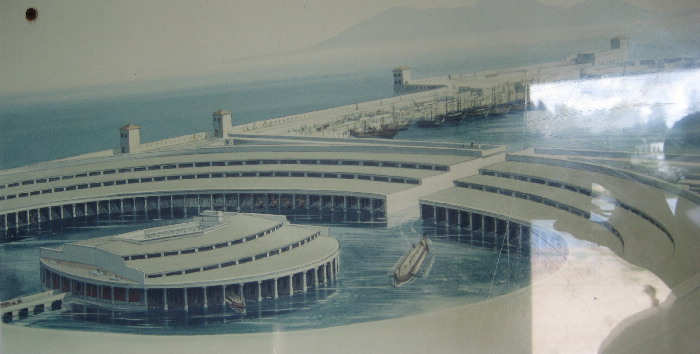
Was Carthage's port design one of the most advanced and effective of it's time period? What are some other famous military ports? I've heard that Carthage's ship deployment was one of the fastest in the world. Literally hundreds of ships pouring out all at once due to the circular design of all the docks and it could hold up to 250 ships.
Also, was the inner circle structure all docks or where other facilities or uses for it? Where did they keep the dry docks? Was the port sectioned off from the main city or was the giant iron chains the only thing keeping the enemies of Carthage from seizing the city?
edit: For those of you wondering, this is what the Carthage port looked like
First of all, what exactly makes a harbor "advanced?" Simply the speed at which ships could enter and exit? What about things like size, capacity, shelter from the elements and from storms? In all of those things Alexandria blew both the commercial and military harbors at Carthage out of the water. The Heptastadion at Alexandria created two separate harbors, an eastern and western one, both of which were (and still are) significantly larger than Carthage's and which were both further subdivided into smaller harbors and dockyards. Piraeus had a comparable harbor, with two circular military harbors at Zea and Munychia and a large commercial harbor. And this isn't including later harbors like Portus. What are the criteria here?
May I know where you've heard that the Carthaginian military harbor could deploy ships quickly and that this was an intended function of the design? Because I've never heard this before. Circular military harbors are hardly unknown in the ancient world--like I said, Piraeus had two of them--and their strength is not that they can deploy ships quickly, but that they can be defended easily. They can be easily walled off to the outside, and the small opening necessary in a circular harbor is easily cut off, preventing assault from the sea and making it difficult from the land as well. But speed? That's a tiny little bottleneck--for the same reason that it's hard for attackers to get in, it's just as difficult to get out, there's a natural difficulty with getting hundreds of ships quickly through a tiny opening. Hell, the Romans walled off the harbor, forcing the Carthaginians to punch a hole in the eastern side of the harbor to sally out. I can only presume that this sally is where the idea comes from, since no source mentions speed as a characteristic of the military harbor--Appian talks at some length about the defensive advantages of the harbor (its double wall, the chain that could close off the twenty-foot wide outlet, the fortifications on the central island) and praises the fact that from the central island a commander could review the situation well and send signals to ships near the shore, but he never mentions speed of deployment. But during that sally the Carthaginians only got 50 ships out, out of the 220 that Appian says the harbor could hold, and they took the Romans by surprise not by the speed with which they got their ships out but because a bunch of triremes (Appian says they got 50 triremes out and some smaller ships, nothing larger than that) suddenly popped out of what was thought to be a wall (the Carthaginians had punched a hole in the wall secretly, disguising the work) at dawn. Appian also mentions that the outer harbor, not the inner, contained the ships' tackle (πείσματα), which suggests that the inner harbor was merely for the protective housing of the ships, to keep them from being attacked. I also question the value of a harbor that could speedily deploy ships. Obviously if the city is under siege there's some value, but even under those circumstances you'd spot an enemy fleet way out on the horizon, miles away and with plenty of time and distance to get your ships out. This isn't August, 1940 in Kent, we're not scrambling fighter planes here.