What is the historical/etymological background to it?
On October 9th 1406 forces of the Republic of Florence entered the city of Pisa and annexed the eponymous republic, ending two hundred years of antagonism between the two regional powers in Tuscany.
While the Republic of Florence could celebrate the acquisition of a saltwater seaport, there remained the issue of pacifying an economically vibrant (albeit declining) city with a well-established ruling class.
The Florentines strengthened the citadel and garrisoned it with some 1500 mercenaries, while prominent families were forced to relocate to Florence (many would refuse and instead flee, mainly to Palermo). This relegated Pisa from being an economic hub to a mere stopping-point between Florence and the rest of the world. The Republic of Florence's continued warfare with the Republic of Lucca in the 15th century would also bode ill for Pisa as the city was taxed heavily to subsidize the war and the surrounding countryside was fought over and trampled by both Florentine and Lucchese armies.
The population of Pisa would revolt against the Florentines in 1430 and again in 1494, the latter being facilitated by Charles VIII's descent into Italy to claim the throne of Naples whereby Florence was preoccupied with challenging Charles and couldn't spare men to pacify Pisa. Following the revolt, the Pisan ruling class was able to play the Republic of Venice and the Duchy of Milan against each other, as they competed for influence in the newly reborn republic (and a chance to stick a thorn in the side of their rival, Florence). The republic's resurgence would be short-lived, the occupation of Milan by the French and Venetian preoccupations in the Aegean against the Ottomans saw subsidies to the Republic of Pisa dry up. Pisa would manage to hold off the Florentines until 1509, and the city would have to endure a near-constant state of siege (the Florentines would come up with many ingenious ways to starve out the city, even attempting to alter the course of the River Arno to deprive the city of fresh water).
At the time, Pisa sat at the mouth of the River Arno on the northern head of a sandy bay about ten miles wide. Historically, ships would be dragged up onto the wide beach to be loaded and unloaded with goods arriving and leaving Pisa. Livorno stands at the southern end of the bay which today is much less pronounced as sediment from the Arno has accumulated. The early fortunes of Livorno were tied to those of Pisa; for much of its early history Livorno was a backwater outpost of the Republic, home to a watchtower and a handful of houses. Early development was mostly focused on the harbor at the mouth of the Arno at the north end of the bay, which apart from being a prime docking location also came under threat more often from the villainous Republic of Lucca. However, as marshy sediment from the Arno made docking close to Pisa more difficult, Livorno saw its fortunes turn.
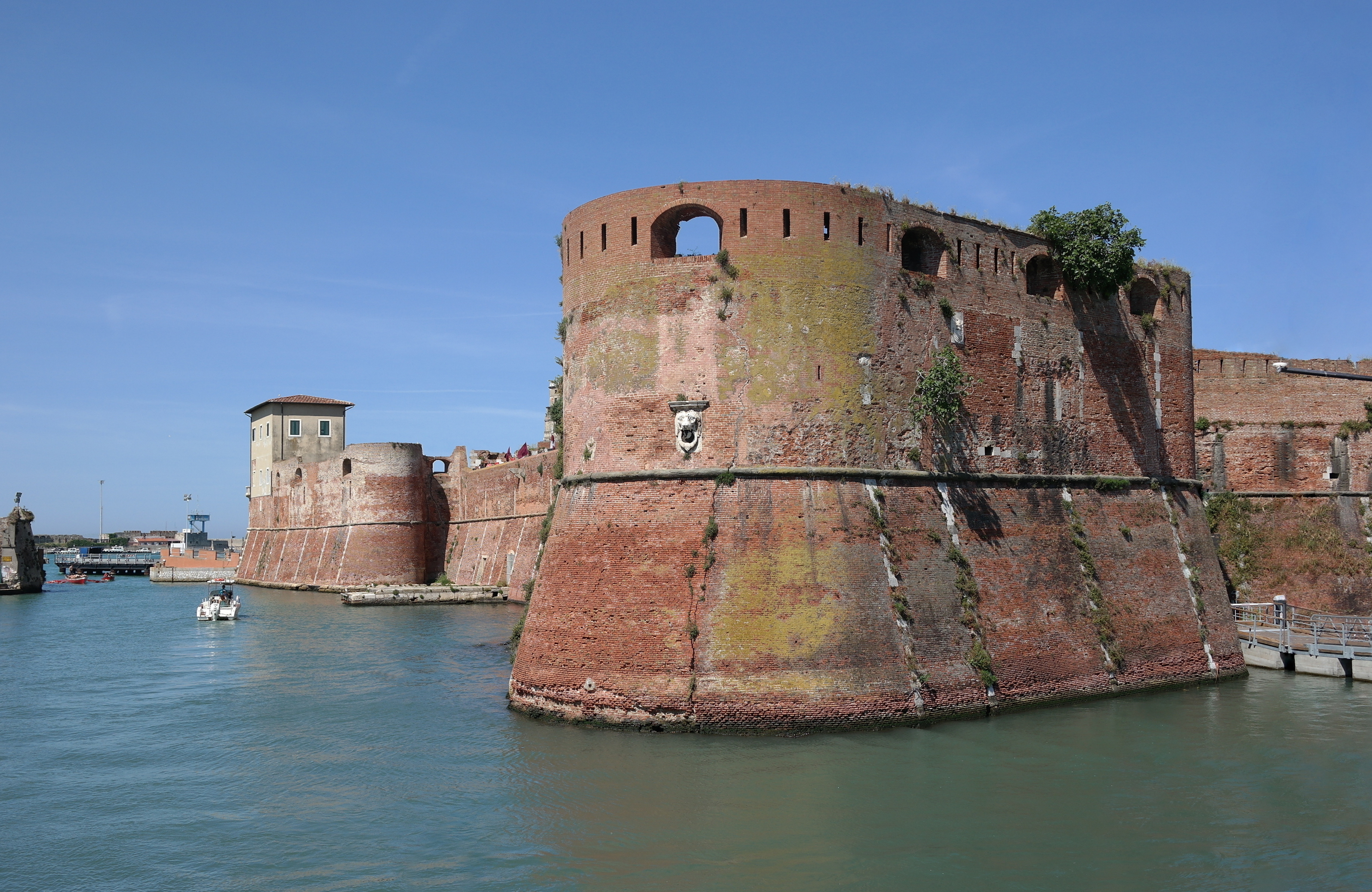
In 1305 the Pisans built a lighthouse at Livorno to guide ships coming up the coast. In 1377, following conflicts with Florence, Livorno's watchtower was turned into an imposing fortress. To encourage settlement (and increase manpower) in the outpost, the Republic of Pisa began exempting the city's inhabitants from certain taxes, with the additional consequence of attracting shipping activity. In 1392, after Malaria broke out in the Pisan Harbor, nearly all Pisan shipping moved to Livorno, and the whole town was fortified by decree of the Pisan Doge Pietro Gambacort. An inland harbor was constructed. Population remained low however, as the surrounding land consisted mostly of sandy sediment and was very infertile.
When Pisa fell to the Florentines, a Genoese garrison moved quickly to occupy Livorno (the Republic of Genoa, a longstanding mercantile rival of Pisa, were in cahoots with Pisa's enemies). The Genoese ran Livorno as a stopping-point and outpost, constructing customs offices for pre-processing and expanding the harbor. Although a fair amount of autonomy was granted to Livorno, the town was run as an enclave and to drive home the point the Geonese dug a deep moat effectively turning the town into an island. The Florentines ended up paying an enormous sum of gold to the Genoese for Livorno in 1421, but they had no choice; shipping capacity at Livorno was unquestionably superior than the Port of Pisa.
After the Pisan rebellion of 1494-1509 and the emergence of the Medici dynasty as monarchs ending the Republic and establishing the Duchy of Florence, the last thing Cosimo de' Medici needed was for Pisa to jeopardize his naval power by defecting or rebelling (a likely scenario, as the Italian wars would define politics in the peninsula for the next century). It was settled, then, that the major seaport of the Florentine State would be in Livorno, to the detriment of Pisa.
The operation was easier said and done. Shipping activity was already centered in Livorno, but the town was small, mostly inhabited by drunken sailors and a handful of merchants too poor to live in Pisa, unquestionably the most important city on the Tuscan coast. Cosimo started by having the city's fortifications expanded (here they are painted by Vasari) and had a palace for himself constructed inside the old castle in the typically understated Medici style. To increase the population, in 1548 Cosimo emitted a decree protecting all Jews from the inquisition as long as they were residents in Livorno, and in 1566 Cosimo discouraged merchants from forwarding goods unloaded in Livorno to Pisa by exempting all inventory deposited in Livornese warehouses from taxation for their first year.
In the 1570's, architect Bernardo Buontalenti was commissioned by Cosimo's successor Francesco to draw up a grandiose plan to turn Livorno into a well-fortified maritime city poised to make the Duchy of Florence a naval powerhouse. The death of Francesco's heirs due to malaria in the vicinity of Pisa seems to have impressed his brother and successor, Federico (who had to hastily resign from a cardinalship to assume the throne) to speed up the work on Livorno.
In spite of the favored position Livorno enjoyed under the Medici, when the Tensho Embassy arrived from Japan, Duke Francesco organized state visits to Pisa and Siena in addition to Florence, meaning that Pisa was still an important city for the Tuscan state. Indeed, in the 1591 census Livorno counted little over 500 residents. Francesco's successor Federico set out to change this. Between 1591 and 1593 he emitted the "Livornie," a series of privileges bestowed onto Livorno in an attempt to turn the city into a cosmopolitan center of trade. The laws, guaranteeing religious privileges, protection from the inquisition, and amnesty for all crimes save a few (notably, counterfeit and murder) were specially designed to attract Jews recently expelled from Spain. By 1625, the city could counted over 1000 Jews (up from two dozen in 1601) and a total population of 5000. Although the explosion of population created many logistical, sanitary, and infrastructural nightmares, Duke Federico had managed to turn Livorno into a major trade hub. Livorno was the only Italian city not subject to a recession in the 17th century. By 1725, 77% of British trade to the Mediterranean passed through Livorno.
In the 19th century, following Italian unification, the laws of the Italian states were made homologous. Free ports like Ancona, Messina, and Livorno were for the first time subject to taxation. With few local industries and its status as the primary gateway into a sovereign state lost, Livorno's growth suddenly stopped (capping out at about 90000 inhabitants) and shipping companies moved to Genoa, conveniently located at the bottom of the Genoa-Milan-Turn triangle, which to this day is Italy's industrial heartland. Although in the late 1880's the union of the Naval Academies of Genoa and Naples into a single Naval Academy in Livorno helped the city remain relevant to an extent, the removal of the city's Jewish population during the Second World War and the severe bombing the city suffered put the city in an irreversible decline. Today, the city is plagued by many issues, not in the least the dual problem of restoring the castle and historic center, and converting the seaport from industrial use to increase passenger capacity. Unemployment is one of the highest in North-Central Italy, and the city shows few signs of its former glory.
It is unsurprising that the local names of cities with many foreign visitors are corrupted by foreigners to be easier to pronounce. The same way an Italian-speaker says he is going to visit, "Londra" and "Edinburgo" instead of "London" and "Edinburgh", an English-speaker will talk about having visited "Rome" and "Venice" instead of "Roma" and "Venezia". It may seem surprising that a small town like Livorno was also given an english-language cognate, but because it was the most important seaport in the Duchy of Florence (if not all of Italy!) during England's rise as a naval power, the town got its own english name: "Leghorn".