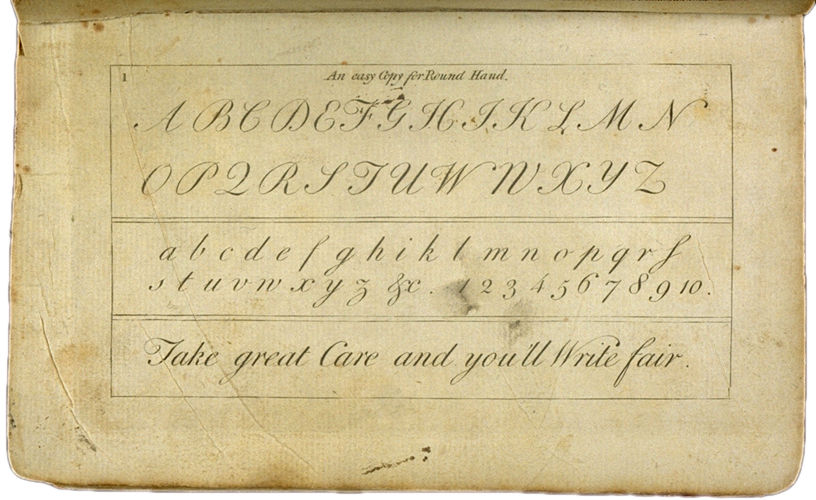
Forgive me for a poorly-worded question. I'm doing some work on late 1800s documents and the handwriting is physically larger than mine.
I'm curious if this was common. "Did people used to write bigger?" is what I want to ask.
As a hobbyist calligrapher, I'm going to comment on the tools of handwriting, and how the differ from modern writing instruments. Until the early 1800s, most people would have been writing with a quill pen. This was literally a feather (primarily goose), with the barbs cut off, and a tip cut into it with a sharp knife. This would be dipped into ink, and as you write with it, the edge would wear down, and you would have to cut it over and over again, every line or two, until you run out of feather, then grab a new feather and start over. I've done this myself, and it's time consuming, and your handwriting gets broader as the tip dulls off. Not to mention the ink of the time would be Oak Gall Ink, which is made by dissolving iron in acid typically made from Oak Galls (hence the name). It's a very non-viscous ink - very thin and watery compared with the very sticky ink in a modern ballpoint pen. And, in the centre of the pen there is a slit, which allows the ink to flow, so the harder you press, the more ink comes out. So, writing very thin strokes is difficult, particularly on the downstroke of a pen (writing a line from top to bottom), as the slit in the pen spreads open and releases more ink. This is also why handwriting at the time looks the way it does, with the upstokes being very thin, and the downstrokes being very thick, it's because of the way the quill works.
With all that being said, in the 19th century they came out with dip pens, that is, a stick with a metal tip to dip into ink. This was a huge improvement over a quill, because you didn't have to constantly sharpen it, and the tips were interchangeable. But still, using oak gall ink, and having the slit in the centre means a heavier ink flow. And the ink takes quite a while to dry, usually a few minutes.
So, with this technology, and with the challenges that come with it, it becomes necessary to write larger for the writing to be legible. For example, if you write a lowercase "m" and put each of the downstrokes too close to each other, the wet ink will bleed and you'll end up with an ink blob rather than a letter. There are even historical examples where we can see this happening.
So yes, writing with these instruments, even in modern day, requires a larger hand, and more space. You're more cognisant of smudging, drying ink, even crossing "t"s takes thought so you don't draw ink from the wet descender (vertical stroke in the "t") and smudge it across the page.
So it's a little less of they just wrote larger, and more of the constraints of the tools they had at their disposal.