I was thinking about the diversity of Native Americans in what is now the United States, and it seems to me that a lot of the stereotypes are a distorted view of some of the Great Plains tribes - such as tipis and buffalo hunting and even supposedly the word "How".
Yet Europeans in what is now the US has been in contact with Native Americans since the very beginning of European settlement. Before the West was settled, what would the average European's stereotype of the indigenous people be? Did this vary by region? Or by time? Did popular novels like "The Last of the Mohicans" contribute to this viewpoint? Did stereotypes shift over time? What about with events - did the views change after events like King Philip's War? How did changing stereotypes alter how the colonists, and later the Americans, interact with the native inhabitants?
Also, I'm interested in Canadian counterparts to this as well, since a lot of my reading recently appears to be concerning Canadian history.
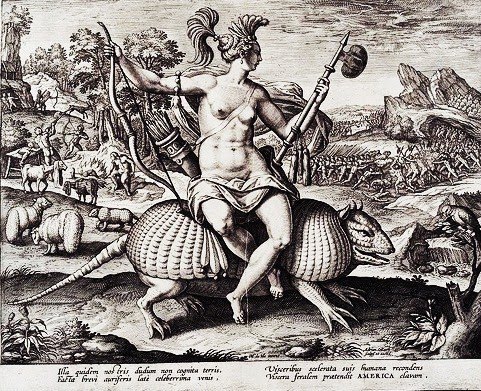
Stereotypes of Native Americans definitely shifted with the times, areas, media, and events. I would highly recommend Phil Deloria's Playing Indian for a good look at how Americans have portrayed Natives and used their image to further really whatever agenda was in vogue at the moment. In colonial America, Indians could be portrayed as the "noble savage" (note also that at the time "savage" meant "wild" as in "wild flower"), a people who loved their homelands and freedoms and were worthy of embodiment. This was the motivation behind the Boston Tea Party dressing as Natives, and the motivation behind Indian-themed depictions of Columbia, or the U.S. Capitol building's Statue of Freedom. However, if public policy turned against Natives - territorial expansion, or a conflict like King Philip's War, Lord Dunmore's War, and others - they could just as easily be portrayed as backwards heathens standing in the way of Christian Progress (here Columbia wears a Roman toga, since Natives are now being driven before her).
Portrayals and perceptions of Native Americans have almost always been completely divorced from the realities of Native-U.S. relationships and policies. As you've noticed, there's great diversity among Natives and a sense of Pan-Indianism is a relatively modern concept (although Europeans and Euro-Americans have long held to it as a truism). There would have been equally great diversity in Euro-Americans' experiences with Natives. In say the 1830s, a resident of New England might not ever actually meet an Indian, despite belonging to a social organization like The Improved Order of Red Men or other Tammany societies, while a farmer in Alabama might live near a Creek Indian family who speak English and go to church and own African slaves. A trapper, trader or farmer living further west on the frontier of Kansas or Nebraska, or even venturing to the Rockies, would have again different experiences based on what was offered for trade, if one party had a grievance of some sort, what water and forage resources were available, etc. The popular image in America would take a darker turn as the "Indian Wars" deepened after the U.S. Civil War, and policies of forcing Natives onto reservations and into boarding schools in order to "kill the Indian and save the man" became popular. Towards the end of the nineteenth and beginning of the twentieth centuries, there was a sort of imperialist nostalgia for the pre-industrialized, supposedly more harmonious way of life that was disappearing before white Americans' very eyes (their own role in that disappearance never bothered them). At this time, you see organizations like the Camp Fire Girls and Boy Scouts, who idolize the "ruggedness" of Native American life. Scouts co-founder Ernest Thompson Seton explicitly linked his organization to Native Americans: "Indian teachings in the fields of art, handicraft, woodcraft, agriculture, social life, health, and joy need no argument beyond presentation; they speak for themselves. The Red Man is the apostle of outdoor life, his example and precept are what young America needs today above any other teaching of which I have knowledge." A similar romantic image of the "Environmental Indian" also became popular during the ecology movement of the 1960s-70s.
Stereotypes of Natives have tended towards either of two extremes - romanticized ("they used every part of the buffalo! they accepted gay people and women held positions of power! they were environmentally conscious!") or demonized ("they never invented the wheel or domesticated animals! they practiced human sacrifice and cannibalism! they stole children and raped women and tortured people to death!"). It's hard to say what stereotype one group of people may have embraced and when, and as Deloria points out, it was common to hold contradictory points of view - the Improved Order of Red Men, for example, despite blatant use of Native images, regalia, and terminology, restricted membership to whites only until 1974. As he phrased it, "they desired Indianness, not Indians," which I would argue is the most constant theme of Native American stereotypes - just the image, please, and none of the messy realities that go along with it.