Those tombs located in the Basilica of St. Paul Beyond the Walls and St. Peter's Basilica.
If we're going to look at this in the wider context of relics of revered ancient religious figures -- which I certainly see no good reason not to -- then I think there are good grounds for thinking it's highly unlikely. Just in general, it's pretty obvious that the impulse to fabricate tangible relics here (or at least to erroneously ascribe some sort of random tomb/whatever to more well-known figures) is far more common than the presence of ancient relics that are generally agreed to be historically authentic.
And at least for St. Peter's Basilica: the origins of the claim that this has been known as the burial site of Peter since the 1st century are easy to discern -- though, really, entirely anecdotal.
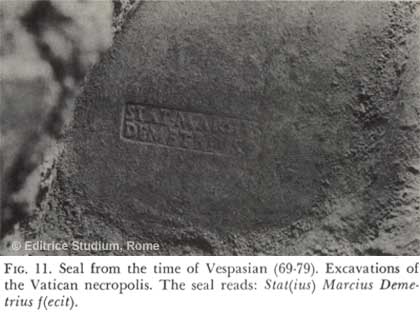
Several mausoleums (and other items) from the Vatican Necropolis -- below Saint Peter's Basilica, naturally -- can be dated to the early Imperial period: for example, this seal apparently dates to the reign of Vespasian from ~70-80 CE.
More importantly, the Circus of Caligula/Nero is right next to the necropolis. The ultimate connection of all this with Peter is probably this (and I'm simply quoting from the Wiki article here):
The site for crucifixions in the Circus would have been along the spina ("spine"), as suggested by early Acts of Peter describing the spot of [Peter's] martyrdom as inter duas metas ("between the two metae or turning-posts", which would have been equidistant between the two ends of the circus).
Constantine I constructed what's now known as Old St. Peter's Basilica on this site.
When the Vatican says that the bones have been identified as Peter's "in a way we believe to be convincing," I don't believe they mean to refer to anything like carbon dating at all. Rather, it's "convincing" to them because 1) the bones were found on a site which, through church tradition (no matter how late this tradition is), has been associated with Peter -- a site which 2) has some legitimate 1st century connections, and that 3) the bones were determined to be of someone in their 60s (though I don't know the details of how this was done)... which, in tradition, is the approximate age at which Peter was martyred. Oh, and there's the dubious 4) "Peter is within" graffiti.
A lot of the best research on the presence of Peter and Paul in Rome -- or at least traditions thereof -- has been in German scholarship (and, naturally, Italian too): see
Thümmel, Die Memorien für Petrus und Paulus in Rom
Zwierlein, Petrus in Rom and Petrus und Paulus in Jerusalem und Rom
In English, Markus Bockmuehl has done some significant work here. See his exchanges with Michael Goulder to get a glimpse of the differing sides on the issue.