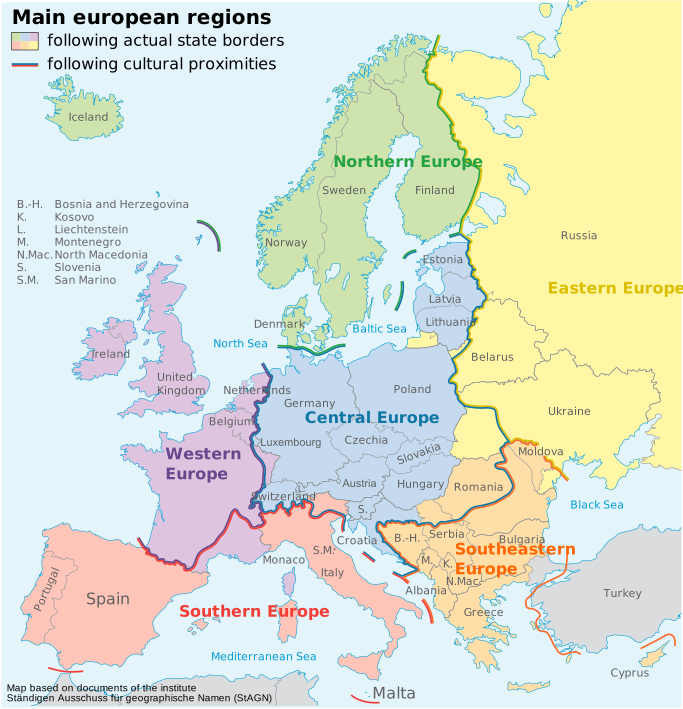
This is a hard question to answer as the answer depends on both the time period you are looking at and your viewpoint. If you were to ask a English person in 1920 about whether Köningsberg was in central or eastern europe, he would say that it was a central european city. If however you asked a English person in 1978 about whether Kalingrad was eastern or central european, he would say that it was eastern european since it lay behind the iron curtain. For many in Western Europe during, after the cold war and even now also refer to the countries in the former Warsaw pact as being in Eastern Europe, to the irritation of central european nations such as the Czech republic and Poland. So politics and the age in question do play a important part. Another way to separate Central and Eastern Europe is religion. For example as seen in this map the Catholic and Protestant nations are included in Central Europe, while the Orthodox nations are included in Eastern Europe. This religious divide between Central and Eastern Europe also corresponds well to the divide between the Latin and Cyrillic alphabet, with the Latin users being Central European and the Cyrillic users being Eastern European.
A more narrow definition than the map provided above can be seen by this map Which largely includes German speaking nations, or nations that includes part of the former German and Austrian Empires, which means that they have a close connection to German and Austrian culture, which Poland being a neighbor to Germany also have. So language and culture also plays a part.
So to sum up: Politics, the age in question, Religion, Culture, Language and the Alphabet all play a important part in defining what Central and Eastern European is. And since most of those areas can be quite controversial, the definition of which country is a central or eastern european country can also be controversial at times, as seen by the different maps above.
As has been noted, it is a fluid answer depending on who is asking the question and who is answering it, as well as the context. Eastern Europe can include everywhere between Berlin and Moscow, or as narrow as Belarus and Ukraine, while Central Europe can stretch from the Rhine to Brest or simply mean Switzerland.
That said the Cold War and division of Europe between capitalist and communist states is one method that is used, though the former communist states encompassed in the "East" (Poland and the Czech Republic being the first that come to mind) stressing they are actually "Central" and pointing out that geographically the centre of Europe (if one calls everything between the Atlantic and Urals, as well as Lapland to Malta, Europe) is roughly in Lithuania. While this is a more modern issue, I'll touch on it here briefly as it refers to historic events, since these states don't like the connotation of being in "Eastern Europe" (which gives the implication of backwardness and underdeveloped states).
Really there is no wrong, or right, answer to the question, and it all depends on how you are using it.
First of all, neither term is really precisely defined.
Western Europe is clear, but while Eastern Europe is usually meant to include the entire former Soviet Bloc (not to be confused with Soviet Union), "Central Europe " is defined even less clearly.
The later is the preferred term in the eastern states of the EU (Poland, Hungary etc.), which for historical would like to be culturally separated from the former Soviet Union, but one sometimes sees Central Europe include Germany.
In short, no clear division one can rely on. Additionally, the use of EE vs. CE is a cultural minefield in the east.