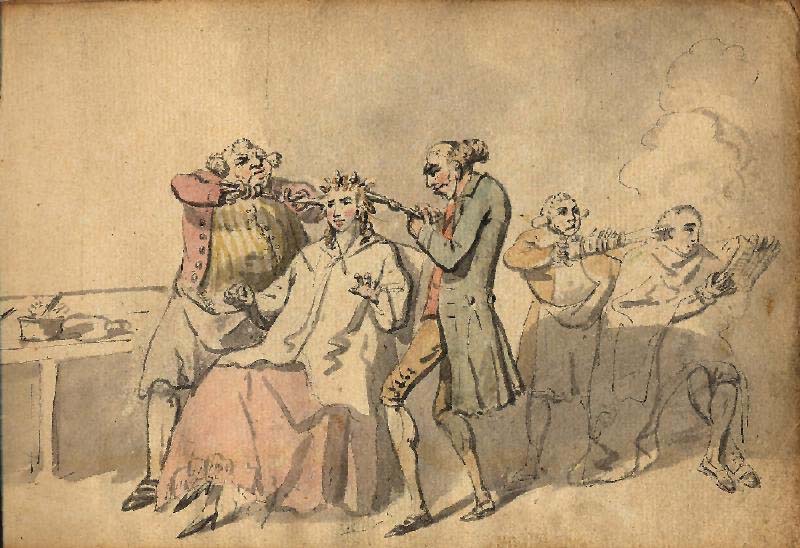
I often read historical novels set in the 1600-1800's and I'm never sure whether to picture the characters in wigs or not.
Some specific examples:
British Naval Officers in the Napoleonic period
Italian Merchants in the 1750's
Aristocratic French women during the French Revolution
I know the basic history of the fashion but I'm never sure who/when it applies to.
Is there a general rule of thumb? Or a flowchart?
On the whole, powdered hair and wigs were aspirational luxuries. Though in some cases they became occupational symbols (I leave it to someone else to say whether this is the case for the British navy in the early 19th century; they were certainly out of fashion by then, but I can't confirm whether members of the navy were in fact still wearing them at that point), on the whole anybody who could afford to did so. Women tended to wear hair powder held in place with pomade, rather than wigs, however.
The original wigs of the 17th and very early 18th centuries were quite expensive - long, richly colored, and curled; these were not powdered - and would not have been within most men's reach. Shorter "bob wigs" came into fashion in the 1730s, along with powdering (mainly for men - visual sources show a great many women with unpowdered hair), and were accessible to a greater range of people - becoming the standard style worn by clergymen and, I believe, doctors as the sleeker queued style became the fashionable choice. Powder was going out of fashion for men and women in the 1790s, as were men's wigs.
Later 18th century women are often referred to in pop culture as having worn wigs, but those towering hairstyles were in fact possible without them. If you like, you can read here about the research/experimental archaeology that the women of the Margaret Hunter Millinery shop at Colonial Williamsburg have done.
Some of it will depend on time, some sex, some class/career, and the rest on "What are they doing at the moment?". So, wigs are much more popular in the late 17th century and onwards into the 18th century. Once we reach around the 1780s for men they really drop off in style. For women wigs are used during the same time, but more as a substitute for actual hair if need be. Lots of things cause hair loss- aging, pregnancy, illness, poor nutrition, etc. Hair pieces are also available for men and women. It's a popular option not only sold by wigmakers, but also in the numerous millinery (accessory) shops. Obviously men are capable in many cases of growing out their own hair as well, and some do. George Washington didn't wear wigs and Thomas Jefferson only did some of the time. It's a personal choice.
For those that are not wearing wigs they will still style their hair using pomade and powder. This means that what you envision with styles and color won't be terribly different in a wig compared to actual hair. The difference lies in the front edge of the wig being visible vs. a natural hair line. It doesn't take much to do the tight curls of the 1750s or the tall styles of the 1770s or the puffy hedgehogs of the 1780s. The height is created through cushions, often made of a wool jersey and stuffed with down. The hair is first pomaded and lightly powdered to give it body and make styling easy. Then the cushions are pinned in and the hair pulled over, extra powdering is done to taste (so it doesn't always come out white). Some of the styles take only a few minutes (pomade and powder was hair care like shampoo and conditioner and was only done as needed every few days or more), others like the frizzed hedgehogs can easily take five hours or more with the heat setting.
So, there are certainly ups and downs to wig wearing. It can mean you just put it on your head and go, no styling each day, just restyling every so often. However, they are expensive, itchy, and hot. So, even if a gentleman has close cut hair (necessary for a wig to fit tightly), he won't have the wig on all of the time. For formal situations, certainly. For time at the tavern or eating breakfast in his home he might just wear a cap. A tradesman might wear a wig for church or parties, but a cap the rest of the time at work. For a lady it would be a similar circumstance, also depending on her need of a wig due to hair loss. Sorry there's no simple answer for this (or flowchart), but it wasn't a rule of fashion when to wear a wig, just when to have your hair styled (which could be your actual hair or not).