I've encountered duels in novels written by Pushkin (who himself died due to wounds sustained in a duel), Lermontov (who died the same way, though in a different duel), Turgenev, and Dostoyevsky. Now, in those stories, it's usually upper class people dueling, and it's usually men fighting over a woman's "honor" or the honor of one of the duelists.
Now, a few romantic novels does not prove a historical pattern, so what's the reality? Were duels as widespread and destructive as these novels depict? If they were at all common, how far back do their roots go? Was ritualized dueling and imported practice? Was it just fancy military men and nobles who dueled, as is depicted in the novels? Or did people from a wider array of classes fight ritualized battles to the death over matters of honor?
They were, if anything, even more prevalent than they've been made out to be. Luckily, historians love this kind of topic. Here's one source:
Irina Reyfman. Ritualized Violence Russian Style: The Duel in Russian Culture and Literature. Stanford, Calif.: Stanford University Press, 1999. xi + 364 pp. $49.50 (cloth), ISBN 978-0-8047-3412-7.
There's a review here: https://networks.h-net.org/node/10000/reviews/10219/smith-reyfman-ritualized-violence-russian-style-duel-russian-culture
"Ritualized Violence Russian Style is divided into two parts. The first part (chapters one through three) surveys the history of dueling in Imperial Russia; the second (chapters four through six) examines the place of dueling in Russian literature, particularly in the writings of Alexander Bestuzhev-Marlinsky and Feodor Dostoevsky. It was largely in the pages of nineteenth-century literary works that Russians learned of point d'honneur and of the precise methods and norms of dueling, and it was here that many Russians found models upon which to base their own behavior in regards to the duel. Writers helped to elaborate the notion of the duel as a safeguard of the individual and to elevate the duelist to his lofty place."
"The central claim of her findings is that the duel, and the "point d'honneur mentality" (p. 10) upon which it was based, was adopted slowly and never completely by Russians over the course of the eighteenth and nineteenth centuries. The chief evidence for this claim is to be found in Russians' violation of the honor code that governed dueling, more specifically, the degree to which raw physical violence was tolerated as part of dueling practice."
There's an interesting source here: https://www.nytimes.com/books/99/03/07/reviews/990307.07lamblt.html
Mostly about Pushkin, with some background: "Serena Vitale, a professor of Russian literature at the University of Pavia, Italy, has written a vivid, meticulous account of that death. Set in a Europe where libel laws had not yet quite supplanted the code duello as a means of settling grievances, ''Pushkin's Button'' is a delightful combination of retrograde pleasures (court balls, the demise of a doomed genius) and primary sources. Her formidable skills as a scholarly detective led her to family archives, 19th-century diplomatic records and letters. The result, capably translated by Ann Goldstein and Jon Rothschild, is both illuminating and pathetic.
''It's Balzac,'' a society woman wrote her husband about the state of affairs that would lead to the duel. ''It's Victor Hugo. It's the literature of our time. It's sublime, it's ridiculous. A sneering husband publicly gnashing his teeth. A pale and lovely wife destroying herself with dancing that lasts entire evenings. A pale and thin young man laughing convulsively.'' It was, she said -- in a phrase that neatly underlines the scale of the tragedy without being in any way true -- a drama so sad as to silence even gossip.''
Interesting detail: "So that January day, the angry poet faced his brother-in-law at the prescribed distance of 20 paces. An experienced duelist, Pushkin waited for the other man to fire first; that meant d'Anths would have to stand stock-still when it was Pushkin's turn to fire. Pushkin, hit by d'Anths's first shot, was elated when his shot knocked d'Anths down. The Frenchman, however, was only slightly hurt, giving rise to generations of conjecture about the pistols used and whether he'd been wearing body armor, frowned upon but available."
Pushkin received the death penalty for that duel. Of course, it couldn't be carried out, because he was, well, dead.
On your question of importation: the Code Deullo was not original to Russia: http://www.artofmanliness.com/2010/03/05/man-knowledge-an-affair-of-honor-the-duel/
"Dueling code evolved over the centuries as weapons and notions of honor changed. Proper dueling protocol in the 17th and 18th centuries was recorded in such works as The Dueling Handbook by Joseph Hamilton and The Code of Honor by John Lyde Wilson. While the dueling code varied by time period and country, many aspects of the code were similar."
https://books.google.com/books/about/The_Duelling_Handbook_1829.html?id=GFHtJoYQkUAC
Wilson's Code of Honor was written in 1838: https://www.gutenberg.org/files/6085/6085-h/6085-h.htm
But things go much further back. Here's a discussion of Dueling in Shakespeare's time: https://prezi.com/u2wztf19cowc/honor-and-dueling-in-elizabethan-times/
Here's an Irish version of the code from 1777: http://www.pbs.org/wgbh/amex/duel/sfeature/rulesofdueling.html
And here's something from the late Rennaissance: https://www.gwu.edu/~magazine/archive/2005_law_fall/docs/feat_duel.html
"That last includes this tidbit: "The duel of chivalry evolved from the judicial duel, and co-existed with it for several hundred years. Scholars generally agree that knighthood originated in the 10th century, and duels of chivalry date from that time. These were events of great ceremony: two knights on horseback with lances engaged in combat to decide questions of law, property, or honor. The duel of chivalry is distinguished from the tournament, a demonstration of a knight’s skill. These could be as bloody as a duel. In fact, the church was opposed to tournaments due to the mortality rate of the participants, and the Council of Reims of 1148 prohibited Christian burial for the casualties of such events.
Duels of chivalry faded around the middle of the 16th century, giving way to the duel of honor."
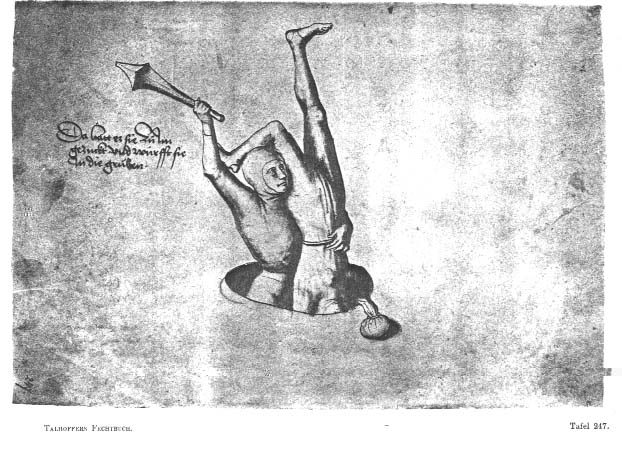
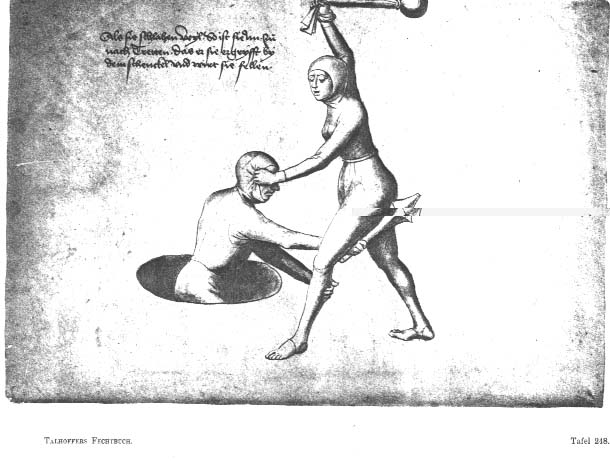
So what, you ask, was a "judicial duel?" Check out the illustrations here: http://www.aemma.org/onlineResources/trial_by_combat/combat_man_and_woman.htm
http://www.aemma.org/onlineResources/trial_by_combat/combat_man_and_woman_files/fecht6.jpg
http://www.aemma.org/onlineResources/trial_by_combat/combat_man_and_woman_files/fecht7.jpg