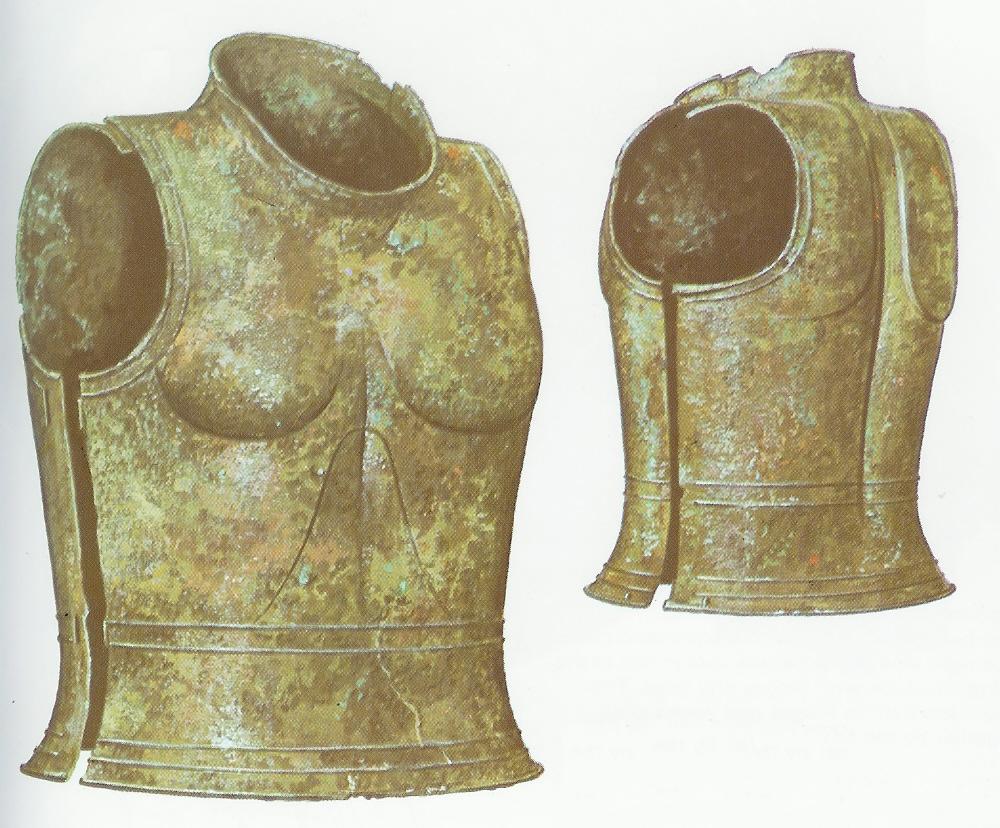
The Greeks appear to have pioneered the muscle cuirass as a Classical development of the older bell cuirass, which in turn goes back to earlier Central European types of body armour. It was constructed out of two plates of beaten bronze between 1-2mm thick.
While the muscle cuirass would have been popular for its shiny and intimidating look, it definitely wasn't just a ceremonial piece of kit. I don't have Schwartz's Reinstating the Hoplite to hand, but I believe his tests showed the muscle cuirass to be a pretty effective type of body armour given the weaponry available at the time. It was a good defence against missiles and probably offered decent protection against spear thrusts and sword blows in close combat too. Its downsides - cost, weight and heat - might have led most Greeks to prefer the vastly cheaper and equally protective linen cuirass, but then they wouldn't get to look like godlike flashing metal apparitions.
Ancient Greek citizen soldiers were "entitled" to wear whatever they could afford. The richest would have worn muscle cuirasses, if they wanted the body protection. However, given the trend towards ever lighter armour for heavy infantry throughout the Classical period, it's likely that even those who could afford it would not have worn one. It was too heavy and hot to be a practical tool for campaigning on foot. It increasingly came to be regarded as typical cavalry equipment.
I don't know my Medieval warfare, but I would imagine they went out of style (like all types of Greek armour) because better alternatives were found. Chain mail, iron scales and steel plate mail all provided better protection, generally at lower cost.
Later European Smiths did craft muscled curiasses. Kinda. And they did it in the Early Modern Period (in art history, the renaissance), not the Middle Ages. Since u/Iphikrates has described the original muscled cuirass so ably, I will talk about the (limited) renaissance revival of the muscled cuirass and other classical tropes in armour.
There is one depiction from the 'Middle Ages' proper of what might be muscled armour. It is a German effigy from the 14th century that is wearing -something- on its torso with what might be abs. The sculptural style is not very detailed, and the depiction I recall from Claude Blair's European Armour 1066-1700 was a line drawing, which might have interpolated some features into the sculpture that were less clear on the original. Since it is a sculpture, it is impossible to tell what this armour(?) was made out of - it might be hardened leather, used to supplement the mail.
After this one sculptural anomaly, we see a revival of ancient-style armour 'alla antiqua' in the 16th century for Renaissance parades and pageantry*. Muscled breastplates, pteruges (the shoulder flaps) and varies vaguely 'ancient' skirts and helmets were used to cloth Renaissance monarchs in the symbols of ancient rome. Contemporary burgonets could be modified to look more like attic style helmets, and most extravagantly, great 'parade shields' were made of out embossed and gilt steel and decorated with motifs like Medusa's head. By clothing themselves in this costume, Renaissance rulers proclaimed themselves heirs of classical 'worthies' like Caesar, both in terms of their power and in terms of their virtue. This emphasized both their power and their legitimacy as rulers who were fit heirs of the Romans of old. MEdieval and Renaissance people saw the ancient world as an age of virtue and culture, and 'reviving' Roman armour was part of the larger Renaissance project of reviving the glories of the ancient world in general. Armour 'alla antiqua' wasn't an exact historical reproduction of Greek or Roman models, but it was a symbolic use of 'antique' elements as a kind of trope to convey the power and virtue of the wearer - many of these armours anachronistically include modern elements, or pieces that are pure fantasy.
There is an undercurrent in modern armour scholarship that is re-evaluating pieces that were formally considered 'just for show' and showing, by metallurgical analysis and other means, that they were actually ready for battle. Just because medieval or early modern armour is extravagantly decorated does not mean it wasn't made for combat! However, by and large the armour 'alla antiqua', including the muscled breastplates, -does- seem to have been made purely for symbollic and aesthetic purposes, not as protection. The main indication of this is that when you put it all together it isn't very protective. Take this armour of Philip II by Bartolomeo Campi as an example. It has no protection for the thighs or the arms, and the lion pauldrosn and metal pseudo-pteruges wouldn't be much use. Moreover, the 'calligae' of this armour are actually made of steel, an the 'mail' around the collar is painted on, which goes to show how much this armour is about -appearance- and -symbolism- and not protection. Its maker was an artist and 'sometime armourer' - I am not aware of any surviving -practical- armours by this maker. So while the original muscled curiass was a practical piece of armour, its Renaissance revival was more about pagaentry and symbolism than protection.
*There are a lot of depictions of ancient figures with classical-ish armour in 15th century paintings, but no armour in this style survives.
Edited to expand