Was there a proper system of labeling streets, and house numbers at this time? How easily could I reliably find the house if I had a proper address? If no system existed, was one eventually developed by future emperors?
It's been some time since I've done Roman urban history, but I hope I can help a bit nonetheless, since this has gotten such high attention.
Leaving aside the obvious answer, that your relative would give you concrete directions towards his house, there might be several ways to locate the specific house you want to visit.
House numbers to my knowledge are an early modern invention, and they're not used everywhere even today.
But think about it - when you give directions to someone (at least before the widespread use of GPS), would you just tell them the number of your house, or the name of the street? Probably not! You'd tell them how to get there by the way of landmarks, where to turn, which roads to take. Locations defined in relation to other, more prominent or easy to find landmarks and main roads. That being said, Roman streets had names, not only the famous overland routes such as the via Appia or the via Claudia Augusta, but also smaller roads such as a clivus, scala or vicus, alleyways, staircases, alleys or city quarters, and so on, often named for famous persons or important buldings, temples or other geographic features along their course.
Furthermore, in the time of Augustus, Rome had been divided into 14 regions or districts to aid with administration of the ever growing metropolis. Here's a map showing the 14 administrative regions of Rome. Amazingly, we have two texts from the 4th century, that give us more information about the individual regions, the so called Regionaries from the time of Constantine - the major landmarks and buildings, how many city quarters (vici) they each contained, and even how many buildings! They are online here, given after the edition of H. Jordan, 1875. This is obviously more useful as a statistic reference, but shows that such general information would be available in some form. So if you knew the region, or at least some major landmark nearby, you could already narrow down your search a bit.
We don't know exactly how a Roman would go about locating a relative's house, since to my knowledge we have no direct literary account of this. A lot of street names and their locations are known from literary accounts, such as Sueton's account of the life of Augustus, where he mentions that Augustus once lived in a house iuxta Romanorum forum supra scalas anularias (next to the forum Romanum above the scala Anularia, the steps of Anularia) [Suet. Aug. 72]. (What we know about such street/place names this is largely compiled in the New topographical Dictionary of Ancient Rome by L. Richardson, if you are interested further.)
Another source of names for places, roads and houses, and the kind of source I'm most familiar with, are inscriptions. One thing locations were important for was selling property, like burial plots, whose exact locations were sometimes given in inscriptions, such as in this inscription on the grave of Statilia Euhodia, which gives its location as:
hoc mon(umen){i}tum sive sepulc{h}rum / quod est via Tiburtina clivo Bassilli / parte laeve quod est conclusum in / fr(onte) a maceria Caesae Paulinae [CIL VI 36364, Roma]
...this monument or sepulcher which is at the via Tiburtina on the clivus (the ascending road or alleyway) Bassilli on the left side, which is enclosed in front by the wall of Caesa Paulina...
Another example would be this inscription of a freedman who bought burial niches for himself and his family in the '(community burial) monument of the carriers':
Q(uintus) Caecilius Q(uinti) l(ibertus) / Primus emit in / mon<u=I>mento palangarioru(m) / in agro Fonteiano quod est / via Aurelia in clivo Rutario / parte sinisteriore col/umbaria n(umero) X ollarum / n(umero) XXXX... [CIL VI 7803]
'Quintus Caecilus Primus, freedman of Quintus, has bought, in the monument of the carriers in the acre of Fonteianus which is near the via Aurelia in the alleyway of Rutarius on the left side, ten burial niches and 40 urns...'
A different form of address is sometimes given on slave collars. Some slaves would wear such collars around their neck, those would inform the reader that he had a runaway slave before him and would instruct him whom to return the slave to.
Serv(us) sum / Leonti scrin(iarii) s(enatus?) / tene me ne fugia(m) / et revoca in cliv/o Triario [CIL XV, 7178, Roma]
"I am the slave of Leontus, head of the chancellery of the senate? Hold so that I do not flee and return me in the clivus Triarius".
As you can see, even in those cases where exact location is important, it is only given in relative or general terms, such as the relevant street and may be further specified by giving nearby buildings or landmarks. When in the vicinity, you'd either see what you were searching for, or would have to ask neighbours or passersby - if a cultural pessimist aside is granted, a lost art nowadays where everyone carries around a smartphone with GPS. I enjoy asking strangers for directions, it's a nice way to learn more about a foreign town and get into contact with people.
So that's fine, you say, but how about when I absolutely need something more precise? Fear not! It seems that, at least under Emperor Septimius Severus, in the early 3rd century, someone thought the same. We have some surviving fragments of a giant (13x18 m!) and incredibly detailed marble map of Rome, the forma Urbis Romae. Most amazingly, you can view all of it for free (including 3D models!) here.
Some of the surviving fragments show names of landmarks, important buildings and the like - but some like this fragment, actually have streetnames on them - here a bit of the name of the clivus Victoriae, the ascent from the Velabrum to the Palatine beginning at the porta Romana.
This fragment shows a bit of the vicus ('row of houses', 'alleyway', 'city quarter', but here obviousley in the meaning of an alley) summi Choragi, the Road of the Great Choragium, an annex to the Colosseum used for storing equipment.
As you can see, the forma Urbis Romae did not show only landmarks and streets with labels, but also the individual buildings and their groundplans. The big problem, as Reynolds has argued, is that this giant marble map was much too large to be used as a reference map to find your way around in the city. The level of detail suggests that this map was based on a precise survey, used to create cadastral and ownership records for the city of Rome (we have such plans for Arausio/Orange, but they include measurements). The big marble map was essentially a showpiece, hanging in the office of the Urban Prefect, while Papyrus copies, which contained actual measurements and ownership information, would be used to easily assess the information. So while this map was useless in practice, you had probably the possibility (how accessible this might have been for the private citizen is impossible to say, since the only information we have about the forma urbis from ancient time is literally the map itself) to consult that information.
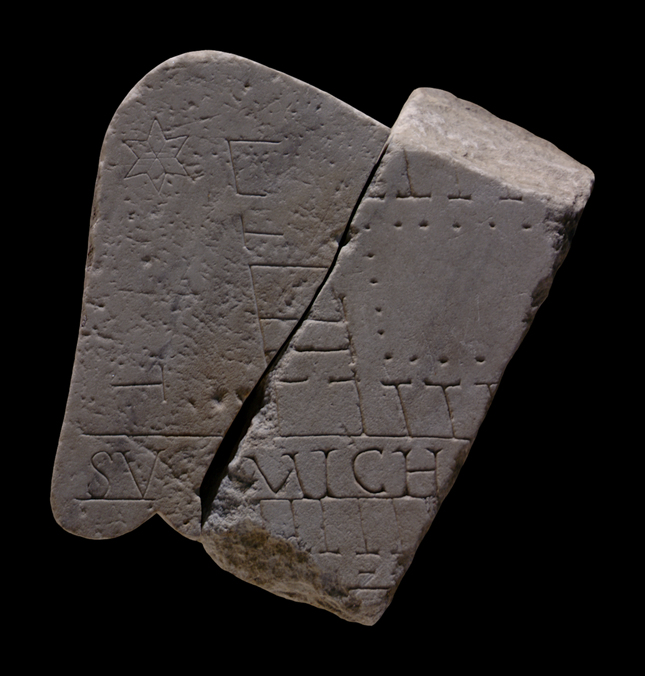
However, we also know that many individual houses had names. In Rome, these were mostly the insulae, apartment buildings of varying size, in which most of the urban population resided. Only the rich would live in an individual domus. Some of the names of these insulae are known, such as the Insula Q. Critoni (the apartment building of Quintus Critonus), the Insula Bolani (the apartment building of M. Vettius Bolanus), and so on; most likely named after the owner or landlord of the building. Some of them might even have had individual labels, such as this fragmentary inscription (AE 1971, 45) from Rome, which reads 'Insula of Saenus Va(?) Aurelia(nus?)' and might have been fixed to the outside wall.
So, to summarize, you'd hopefully know at least the region, or your relative might give you some direction such as 'on the clivus Scauri', or 'on the vicus patricius, next to the temple of Isis, in the insula of M. Aurelius.' Otherwise, you'd probably have had to ask someone.
Was at a dinner party and was not able to thank you for the correction, so I'm doing it now. Thank you for aiding a Latin deficient Redditor.