As someone who reads a lot of medieval history, I am fully aware of the myriad of tiny states that Europe once was. I'm sure I don't have to explain the situation in this subreddit for sure.
But one thing I notice as I look closer and closer towards modern history, is the arrival of larger states in Europe, reflective of large cultural groups (i.e. Germany and Italy). Almost all the tiny states of Europe merged or were swallowed up, besides a few anomalies like Lichtenstein and Andorra. But my question is: how did Luxembourg keep its independence? Why wasn't it integrated into Germany because it was Germanic, or annexed by the Netherlands because of its political ties?
Thanks in advance!
annexed by the Netherlands because of its political ties?
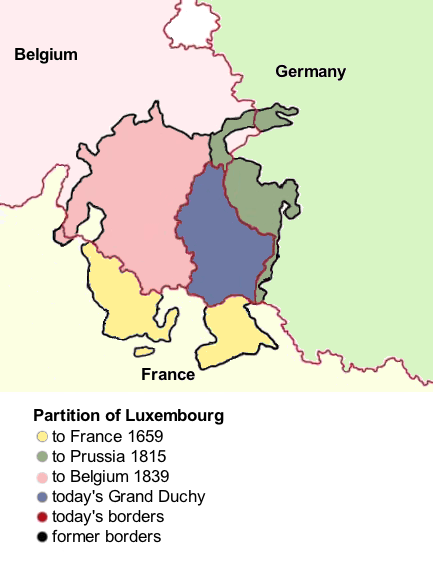
Actually, Luxembourg has been absorbed into other countries through history, and the current Luxembourg is nowhere near as large as the historical Duchy of Luxembourg. See this map.
It came into the possession of Philip the Good of Burgundy, along with other Low Countries states. They all came under Habsburg rule as the Burgundian line became extinct, and under Charles V was united in inheritance. When the northern provinces rebelled under Philip II, Luxembourg remained part of the Southern Netherlands.
However, as France and Spain continued their war after 1648, France gained the southern parts of Luxembourg.
The entire Low Countries were annexed by the revolutionary French, until it was restored in 1815, minus eastern parts annexed by Prussia. Then it was forced to be part of the United Kingdom of the Netherlands until the Belgian revolt of 1830, which settlement in 1839 once again split off parts of it into Belgium.
So, you need to better define what "survive" means.