Or were naturalized (West)* German citizens always (as in, up to the present-day) able to become (West) German President and/or (West) German Prime Minister after the end of World War II?
*I'm talking about West Germany before the end of the Cold War and about all of Germany after the end of the Cold War.
Also, for the record, the reason that I'm asking this question is that some people here in the U.S. use the fact that Adolf Hitler wasn't a natural-born German citizen to justify keeping the natural-born U.S. citizen requirement for the U.S. Presidency. :(
There never has been such a requirement (and we have a chancellor, not a prime minister btw).
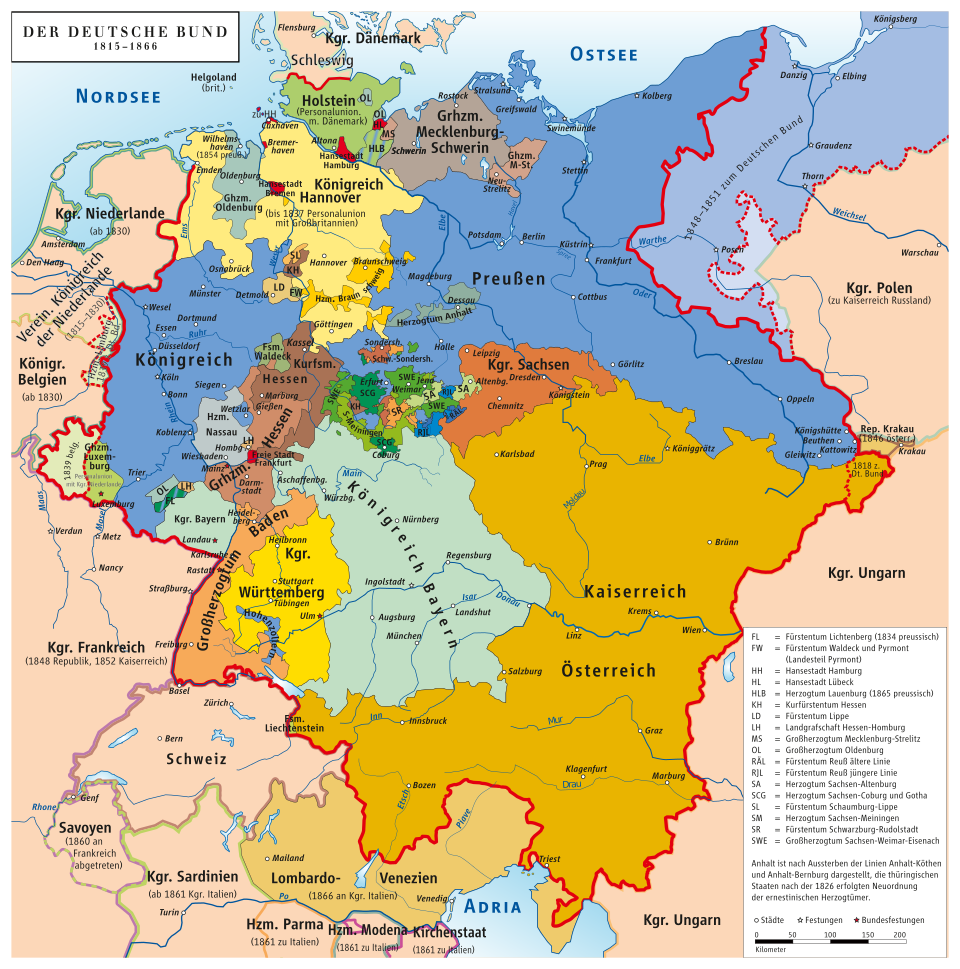
Look at all these colorful kingdoms and duchies: image
Borders haven't been crucial when it comes to questions of German identity because historically we've had an awful lot of them. There also were Germans living entirely outside of whatever borders you might draw around "Germany" (e.g. the Danube Swabians, German settlements in Bessarabia, ...) who still conceived of themselves and were were perceived as German. My mother's parents were from the Danzig area and there "Germans" and "Polaks" were living literally in the same villages - borders wouldn't have helped you at all in distinguishing between them.
"Natural-born German" just doesn't make much sense as a concept (plus after the world wars you would have had to ask "natural-born according to which borders?") and regarding Hitler as an Austrian in a way that makes it sound incompatible with being German to me mostly seems to be a reddit thing.
(edit: Someone smarter than me should explain this but it seems to me that you are coming from a conception in which nation states are a given. But although historically there was a strong idea of there being a German nation - that, again historically speaking, German-speaking Austrians would have been a part of - the political borders at no point fully reflected that nation.)
Not really. The German Basic Law requires that both the Chancellor and President be German citizens. However, the citizenship rights of Basic Law are somewhat broadly defined in Article 116:
(1) Unless otherwise provided by a law, a German within the meaning of this Basic Law is a person who possesses German citizenship or who has been admitted to the territory of the German Reich within the boundaries of 31 December 1937 as a refugee or expellee of German ethnic origin or as the spouse or descendant of such person.
(2) Former German citizens who between 30 January 1933 and 8 May 1945 were deprived of their citizenship on political, racial or religious grounds, and their descendants, shall on application have their citizenship restored. They shall be deemed never to have been deprived of their citizenship if they have established their domicile in Germany after 8 May 1945 and have not expressed a contrary intention.
Thus according to Basic Law, it was possible for an Israeli citizen born in Germany to reclaim their citizenship, or for someone born outside the borders of the FRG to be considered under the law as Germans. This somewhat broadly defined citizenship laws was a consequence of the territorial rearrangements and expulsion of the German Volksdeutsche out of Eastern Europe. Many of these refugees ended up inside what would soon become the FRG and the expellees were a strong voting bloc in the first few decades of West Germany. This flexible approach to citizenship ensured there was a strong continuity of in Federal citizenship law and the Jus sanguinis (citizenship by blood/ancestry) nationality laws of Imperial Germany. The existence of these laws was why a number of Soviet Volgadeutsche were able to enter into Germany after the collapse of the Soviet Union.
As for Hitler and his eligibility for office in the Weimar Republic, it had much less to do with the laws of Weimar and more to do with Hitler's shortsightedness. Hitler had renounced his Austrian citizenship in 1925, but never really did much of the paperwork to become a German citizen. Ordinarily, this would not be as much of a problem as Jus sanguinis laws should have eased the process for people like Hitler (German-speaking parents, served in the Bavarian/German army), but Hitler's avowed pledge to overthrow the Weimar government meant his statelessness was a weapon his political opponents could use to deport him or render him ineligible for public office. Various state bureaucracies in Bavaria and Thuringia thwarted attempts by Hitler to normalize his citizenship status. NSDAP electoral successes after 1930 allowed Hitler to be nominated as a civil servant in Braunschweig, which meant he swore an oath to the German state and thus became a full German citizen.