What is the red cape/piece of cloth that is draped around there arms?
https://s-media-cache-ak0.pinimg.com/564x/a6/4c/08/a64c08aad6e20f0c4fe0732bd28897cc.jpg
Edit: Would the Romans also have worn something similar to this?
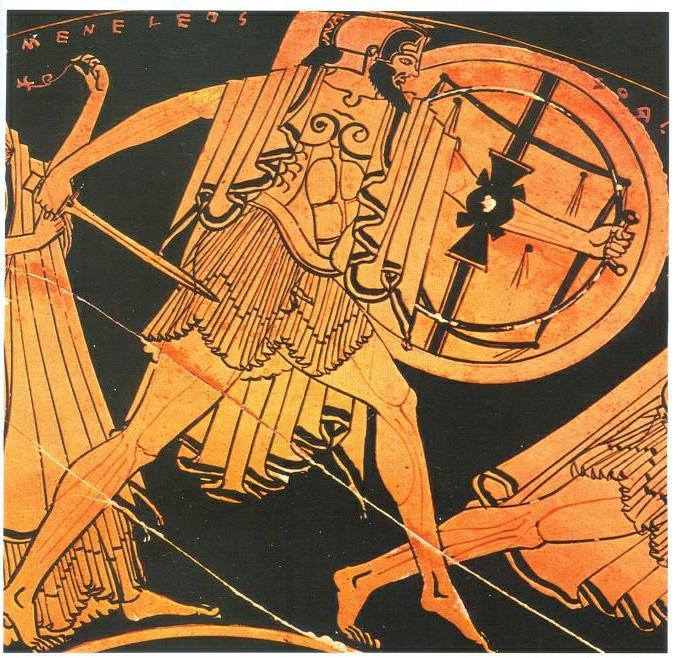
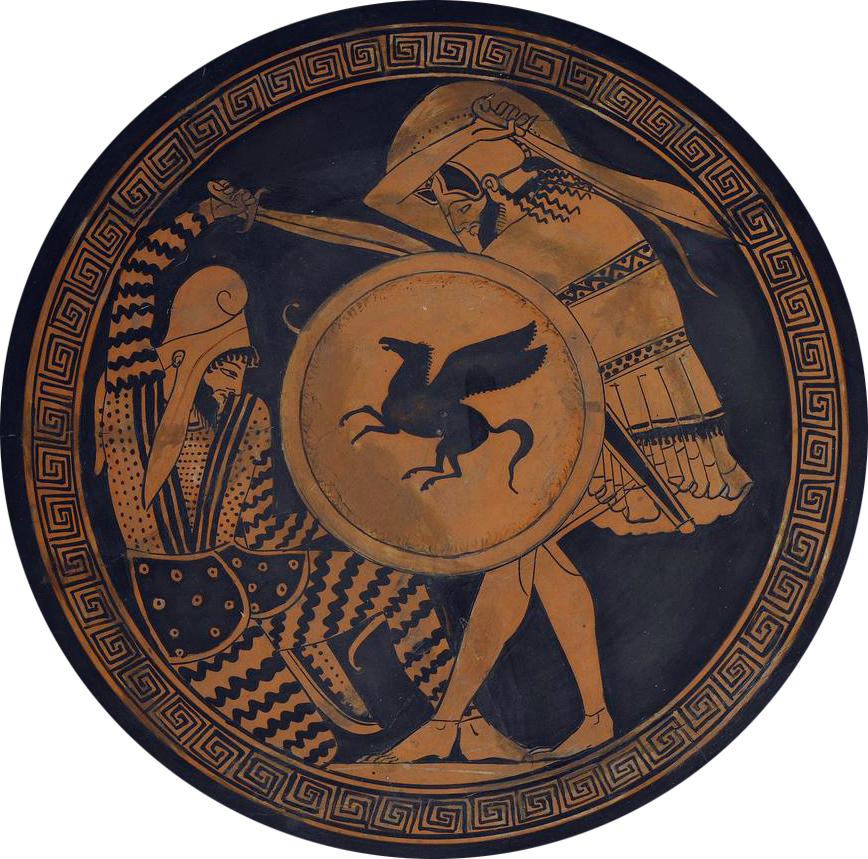
It appears to be a fanciful rendition of the chlamys, a short cloak commonly worn by the Greeks. On these pictures they are made much too long, and are artfully draped over the arm to resemble Renaissance paintings. This vase painting shows how much shorter the real chlamys was. This picture of a young hoplite pouring a libation shows a sort of shawl draped over the arm, which may have served as an inspiration for the reconstructions you linked.
The vast majority of ancient depictions of hoplites do not feature cloaks of any kind. You can imagine how it would rather get in the way in combat. Hoplites are normally pictured like this or like this, with a linen cuirass (if any) worn over a short tunic.
Yes, the chlamys was worn by the Romans, although in a manner different than the Greek images provided by /u/Iphikrates. The Roman chlamys was a sleeveless, ankle-length cloak made from a singular piece of semi-circular cloth. It was worn over a patterned tunic (often referred to as a Coptic tunic, as whole tunics have been preserved by the Egyptian desert), and was fastened at the right shoulder with a crossbow-shaped broach. Attached to the vertical edges were a pair of tablia, square or rectangular patches of colored or patterned cloth. The famous [mosaic of Justinian] (https://upload.wikimedia.org/wikipedia/commons/6/66/Meister_von_San_Vitale_in_Ravenna_003.jpg) at San Vitale in Ravenna depicts the emperor and his senior officials wearing the chlamys costume. The chlamys was originally a military cloak, and entered civilian fashion sometime during the late third/early fourth centuries A.D. as part of a broader pattern of military styles shaping civilian dress. Over the course of the fourth century, the chlamys and it’s associated garments (“Coptic” tunic, footed hose, open faced campagi shoes, military belt) became the characteristic attire of military and civilian elites in Late Antiquity. In Late Roman officialdom, the color and patterning of one’s tunic, trousers, and chlamys denoted department and rank, and were thus critical markers of status.