Would I feel a sense of solidarity because they are Christians, or would I harbor ill feelings- even possibly blurring the lines between Orthodoxy and Islam? This questions applies to all Crusades in the Holy Land (and not just the 4th).
Your attitude would depend on a number of factors, but the two most salient determiners I can think of are how rich you were, and which crusade this is. I think the end result would be more or less the same, but there are a few things that might change depending on your exact situation.
On the one hand, yes - the Crusades were conceived (however theoretically) as a mission to assist the Byzantines, whether specifically in the recuperation of territory lost to the Turks in Asia Minor or in a more general concept of reconquering the Holy Land. If you're on the First Crusade, you may feel some general sympathy for the beleaguered eastern Christians, though depending on how much theology you know you might also think they're a bit suspect - they use leavened bread for the Eucharist, they allow eunuchs to hold high ecclesiastical positions (forbidden since the Council of Nicea!), they regularly and flagrantly disobey the Pope, they omit parts of the Creed (specifically, the filioque, which Latins insist on), and until recently they actually seemed to tolerate some of these awful heathen barbarians they're now asking your help against. You might be old enough to remember the Schism of 1054, though maybe not in those exact terms (it was important at the time, but it's more important - and obvious, I think - to moderns than it was to medievals). You can definitely sympathize, at least in theory, with their Turkish problems - if you're from southwestern France, you might have personal experience fighting with Muslims in/from Al-Andalus - but by and large you will never have experienced anything remotely like the enterprise of a crusade. As a result, you may have a number of rather fantastic expectations for your trip - almost none of which will be borne out.
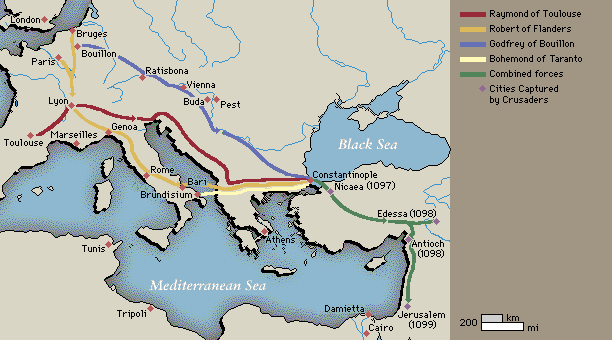
Once you actually arrive in the empire your impression will probably get worse. The journey to Constantinople is an ordeal in itself. There were a number of possible routes, but the trip was a long and dangerous one, even if you're coming from somewhere relatively close like Italy. The Byzantines are not expecting the sheer number of people arriving for this project so they aren't adequately prepared to escort you or feed you. You may or may not know Greek - or whatever is spoken in the area you're currently passing through - but most likely not, further complicating your interaction with the locals. If you are with a big enough group, this isn't as much of a problem (for you): you might be able to get your point across, or you might just go straight to pillaging the countryside a bit for provisions. You may well do both at different points on your journey. Once you've done all across the Balkan peninsula, though, you've antagonized a significant population before you've even made it to Constantinople.
The city itself is an equally thorny problem. For the past couple hundred years, Constantinople was unquestionably the greatest and most beautiful city in Christendom. Pilgrims before you have brought back stories not only of its beautiful religious culture - beautiful churches like the Hagia Sophia, of course, but this is the resting place of the most powerful relics in Christendom, including the True Cross itself - but also of the grace and majesty of the emperor and his court, the deeply codified ritual and ceremony, golden automata of lions or birds that surround the imperial throne and roar or sing on command. But the Byzantines won't let you inside the city walls. If you're part of the forces that arrive before the big-name Latins like Godfrey of Bouillon, Baldwin of Boulogne, Bohemond of Taranto, etc., the Byzantines will have absolutely no idea what to do with so many poorly-trained commoners - Alexios requested a few thousand knights, a highly-trained and highly-skilled elite force, specifically to defend Anatolia, not this mass of pious but useless peasants. They might deign to sell you provisions, once the threat of (your) impending violence gets too big to ignore, but they'll almost certainly try to cheat you. Once you're shipped across the Bosporus with all possible haste you'll probably think the Greeks are cheap, stingy, and ungrateful - and they almost definitely hate you, even though you're still theoretically signed on to help them.
If you're one of the elites who show up afterwards, Constantinople is even more of a nuisance. You show up at Alexios' own request to help him fight the barbarians. Maybe you're genuinely interested in helping your fellow Christians, maybe you're really just interested in acquiring personal glory and maybe a title in the Holy Land. Maybe you're a little of both. Once you actually get here, though, this Greek king has the gall to demand you swear an oath of fealty to him, and that anything you reconquer, you're only reconquering in his name. Some elites are convinced to play nice more than others - Raymond IV, Count of Tolouse, never does manage to swear that oath to Alexios - but overall it's a perfect storm of very strong personalities unwilling to lose face. (I don't know if Latins ever called attention to Alexios' usurpation in 1081; none of the Latin sources I've read ever imply he was somehow holding his position unjustly, though they have a lot to say about what that position is, i.e. they usually make a point of calling him "king" instead of "emperor" at least once.) You are duly hurried onto a boat to join up with the rest of the Latin forces in western Anatolia and from there you proceed on the task for which you originally came this far: the Christian (or was it Byzantine?) reconquest of Asia Minor.
Once you get there, you do actually manage to successfully reconquer a few cities. Some of these, like Nicaea, you even return to Alexios as promised. A year later, you even manage to recapture Antioch. Then any hope you might have had of serious cooperation with Byzantium falls apart. Almost as soon as Antioch is yours, a Muslim army appears and lays siege to the city. You eventually manage to repel them (though mostly because part of their army defected), but not before the news reaches Alexios that Antioch is in trouble. Alexios recalls his military support in the face of what looks like impossible odds, but to you, this is the final straw - the ultimate proof of the perfidy of the Greeks. Bohemond argues that this treachery invalidates the Crusaders' oath to Alexios, and claims Antioch for himself - thus creating the Principality of Antioch, the first of the so-called Crusader States (which theoretically should have been returned to Byzantine rule). From this point on, even after reaching Jerusalem, any aspect of the Crusade dedicated to assisting Byzantium disappears - especially for the elite Crusaders, but also, I think, for the less noble ones who either stayed in the Crusader States or returned to their original homes (though some had certainly turned back before then).
As for other crusades, I really only know about the Fourth Crusade, and then only really about the Venetian/Latin expedition to Constantinople. Again, the Fourth Crusade might have started out with some general sentiment of solidarity towards Eastern Christianity - though I don't think so much to Byzantium per se - but that's completely overshadowed by the events up to/surrounding/following 1204. If you're interested in that kind of specific view, I can go into more detail - just ask.
ETA: Sources! (I don't have RES on this computer, so I wasn't sure if this comment was already too big.) There's a fair bit of material on Byzantine reactions to Latin crusaders on the First Crusade, which I can also include, but since you specifically asked about Latin perspectives:
If you have any other questions (specifics, etc.), just let me know!