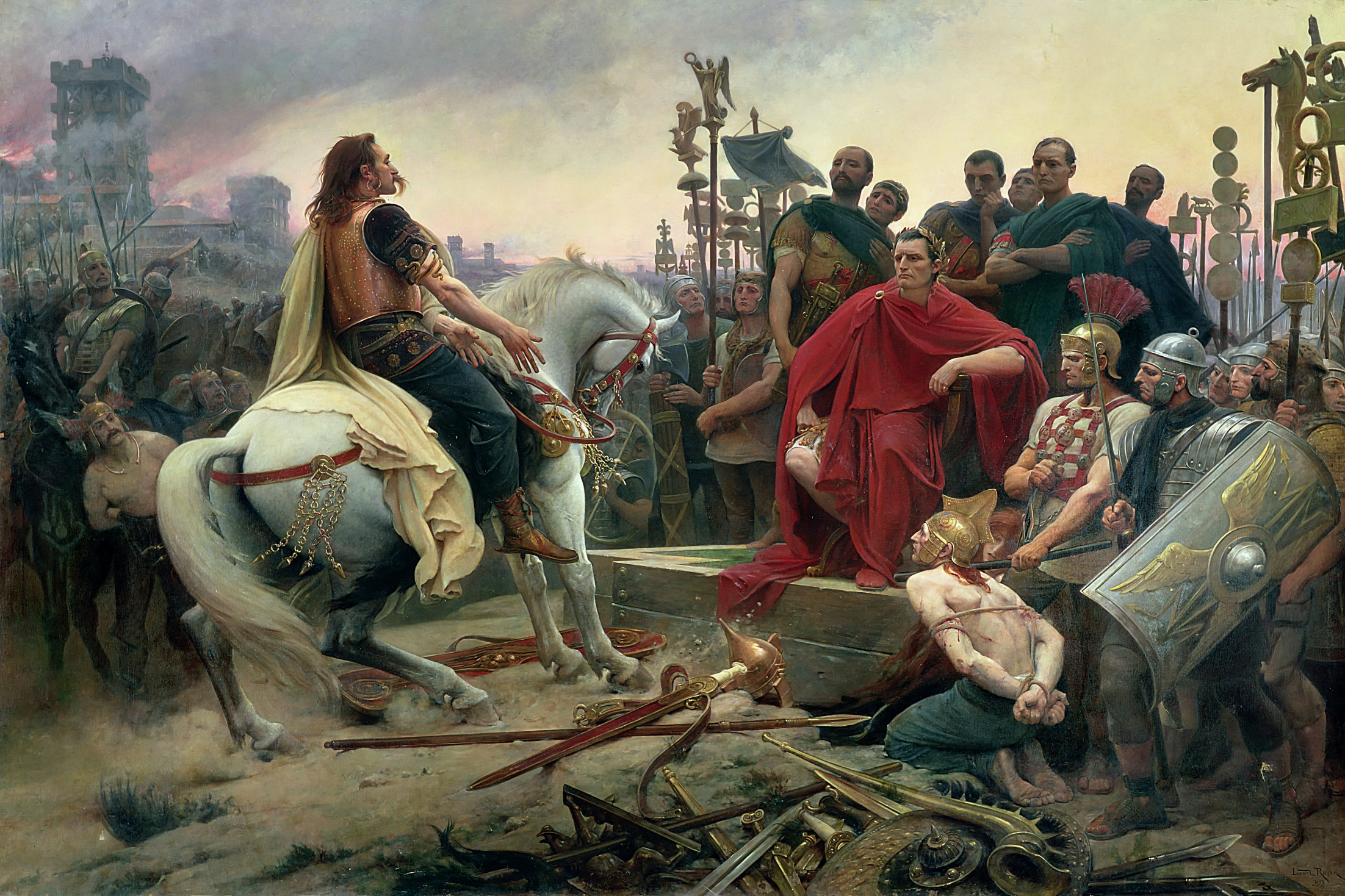
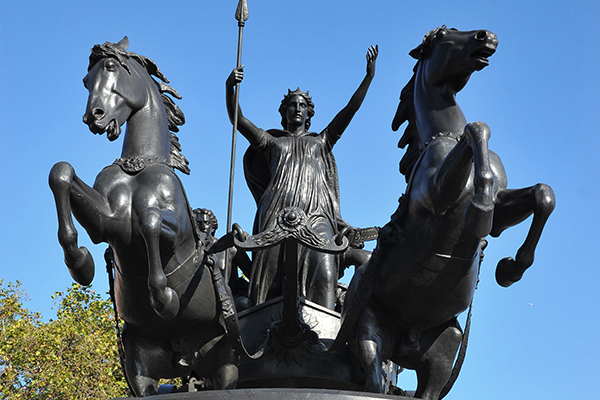
In the days of Byron the dying Celt statue was referred to, for some reason, as a dying gladiator. What made us realize (or presume?) that it is a Celt and that the "Celts", in general, were much like what we nowadays get to see in the media?
example:
19th century French painting: 1, 2
20th century comic books: 1, 2
Boudiccea as pictured by the Americans in 21st century
And compare that to Boudiccea as pictured by 19th century or 18th century Brits.
Have real life celts really dressed like our current idea of them, from Britain to Galatia, or is it just a popular culture thing, like the Peplum cinema Romans analyzed by Roland Barthes in his Mythologies?
yes, i've asked that before but with 0 success.
Ah! Vercingetorix Throws Down his Arms at the Feet of Julius Caesar—such a beautiful, tragic painting. While there is archaeological influence, several depictions you've chosen appear to draw quite literally from the written record of a few Classical authors, four in particular: Athenaeus, Diodorus Siculus, Strabo and Gaius Julius Caesar himself. All four wrote accounts of the Gallic Celts, and each to varying degrees drew upon the earlier ethnography of Posidonius, whose own work does not itself survive. Take for instance these passages from Diodorus of Sicily:
The Gauls are very tall with white skin and blond hair, not only blond by nature but more so by the artificial means they use to lighten their hair. For they continually wash their hair in a lime solution, combing it back from the forehead to the back of the neck. This process makes them resemble Satyrs and Pans since this treatment makes the hair thick like a horse's mane. Some shave their beards while others allow a short growth, but nobles shave their cheeks and allow the moustache to grow until it covers the mouth.^^1
The Gauls were stunning clothing—shirts which have been dyed in various colours, and trousers which they call bracae. They also wear striped cloaks with a chequered pattern, thick in winter and thin in summer, fastened with a clasp. They use uniquely decorated, man-high shields in battle, some with projecting bronze animals of superb workmanship. These animal-figures serve for defensive purposes as well as decoration. Their helmets have large figures on top—horns, which form a single piece with the helmet, or the heads of birds and four-footed animals—which give the appearance of added height to the warrior. Their trumpets are also of a peculiar and barbaric kind which produce a harsh, reverberating sound suitable to the confusion of battle. some use iron breastplates in battle, while others fight naked, trusting only in the protection which nature gives. They do not use short swords, but prefer a longer variety which are hung on their right sides by chains of iron or bronze. Some wear gold or silver-plated belts around their tunics. Their spears, called lanciae, have iron heads a cubit or more in length and slightly less than two palms in width. Their swords are as long as the spears of other peoples, and their spears have heads longer than others' swords. Some of the spears have straight heads, but other are twisted in their entire length so that a blow not only cuts but mangles the flesh and withdrawal tears the wound open.^^2
The popular conception of The Celt is a broad topic, others may be able to elaborate further.
^^1 ^(John Koch and John Carey. The Celtic Heroic Age. Literary Sources for Ancient Celtic Europe and Early Ireland and Wales. s.v. "Diodorus Siculus". Aberystwyth, Wales: Center for Advanced Welsh and Celtic Studies, 2009. p. 12 ^¶28)
^^2 ^(Ibid., p. 13 ^¶30)